

In the early 2000s, Russia faced an emerging and large-scale threat posed by neo-Nazi and extreme-right violent organisations. The government response at the time was strong – security forces and police relentlessly pursued violent groups, arresting their members and handing out long sentences, many for life. For almost two decades, while single incidents of right-wing violence still took place, the government’s tough approach was able to, if not eliminate, significantly reduce the activity of major neo-Nazi groups operating at the time (from more than 250 attacks per year in the 2000s, to fewer than 50 per year between 2011 and 2021).
However, this state of affairs has changed dramatically since Russia’s full-scale invasion of Ukraine in 2022. According to Russia’s independent extremism research centre SOVA, since 2023 the number of hate-motivated and racist crimes has spiked dramatically, from fewer than 100 victims in 2015 to over 250 victims in 2024. This brought the scale of violence back to a level not seen since several high-profile arrests ended a wave of far-right violence in 2011. The trend appears to persist in 2026. What is more concerning is that most of the perpetrators tend to be very young – often just 13-14 years old, which appears to be a common thread within Russian Neo-Nazi movements. This Insight discusses the recent rise in prominence of neo-Nazi ideas on Russian-language social media – specifically NS/WP Crew and takeaways from this case. First exploring the emergence of the group and its engagement with young people, the Insight then considers reasons why they may be drawn to Neo-Nazi ideology and suggests possible measures that tech companies could undertake to address the threat of spreading Russian-language Neo-Nazi propaganda online.
Neo-Nazism 2.0
Driving the resurgence of neo-Nazism in Russia, the increased activity of various organisations has been an important engine in recent years. Among the most prominent online is the so-called National Socialism/White Power Crew (NS/WP Crew), also known as the Sparrows Crew and the Four Leaf Crew. The organisation was founded in 2004, and quickly became one of the most prolific neo-Nazi organisations in the country. They became notorious for filming violence and murders against migrants and non-white or homeless Russians, and uploading footage to the internet – pre-empting ISIS’s self-promotion through gore content 10 years later. By 2014, many of its members were arrested for murders and sentenced to 6 to 24 years in prison.
In 2021, one can observe a slow re-awakening of Russian neo-Nazis, including NS/WP, beginning with the publication of the memoirs of Andrey Pronsky – an infamous neo-Nazi who became notorious for filming and posting videos of murders on the group’s forums. Around the same time came the decision of the Russian Supreme Court to designate NS/WP as a terrorist organisation. The decision was unexpected, as the organisation had been inactive for almost a decade by then. This timing aligned with the fact that a few prominent neo-Nazi figures, including Andrey Pronsky, had been released from custody the same year, though the exact reasoning behind the court’s decision is unknown.
In his book, Pronsky expressed regret about the movement’s decline and called for its revival. In response, the first large neo-Nazi Telegram channel, Oderint, Dum Metuant [Let them hate us as long as they fear us], was created in 2021. The channel used the old NS/WP symbols, the wreath and knuckledusters, reflecting the organisation’s ideological continuity with previous iterations. On 20 April 2022, Hitler’s birthday, the channel posted a picture of a person in a clown mask who proclaimed himself to be the speaker of NS/WP, and announced that the group had declared war against the Russian government. The announcement followed a series of arson attacks on military offices, police and security officials and even an assassination attempt on the infamous media propagandist Vladimir Solovyov.
These actions appear to have drawn attention to the group not only from the government but also from younger people, who became its main consumers, mostly on Telegram, TikTok, and the group’s secure website.
Online Ecosystems
Telegram channels appear to serve mostly as a platform for instructions, training, and financing. After joining the channel, a new recruit gains access to a lengthy manuscript with instructions on conducting violent attacks and arson. New recruits are also required to attract other followers who are registered on burner phones. For security reasons, they keep contact with at most two or three potential recruits. The channels also post crypto-wallet details to which people can donate money, which the group then spends, according to social media posts, on aid for arrested members or on rewarding new recruits for the criminal acts they commit.
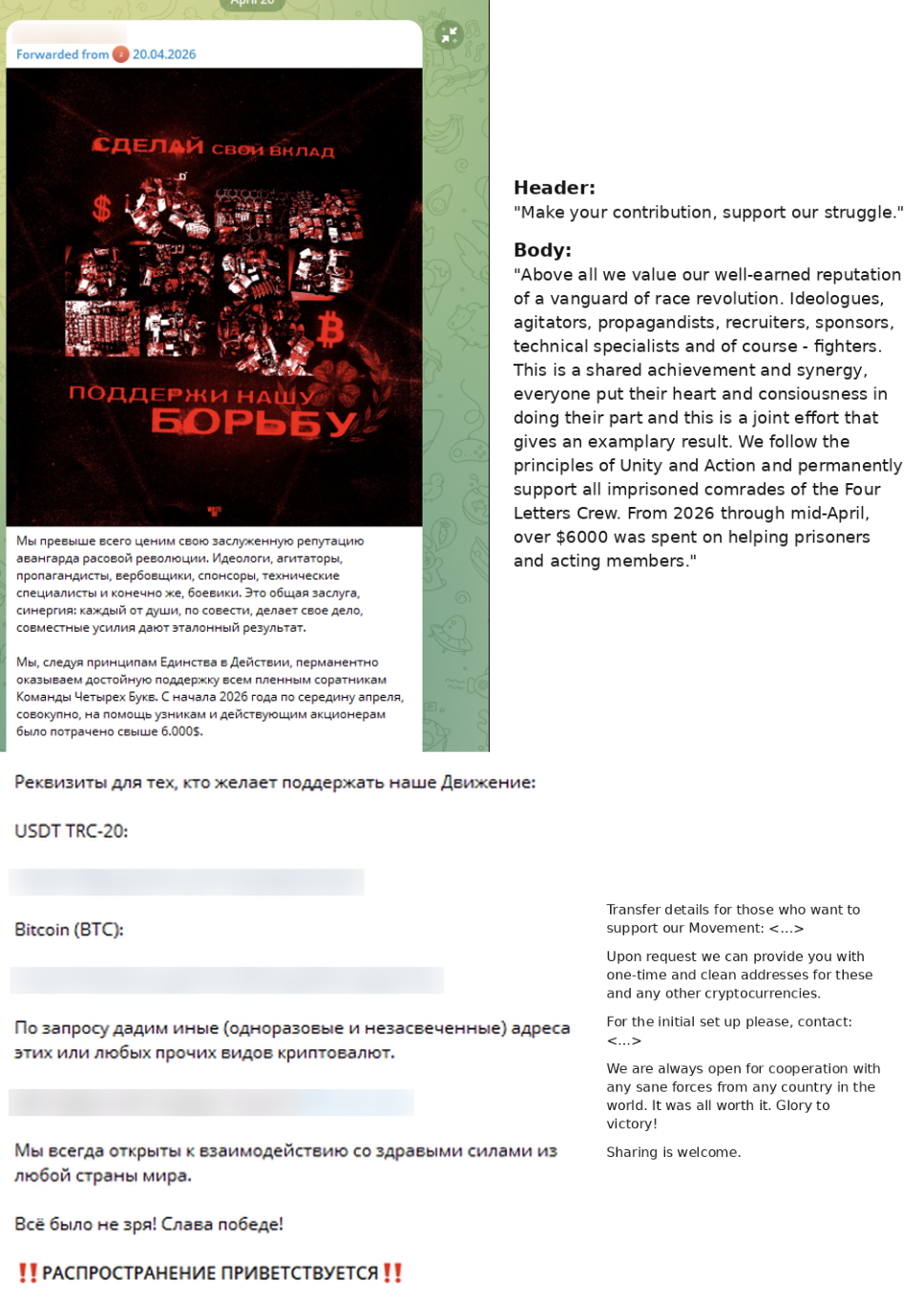
Figure 1: Sections of a post from the group’s Telegram channel reporting that it passed on donated funds to support its imprisoned allies, and calling on members for financial support (20/4/2026).
An ecosystem of promotion means that many members may not be first exposed to the group through Telegram directly. The initial contact through attention-grabbing content appears to happen on TikTok, an important platform where “most” young Russian people with neo-Nazi interests are exposed to and consume extremist content, according to a former extremist interviewed by BBC News Russia. On average, the group’s official TikTok videos receive about 50 likes and shares, and its accounts have around 1,000 followers. Exemplar TikTok accounts include links that lead users to join private chats or the group’s website (a process known as outlinking). Searches for Russian keywords linked to neo-Nazi ideology readily lead users to TikTok content produced by NS/WP or featuring elements of the group’s aesthetics, which in turn links to Telegram or other platforms hosting more extreme content.
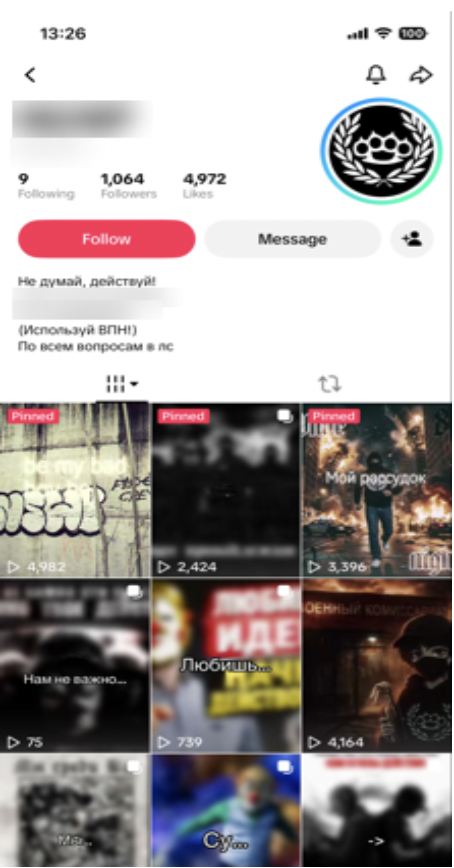
Figure 2: An example of outlinking: a TikTok channel hosting NS/WP content shares links to the group’s Telegram channel and website in its bio [Translated by the author].
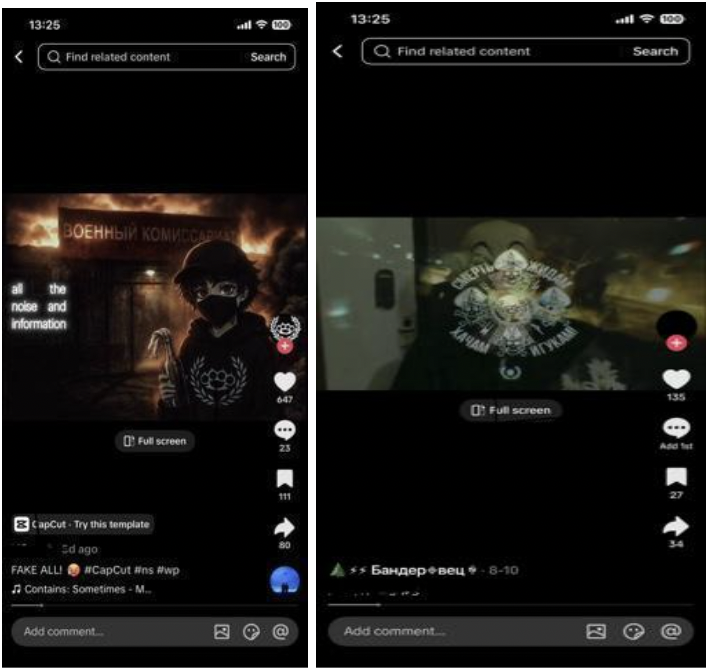
Figure 3: Examples of banal violent content, with a cartoon-style depiction of one of the group’s members preparing to throw a Molotov cocktail at the military office building (left) and a point-of-view shot of an act of violence carried out against an immigrant by the group (right).
Attractive Narratives
The casual representation of violence is combined with the use of cryptic symbols, secrecy and the narrative of coolness and heroism. For example, the group’s website has a section answering popular questions, including why recruits should act alone. The group explains that individuals can more easily resist a system, suggesting its members are not committing criminal acts but resisting an oppressive system. The group also uses the language of “heroism” when describing its activities and fighters and also displays signs reminiscent of “Saints culture”, glorifying and praising racially motivated mass shooters. For example, in one chat dedicated to the group’s founder, Andrey Pronsky, the introductory message says: “If you are ready to be alongside heroes, act now. And we will always support you with cryptocurrency, instructions and instruments”.
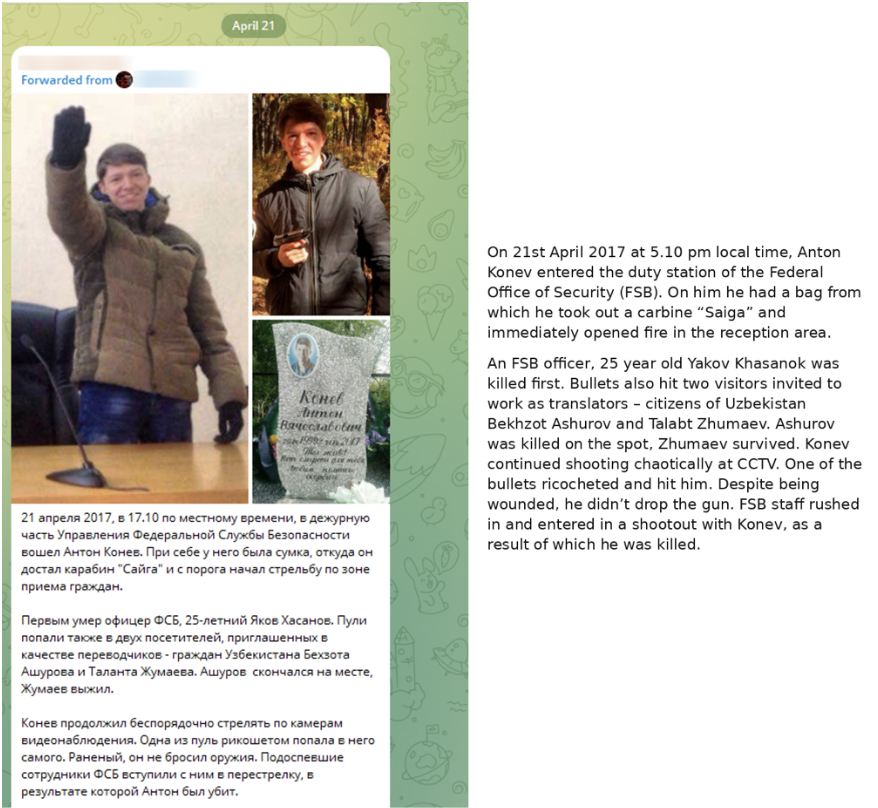
Figure 4: A post from Telegram commemorating a 17-year-old mass shooter, Anton Konev, who killed an FSB officer and a citizen of Central Asia in 2017 (21/04/2026) [Translated by the author].
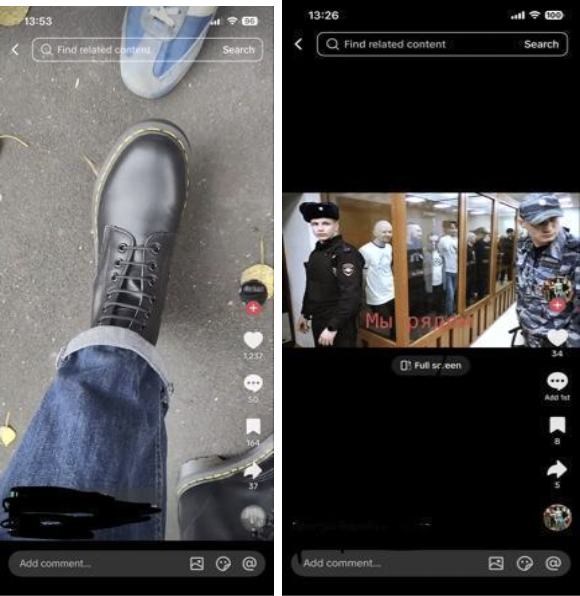
Figure 5: Example of NS/WP aesthetics on TikTok, including logos, typical skinhead-style boots, and a depiction of a Russian court with the message “We stand by you.”
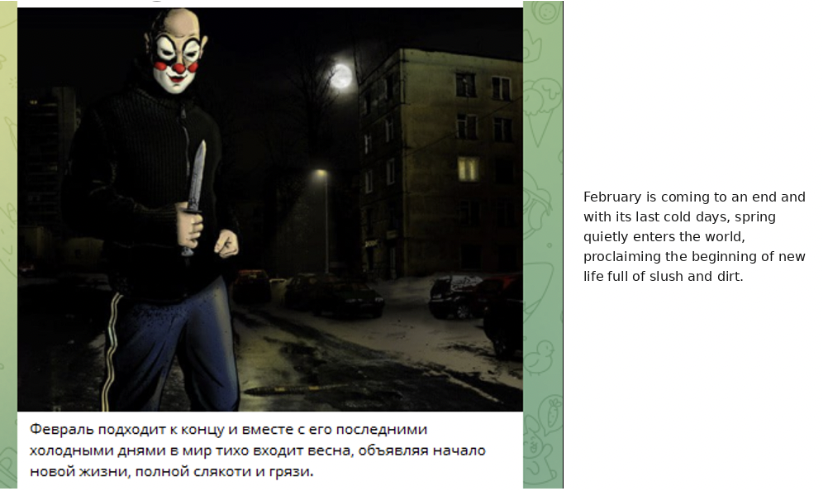
Figure 6: The beginning of a Telegram post glorifying NS/WP members’ activity, with the clown-masked figure holding a knife in a dark urban area, representing the kind of nighttime attacks against vulnerable groups that the group often films. The rest of the text refers to them as “heroes” and “city partisans who are shining in the invisible fronts of street fights” (27/02/2026) [Translated by the author].
Nevertheless, you people still become drawn to NS/WP and similar groups. The question is: what draws them in?
On the one hand, the motivations of Russian youth may not differ much from those of young people elsewhere in the world. The aesthetic elements of recruitment, promise of adventure, the “cool” and “heroic” status, used by NS/WP have already proven to be an effective strategy for terrorists and extremists to connect with their target audiences.
The material motivation may be another powerful factor – with the invasion of Ukraine, the economic consequences are felt by large sections of the population, and an opportunity to earn what is perceived as ‘easy money’ may indeed push some young people to cross legal boundaries, especially with the rising feeling among young people that their own country isn’t providing them with adequate conditions for life and growth.
Finally, it may also reflect another global trend, “mainstreaming the extreme”, as discussed in Julia Ebner’s research, but with a Russian twist. Over the last few years, the country’s society has taken a drastic nationalist turn, and it is not uncommon to hear official speeches securitising migration. This results not just in the formation of a specific narrative around migrants, but also in the emergence and operation of vigilante groups like “Russian Community” that present themselves as fighters against illegal migrants and their alleged abuse of Russian citizens. This may not just desensitise young people, but also shape a worldview in which they might eventually agree with these narratives and even see them as an appropriate way to find community and meaning in life.
Conclusions and Recommendations
While this case may at first glance seem only regional, it also directly affects spaces beyond Russia. First, it shows the danger of ignoring or allowing extreme discourse to enter mainstream online and offline spaces. Second, in 2025, over 100 million Russians use social media, and 285 million speak the language globally, meaning they can understand harmful content and, for some, disseminate it well beyond Russian borders. Finally, there is a crossover between Russian and international neo-nazi groups – not only through populating the same online space but also through direct communication and collaboration. This means that platforms need to pay more attention to the Russian-speaking segment of their online space and take measures to address the spread of extremist ideas.
One measure that may be needed is breaking the mainstream social media chain. Specifically, the Telegram outlinking chain: young people become fully involved in the groups when they transition to closed Telegram channels. One way to address this is to push platforms to flag content where a link leads to an outside website and/or a Telegram channel previously identified as extremist, which should help disrupt the transition pathway between the two platforms. Another measure could extend the GIFCT hash-sharing database’s taxonomy to include NS/WP (and similar groups) visual markers and outlink destinations, enabling timely removal and blocking of content.
The second measure could be to enhance monitoring and moderation of Russian-language content. Platforms should invest in hiring staff with relevant linguistic and cultural knowledge and encourage moderation and reporting from the Russian-speaking audience. Furthermore, expanding the platforms’ automatic detection glossary with the groups’ specific words and expressions could help detect and remove harmful content more quickly. This can be done in partnership with Russian independent media and monitoring sources like Mediazona and SOVA, which have already been collecting this information for their databases.
Finally, and most crucially, alternative narratives could be created that credible messengers (both in Europe and, if feasible, among Russian-speaking communities) can disseminate. Rather than attacking the ideology and promises these groups offer, communication specialists should use an active communication strategy that delivers the same outcome (adventure, coolness, community) through non-violent, productive means. While reaching credible messengers in Russia may be challenging right now, partnering with Russian expat communities, independent media outlets, and research companies (SOVA, Meduza, Mediazona, Dozhd Channel) can help craft a message that resonates with young Russians.
–
Dr Anna Kruglova is Lecturer of Terrorism Studies at the School of Arts and Media at the University of Salford and an Associate Fellow at the International Centre for Countering Terrorism (ICCT) in The Hague and Advisor for the Organisation for Identity and Cultural Development (OICD). Anna’s book, Terrorist Propaganda, Recruitment and Branding: Selling Terror Online, represents her main research interest in the terrorists’ use of marketing techniques (such as emotional branding) and identity manipulation in their recruitment strategy. Her broader research interests focus on terrorist and extremist groups and hostile states’ propaganda, and their use of disinformation and misinformation.
–
Are you a tech company interested in strengthening your capacity to counter terrorist and violent extremist activity online? Apply for GIFCT membership to join over 30 other tech platforms working together to prevent terrorists and violent extremists from exploiting online platforms by leveraging technology, expertise, and cross-sector partnerships.
The views and opinions expressed in this Insight are the authors’ own and do not necessarily reflect those of GNET or any of its partners.