

Since the launch of Israeli and United States’ military operations against Iran on 28 February 2026, online jihadist ecosystems linked to al-Qaeda (AQ) and the Islamic State (ISIS) have reacted extensively across official propaganda outlets, encrypted messaging applications and supporters’ accounts on social media. Based on primary sources collected through monitoring across these digital spaces, this Insight examines how both organisations position themselves toward Iran and how the conflict has exposed existing divergences between them.
Existing research has already highlighted AQ’s ambiguous positioning toward Iran, often explained by AQ’s strategic and operational considerations, its historical ties with the Islamic Republic, and its longstanding prioritisation of the “far enemy”. Together, these factors have contributed to a more cautious approach toward Iran. This positioning contrasts with ISIS’s tendency to place Shi‘a actors at the centre of its propaganda and enemy hierarchy. By examining reactions within pro-AQ online circles, this Insight highlights tensions between AQ’s cautious official line and more overtly anti-Iranian rhetoric among segments of its support base, while some pro-AQ cyber actors and supporters openly aligned themselves with Iran.
The Insight further shows how Islamic State media and online sympathisers have exploited AQ’s ambiguous stance toward Iran to delegitimise it and present themselves as the only ideologically pure and credible jihadist organisation. It also emphasises how periods of geopolitical conflict recurrently provide jihadist organisations and their supporters with opportunities not only to intensify the production and dissemination of online propaganda, but also to transform digital platforms into spaces of ideological competition, through which extremist narratives can reach wider audiences and attract new sympathisers. More broadly, it argues that such crises should be understood as periods of heightened extremist activity online, particularly on mainstream social media platforms, creating additional challenges for technology companies seeking to counter the dissemination of harmful content.
AQ’s Strategic Ambiguity Toward Iran and Divisions Within Pro-AQ Online Ecosystems
At the end of January 2026, prior to the outbreak of the war and amid rising tensions between the United States, Israel, and Iran, AQ official media outlet As-Sahab released a statement from AQ General Command calling for mobilisation and incitement against Western powers. Notably, the communiqué made no reference to Iran and instead focused on the United States and its allies.
This caution reflects AQ’s longstanding strategic pragmatism toward Iran and its preference for prioritising confrontation with the West over sectarian escalation against Shi‘a actors, leading the group to avoid placing Iran and the Shi‘a at the centre of its enemy hierarchy (S. Altuna, Sectarian Priorities, pp 9-11). This position is partly shaped by historical ties and strategic constraints, including the presence of senior AQ figures in Iran since the early 2000s, notably Saif al-Adel, widely regarded as AQ’s de facto leader after the death of Ayman al-Zawahiri in 2022. It also reflects a deliberate and well-established AQ strategy, aimed at preserving a broader intra-Muslim mobilisation against common enemies, specifically in contexts where tensions with Shi‘a actors are not the primary issue.
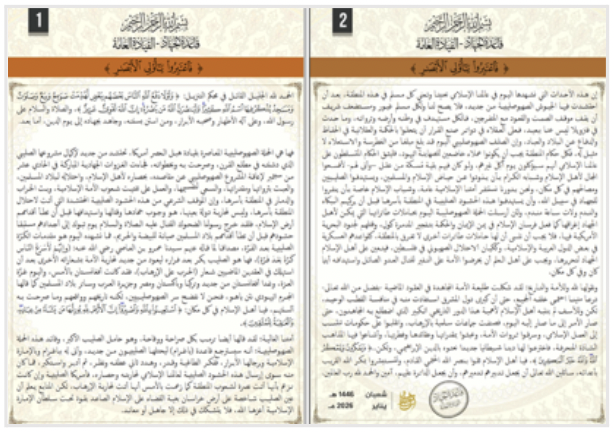
Figure 1. Statement released by al-Qaeda General Command through As-Sahab media in January 2026.
Following the outbreak of the war, AQ’s official propaganda outlets did not mention Iran a single time. Instead, it continued to focus on confrontation with the West, particularly through emotional narratives often linked to the Israeli-Palestinian conflict. Moreover, some unofficial actors, including pro-AQ Telegram channels, supporter-run media foundations and sympathisers aligned themselves with this messaging. For example, on 1 April, two posters produced by pro-AQ media foundations, in Arabic and Persian, circulated across Telegram, Signal and social media. Addressed to “Muslim brothers” worldwide, particularly in the West, they framed the situation in Palestine as justification for attacks and called for violence against Western and Jewish targets, as well as the killing of Jews and Americans. The posters framed inaction as unacceptable, considering ongoing conflicts and used retaliatory rhetoric, including “blood for blood and destruction for destruction,” to justify attacks. This type of content, disseminated in Persian during the war, clearly tries to capitalise on the upheavals generated by the conflict while avoiding any expression of solidarity with Iran.
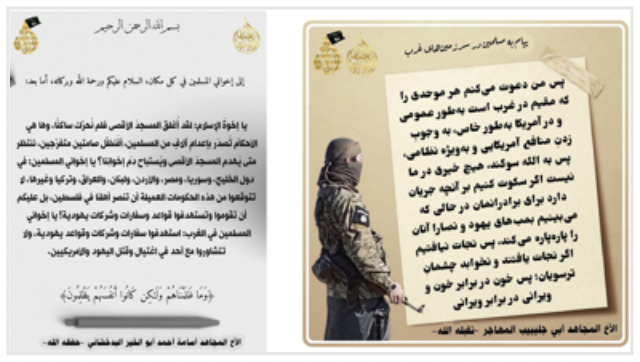
Figure 2. Arabic- and Persian-language pro-AQ posters calling for attacks against American, Western, and Jewish targets.
Furthermore, comments posted in multiple pro-AQ Telegram channels expressed satisfaction with Iranian strikes against Israel. Some sympathisers rejoiced over the damage caused by Iranian missiles, portraying the attacks as just revenge for the war in Gaza. Beyond expressions of satisfaction with Iranian strikes, some elements within pro-AQ online ecosystems openly advocated alignment with Iran. On 4 March 2026, the Cyber Jihad Movement announced that it was joining “pro-Iranian hacker movements and groups in their fight against the United States and Israel”, in what Daria Alexe has described as “the first explicit declaration of cross-ideological cyber collaboration between Sunni jihadist and Shi‘a-aligned hacker collectives“. Similarly, some AQ sympathisers on Telegram argued that it would be in the interest of Muslims “to stand with Iran against the Zionist entity and its allies.”
However, such statements were far from widely accepted within pro-AQ online spheres. Users calling for Muslims to unite against Israel rather than continue sectarian divisions were often criticised by others, who argued that Muslims should not side with “one camp of disbelievers against another.” On several mainstream social media platforms, some anti-Shi‘a and anti-Iran visuals, some of them AI-generated, were shared by pro-AQ accounts. Some supporters also circulated comments celebrating the deaths of Shi‘a Muslims, calling for the mutual destruction of both camps, and portraying the war as a divine plan in which oppressors of Muslims are turned against one another. These reactions highlight anti-Iranian and sectarian views among segments of pro-AQ online supporters, despite AQ’s more ambiguous official line toward Iran.
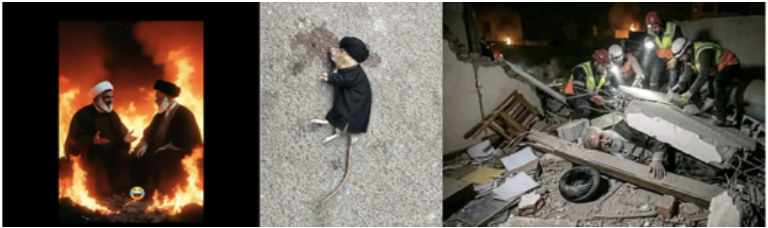
Figure 3. Examples of anti-Iran and anti-Shi‘a visuals circulated by pro-AQ accounts on social media.
Such rejection of both camps was also central to ISIS rhetoric, both in official propaganda and in online reactions from ISIS sympathisers, as illustrated in the following section.
“Conflict among the kuffar”: ISIS’s Response to the War and AQ’s Ambiguous Stance Toward Iran
ISIS reactions and those of its supporters were far less ambiguous, and embraced a rigid ideological narrative which, much like some segments of AQ supporters, portrayed the war as a conflict between “kuffar” (disbelievers). Even before the outbreak of hostilities, on 26 February, the editorial published in issue 536 of ISIS’s weekly newspaper An-Naba positioned itself in opposition to the January 2026 As-Sahab communiqué, to which it is a direct response. In the editorial, ISIS denounces what it portrays as Iranian influence over AQ, arguing that the group’s historical ties with Iran have led it to deviate from authentic jihadist principles. By doing so, ISIS seeks to discredit its rival and present itself as the only credible jihadist alternative for supporters dissatisfied with AQ’s position toward Iran.
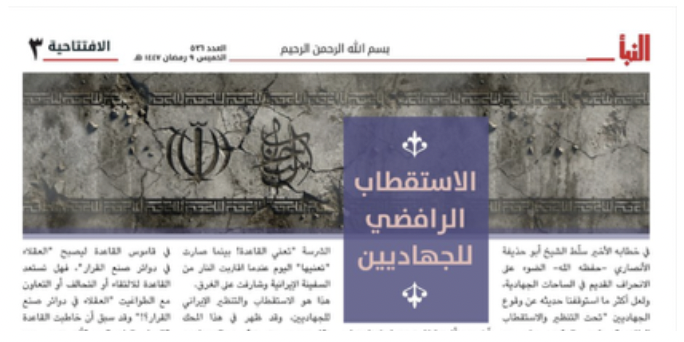
Figure 4. Excerpt from An-Naba issue 536. The editorial criticises AQ’s relationship with Iran and is part of ISIS’s broader effort to delegitimise its rival.
Once the war had begun, issue 537 of An-Naba, released on 5 March, reaffirmed this position in an editorial titled “Conflict Among the Kuffar.” The text urges its audience not to side with either side in the conflict, portraying both the Iranian axis and the United States–Israel camp as enemies of Islam while once again emphasising that Iran and the Shi‘a are longstanding adversaries responsible for corrupting Muslim societies, consistent with ISIS’s anti-Shi‘a rhetoric. Indeed, ISIS views Shi‘a actors as particularly dangerous because, unlike external enemies, they are perceived as an internal threat capable of infiltrating and subverting Muslim communities from within. Beyond commenting on the war itself, the editorial implicitly continues ISIS’s campaign of delegitimisation against al-Qaeda. Its rejection of any form of tactical alignment with Iran serves to undermine AQ’s credibility among jihadist audiences and reinforce ISIS’s claim to ideological purity. The editorial was then shared by pro-ISIS media outlets active on Telegram and other platforms, which republished or repurposed it under their own branding. It also presents the conflict as an opportunity to benefit from the mutual weakening of both the Iranian axis and the United States-Israel camp and to exploit the resulting chaos. Comments observed across pro-ISIS online spaces suggested that the Khorasan Province of ISIS (ISIS-K) could take advantage of Iranian security forces being focused on responding to Israeli and U.S. strikes. Given ISIS-K’s demonstrated ability to operate inside Iran, notably during the 2024 Kerman attack, some sympathisers on social media and within pro-ISIS online communities expressed hopes that ISIS fighters would benefit from the resulting chaos.
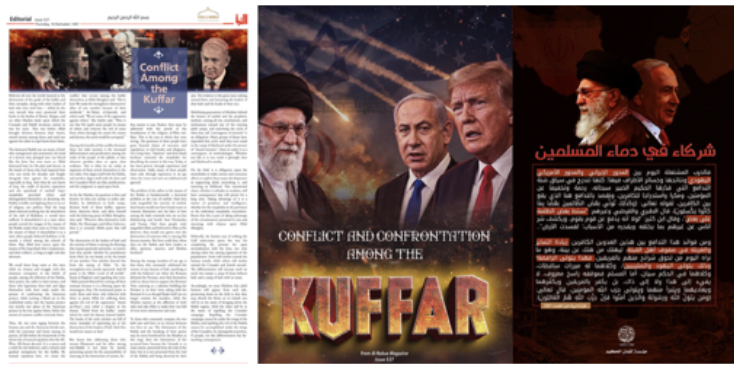
Figure 5. From left to right: the original editorial “Conflict Among the Kuffar” published in An-Naba 537; a visual adaptation published in Voice of Khurasan issue 48; and a poster produced by an unofficial pro-ISIS media outlet active on Telegram and social media.
On Telegram and social media, the war generated significant enthusiasm among ISIS supporters who, consistent with official messaging, largely welcomed the conflict and expressed hopes that the belligerents would inflict maximum damage on one another. Iran is accused of killing Sunnis in Iraq, Syria, Yemen, and Lebanon through its support for Shi‘a armed groups such as Hezbollah and the Houthis, while Israel and the United States remain the archetypal aggressors and oppressors of Muslims. Numerous publications celebrate the idea that when two camps of unbelievers fight one another, Muslims should welcome their mutual destruction, a view also articulated in An-Naba 537 through the concept of tadāfuʿ, which portrays the conflict between the Iranian axis and the United States and Israel as part of a divinely ordained process through which God weakens and punishes the enemies of Islam by setting them against one another.
Conclusion
The conflict has not fundamentally altered the positions of either organisation, but it has brought them into sharper focus. It has provided ISIS with new opportunities to attack AQ’s jihadist legitimacy.
The reactions observed online show that the conflict has not only been exploited in official propaganda but also by supporters. Consistent with official messaging, ISIS sympathisers used the war and AQ’s ambiguous stance toward Iran to portray the Islamic State as the only ideologically pure and credible jihadist organisation, while discussions within pro-AQ circles revealed disagreements over how supporters should position themselves toward Iran. As a result, social media platforms became spaces of ideological competition between AQ and ISIS supporters, reflecting broader disagreements over strategic priorities and competing visions of jihad, particularly regarding the balance between confronting the “far enemy” and prioritising sectarian opposition to Shi’a actors.
Beyond these differences in positioning toward Iran, the conflict also generated heightened activity across jihadist online ecosystems, resulting in an increase in extremist propaganda and online mobilisation, consistent with trends observed following other major geopolitical crises and their aftermath. Official propaganda was rapidly adapted, repackaged, debated, and disseminated by sympathisers, particularly across mainstream social media platforms. In doing so, these supporter ecosystems contributed to amplifying extremist narratives and extending their reach, illustrating the continued role of mainstream social media platforms in the dissemination and normalisation of terrorist content and narratives.
For technology companies involved in countering extremist content online, these observations highlight the importance of looking beyond the detection and removal of official propaganda content alone. Major geopolitical crises should be regarded as predictable trigger events for heightened extremist activity online, warranting increased monitoring of supporter-run media foundations, discussion spaces, and social media accounts. Such an anticipatory approach may help detect and remove extremist content and narratives before they can be amplified by supporter ecosystems and reach audiences beyond extremist circles.
–
Ruben Celada is an analyst at The JOS Project/Jihadoscope. With a background in law, international relations, and security studies, he specialises in the analysis of jihadist propaganda, online extremist ecosystems, and how violent extremist organisations exploit digital platforms to disseminate propaganda and extremist narratives.
—
Are you a tech company interested in strengthening your capacity to counter terrorist and violent extremist activity online? Apply for GIFCT membership to join over 30 other tech platforms working together to prevent terrorists and violent extremists from exploiting online platforms by leveraging technology, expertise, and cross-sector partnerships.
The views and opinions expressed in this Insight are the authors’ own and do not necessarily reflect those of GNET or any of its partners.