

This Insight relies on open-source intelligence to examine how nasheeds – Islamic hymns – are exploited by violent extremist actors, and rendered linguistically accessible by regional pro-Islamic State (IS) supporters as a tool for building radical online communities in Southeast Asia. The Insight traces the emergence of a nascent extremist nasheed online subculture in the region, demonstrating how it has been used to consume and circulate extremist content on mainstream platforms. This is followed by a case study analysis of an Indonesian pro-IS extremist nasheed online community, which, for the purposes of this Insight, is referred to as ‘MN’. Its operational strategy, comprising propaganda tactics and functional tactics, facilitates the extremist nasheed subculture and bolsters online community-building by promoting radical narratives within the in-group and preserving the feasibility of extremist activity on mainstream social media.
Nasheeds in Salafist-Jihadist Culture and Contemporary Online Subculture
Nasheeds are understood as Islamic hymns intended for worship and to call others to Islam. Although nasheeds are not inherently extremist in nature, Salafi-Jihadist groups have exploited various compositions and the medium itself as a propaganda tool to promote violent extremist ideologies. Contemporary jihadist nasheeds trace back to the 1970s and 80s, following a period of Islamic revival and Islamist resistance movements in Syria, Egypt, Afghanistan, and Palestine, consequently influencing the format of nasheeds that emerged subsequently.
Despite jurisprudential debates over the permissibility of nasheeds, jihadists have generally adhered to conservatively permitting acapella compositions which do not resemble Western music or distract listeners from religious obligations. Ultimately, the production style and contents of an extremist nasheed depend on the group’s ideological framework and recruitment goals.
Early Salafi-Jihadist leaders recognised the utility of extremist nasheeds in fostering jihadi culture and promoting militancy and hijrah (migration) amongst their followers. As Nelly Lahoud contends, it is the rhythmic and melodic aspects of these acapella compositions which contribute to their ‘musicality’ and affective power to evoke strong emotional responses in listeners, despite the absence of musical instruments (p.44).
Hence, these nasheeds are exploited as potent propaganda tools, serving both to unify and inspire jihadists who collectively seek to adhere to the messages propagated in these compositions and to function as effective recruitment mechanisms.
From a contemporary perspective, extremist nasheeds have served as an integral component of online jihadist propaganda operations, proliferating beyond encrypted platforms into mainstream social media and audio file hosting sites. In particular, the digital realm has facilitated the cultivation of an extremist nasheed online subculture, where jihadist supporters coalesce as ‘fans’ of nasheeds in certain enclaves within the wider online extremist ecosystem.
Within this online subculture, the interactive nature of the consumption and circulation of nasheeds cultivates social relationships in which supporters develop a sense of in-group and relational identity based on a mutual passion for the extremist content. This fosters a sense of belonging and community, which may not be readily available elsewhere, and serves as a shared outlet for responding to status frustration exacerbated by marginalisation and exclusion, and perceived global injustices.
Islamic State’s Exploitation of Nasheeds as a Propaganda Modality
Existing scholarship notes that IS founded its dedicated nasheed production unit, Ajnad Foundation, in 2013 and that the group has prioritised nasheed-centric propaganda operations. These include discrete audio releases of nasheeds and their integration into propaganda videos.
Henrik Gråtrud’s 2016 study demonstrates how the group employs nasheeds to expound its master narratives, including: jihad as the solution, fighters as role models, war and brutality, as well as IS’s role as the rightful leader and defender of Islam (p. 1054). As demonstrated below, IS continues to employ these tactics today.
Stephane Baele and Charlie Winter conclude that IS’s strategic manipulation of nasheeds remains an effective propaganda tactic for promoting IS’s core messaging as it evokes powerful emotional reactions amongst listeners. This is attributed to the inherently affective qualities of musical compositions, as well as the embedded techniques of repetition and symbolism, which stir listeners’ emotions and perceptually reinforce the group’s legitimacy by “winning hearts and minds” (p. 196).
Although IS nasheeds were initially produced solely in Arabic, language diversification efforts have been undertaken since 2014 to expand propaganda reach and meet growing interest. Even so, scholarship from Baele and Winter reflects how, in an index of 104 IS-produced nasheeds tracked between February 2013 and March 2017, only one nasheed, ‘Return of the Caliphate’, was available in Bahasa Indonesia. A marked shift occurred from 2017 onwards, as decentralised regional pro-IS supporter groups increasingly drove the reproduction of IS-related content translated into Bahasa Indonesia, including nasheeds.
Tracing the Emergence of Extremist Nasheed Subculture in Southeast Asia
Following central IS’s discernible digital disengagement from Southeast Asia after 2017, unofficial Southeast Asian pro-IS supporters persisted in their online operations, leading to an uptick in IS content translated to Bahasa Indonesia. In response to rising demand for linguistically accessible extremist nasheeds, Indonesian-speaking pro-IS supporters carved out dedicated online spaces for the reproduction and circulation of translated nasheed media.
Upherogy Media (UM) emerged as an influential entity that systematically produced and distributed both original and linguistically adapted pro-IS nasheeds performed in Bahasa Indonesia within a demarcated online space. The now-defunct outlet surfaced on an IS-affiliated encrypted platform in 2022 and directed users to join its dedicated channel (Fig. 1 and 2).
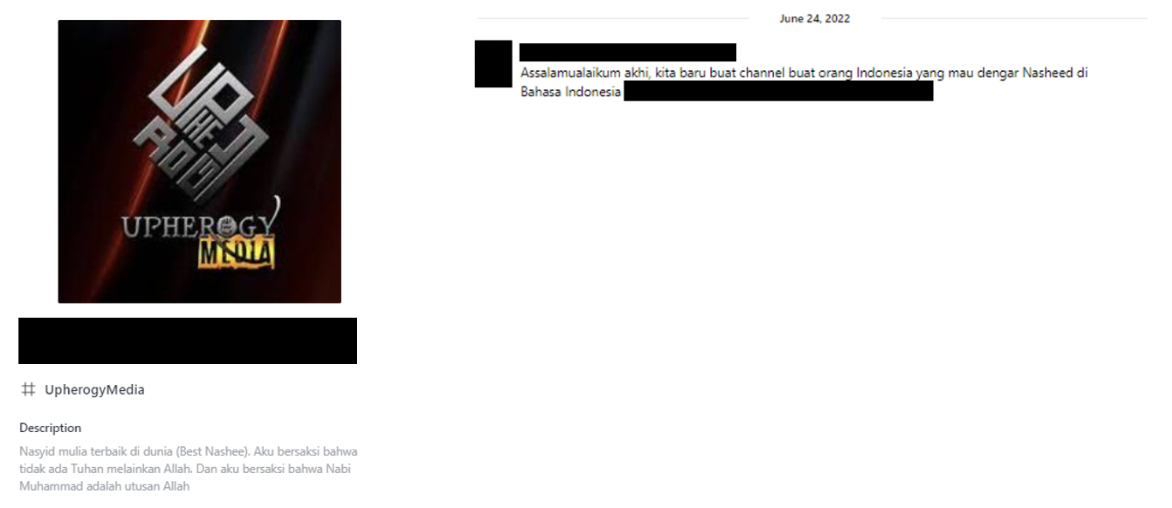
Figures 1 and 2: Upherogy Media first emerged on an encrypted pro-IS chat platform and invited users to join its dedicated nasheed channel through an invitation link
UM strategically packaged some of its extremist nasheed content in audiovisual format. The Islamic State’s master narratives, embedded in these compositions, are accompanied by visual imagery that amplifies their emotional impact. Four recurring IS core narratives propagated by UM nasheeds include: calls for listeners to wage jihad against enemy out-groups, glorifying the mujahideen (fighters who engage in armed jihad) and martyrdom, IS’s role as the legitimate protector of Muslims, as well as the dire need to protect a vulnerable ummah (global Muslim population) that is under siege (Fig. 3 and 4).
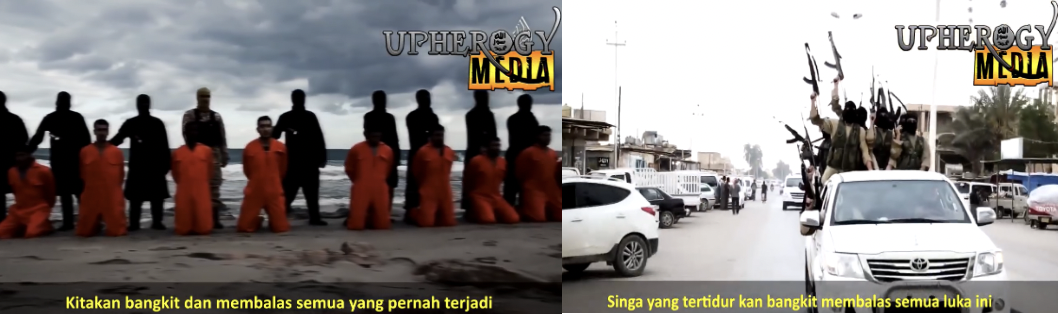
Figures 3 and 4: An analysis of one nasheed, Ya Ummatku (O My Muslim Community), illustrates how visual imagery is used to reinforce IS master narratives and maximise emotional appeal.
UM served as a distinct earlier effort to consolidate a designated social space for the consumption and circulation of Bahasa Indonesia extremist nasheeds, and marked the cultivation of a nascent extremist nasheed subculture in the region. Despite its takedown, content from UM and a notable producer associated with the group continues to circulate on YouTube, contributing to the group’s enduring popularity despite its dissolution (Fig. 5).
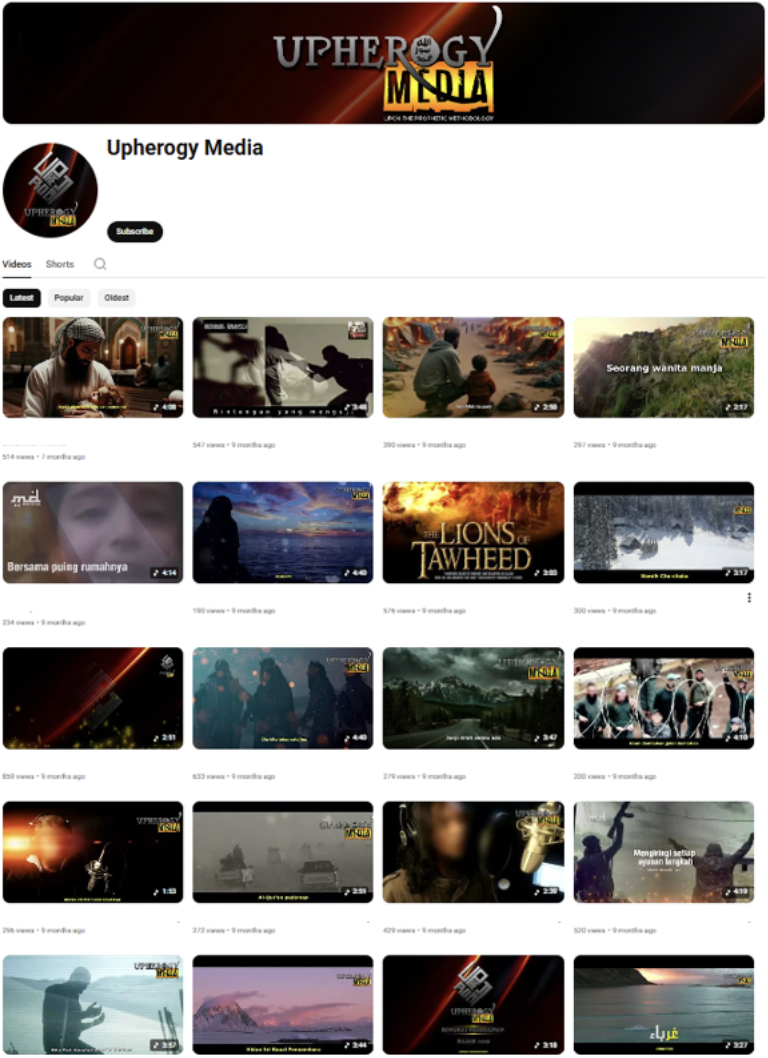
Figures 5: Despite the group’s official dissolution, UM nasheeds have been recirculated on YouTube, where they function as a repository of the group’s output.
Examining Regional Developments in Extremist Nasheed Subculture
The emergence of ‘MN’ in August 2024, an Indonesian pro-IS online community on Facebook which circulates Bahasa Indonesia translations of extremist nasheeds, marks a pertinent development in the nascent regional online subculture.
This case study reflects how extremist nasheeds continue to be exploited and rendered linguistically accessible by regional pro-IS supporters as a tool for building radical online communities in Southeast Asia. This occurs through the construction of a subculture that is centred on the interactive consumption and circulation of extremist nasheeds. Specifically, user requests for nasheeds, administrator responses, and intra-group interactions are three critical mechanisms that sustain activity, confer group identity, and establish the online community.
Based on open-source monitoring from August 2024 to October 2025, MN has released over 70 videos, with many of its nasheed video posts surpassing 1,000 views and generating substantial in-group engagement through comments and likes.
Online monitoring further reveals that MN’s operational strategy, comprising propaganda tactics and functional tactics, helps to promote radical narratives within the in-group and preserve the feasibility of extremist activity on mainstream social platforms respectively. Cumulatively, this operational strategy facilitates the extremist nasheed subculture and bolsters the online community’s resilience.
Propaganda Tactics: IS Master Narratives
MN translates and circulates extremist nasheeds which propagate key IS master narratives, although these are not exclusively IS-produced nasheeds since it functions as an unofficial supporter community that solicits requests from in-group members.
First, these translated nasheeds frequently glorify the use of violence and encourage listeners to engage in offensive jihad against enemy out-groups. For example, a nasheed published in August 2024 reinforced the idea that jihad for the sake of God is the “highest victory”, and that the mujahideen “love death as you love life” (Fig. 6).
As derived from the translations, the language used to advance this narrative is particularly explicit. For instance, another nasheed posted in August 2024 included the following excerpts: “O fire worshippers, killing you is an obligation, an honour, and a (source of) pride […] the sword will not return to its sheath until blood flows like a river […] we will not accept anything but your death O polytheists” (Fig. 7).
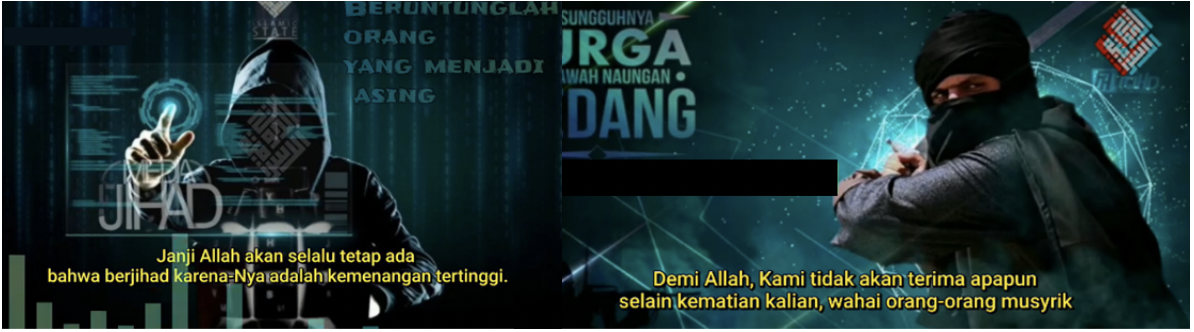
Figures 6 and 7: Excerpts from MN nasheeds which promote narratives that glorify the use of violence and call for listeners to engage in offensive jihad against disbelieving enemies.
A second key narrative is the glorification of martyrdom and the mujahideen. An October 2024 nasheed encapsulates this narrative through the sentiment that “victory can only be achieved through bloodshed by martyrs” and that the “spilling of blood is the pride of the mujahideen” (Fig. 8). Another nasheed from the same month declares that IS is established through jihad by believers who “willingly sacrifice their lives with the fullest conviction”.
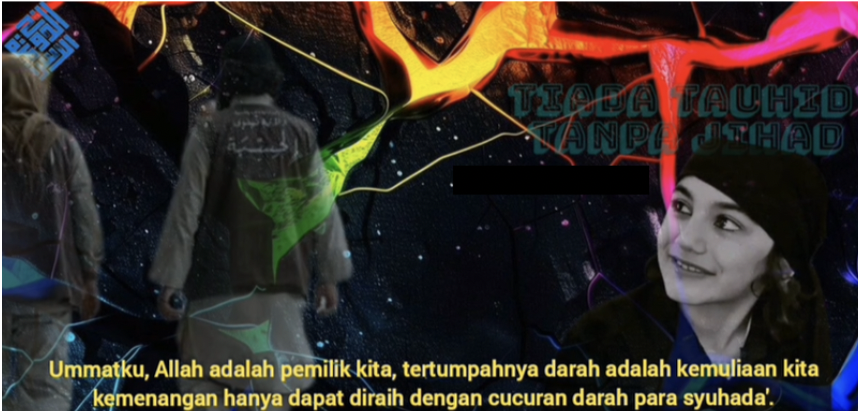
Figure 8: An excerpt from an MN nasheed which glorifies martyrdom through jihad and the mujahideen.
A third key narrative is the call to defend a vulnerable global Muslim population from persecution through waging violence against enemy out-groups. Nasheed videos that peddle this narrative frame the use of violence as necessary to protect innocent Muslims and typically include imagery of children to elicit charged emotional responses amongst target audiences.
Functional Tactics: Circumventing Detection & Admin-User Dynamics
To sustain its online presence on Facebook, MN videos are typically produced with substantial visual stylistic effects. While these visual configurations also serve an aesthetic role by conferring a unique style and identity on MN nasheed videos, the deliberate use of glitch effects in IS branding and low-opacity overlays of mujahideen images serves to circumvent content-moderation detection. In one instance, the administrator of MN responded to a member who requested the removal of an overlayed image that obscured an aspect of the video, stating that it is a deliberate strategy to avoid detection. This strategy reduces the likelihood of frequent takedowns and enables continued operations to sustain community activity. Even so, the account has been compromised or taken down at least twice since its inception.
Notably, the administrator of MN also maintains a high level of interaction with members, such as by promptly responding to nasheed requests and accommodating user feedback. For example, when one user had requested the inclusion of more war imagery, the administrator justified the use of generic “AI landscapes” to circumvent detection, yet still incorporated the feedback in the subsequent video, which featured the headline “Flames of War” with a discreet overlay of two fighters (Fig. 9). These types of reciprocal interactions help users feel like they hold a stake in the group, strengthening interpersonal bonds and fostering a sense of community.
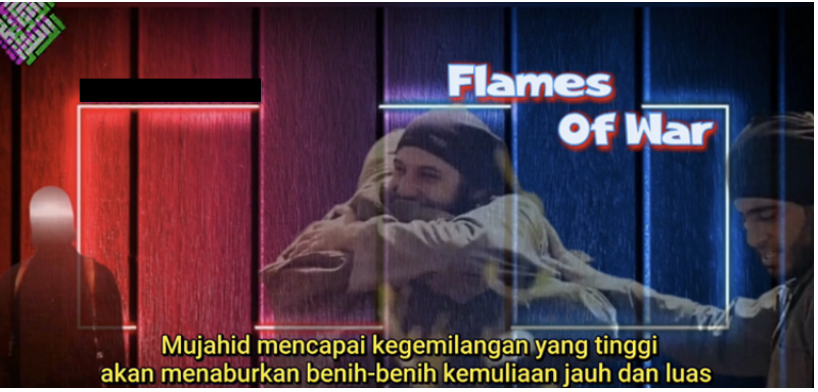
Figure 9: An example of how MN’s administrator accommodates the feedback of in-group members. This frame of the nasheed translates to read: “the mujahid who achieves excellence will sow seeds of honour far and wide”.
Conclusion
Extremist nasheeds have been exploited and rendered linguistically accessible by regional pro-IS supporters to cultivate radical online communities in Southeast Asia. This occurs through the construction of an online subculture that is centred on the interactive consumption and circulation of extremist nasheeds.
The affective qualities of nasheeds as musical compositions play a vital role in enabling the subculture by evoking strong emotional responses in listeners, promoting interpersonal bonds, and cultivating social relationships premised on a mutual passion for nasheeds. Even after content is removed, supporters continue their proliferation efforts by creating spin-off pages and repositories on audio hosting sites.
The audio-based nature of the content and language barriers complicate automated threat detection and content moderation processes. It is critical to incorporate human intervention, in the form of knowledge experts, to holistically assess potential threat developments within this nascent subculture.
While extremist nasheeds on mainstream platforms in Bahasa Indonesia are less prevalent than other forms of propaganda, the evolution of a nascent extremist nasheed subculture in the region as an effective conduit for online extremist community-building raises concerns surrounding the potential for IS ideology to gain a stronger foothold in the region, as well as the spillover of radical ideologies to non-extremist segments of mainstream online spaces.
Following an internal review, YouTube has terminated the channel noted in this Insight.
–
Nurrisha Ismail is a Senior Research Analyst at the International Centre for Political Violence and Terrorism Research (ICPVTR), a constituent unit of the S. Rajaratnam School of International Studies (RSIS) at Nanyang Technological University (NTU), Singapore. She earned her Bachelor of Social Sciences in Political Science (Honours) from the National University of Singapore and is currently pursuing an MSc in Strategic Studies at RSIS, NTU. Her research primarily draws on open-source intelligence (OSINT) to examine political violence and terrorism in Southeast Asia, as well as nonviolent religious extremism.
–
Are you a tech company interested in strengthening your capacity to counter terrorist and violent extremist activity online? Apply for GIFCT membership to join over 30 other tech platforms working together to prevent terrorists and violent extremists from exploiting online platforms by leveraging technology, expertise, and cross-sector partnerships.