


Following the heinous attack on members of the Jewish community celebrating Chanukkah on Bondi Beach on 14 December 2025, large amounts of antisemitic content and content praising the attack surfaced on popular social media platforms.
This Insight examines two core narratives from the selected content on X and TikTok and explains the connections between the attack and antisemitic narratives that continue to circulate online. While it is certainly necessary to interrogate this type of extremist content in a variety of languages, this Insight solely analyses Arabic-language material. Drawing attention to Arabic content is particularly important as this type of material continues to be undermonitored and underresearched.
Methodology
For this Insight, initially, four social media platforms were scanned via keyword searches, reviews of follower and following lists, and identification of relevant hashtags that led to the respective content. After manually reviewing content posted on various social media platforms immediately after the attack and again at the beginning of February 2026, content from X and TikTok was selected to illustrate how similar sentiments or ideas are disseminated across two very different platforms (one being text-based and one being video-based). Among the hashtags with which relevant content could be identified were هجوم_سيدني (engl. “Sydney attack”) or إسرائيل الارهابية (engl. “Terrorist Israel”) – or other variants of them – often also used in combination with one another. All posts included in the analysis are openly accessible and were not taken from restricted groups or networks. The goal of this analysis is not to classify identified content as right-wing extremist, Islamist, or left-wing extremist, but rather to show how users across the political spectrum connect the attack to previous events and broader narratives circulating in extremist networks. In addition, this analysis identifies posts that glorify the attack but otherwise do not appear to have a political or extremist agenda. All translations included in this analysis were created by the authors.
Understanding In-group/out-group thinking
In line with common mechanisms of extremist messages, a variety of posts published in the week after the attack demonstrate or solidify clear in-group and out-group thinking. Across several posts, different religious communities are presented as being in ‘natural’ rivalry with one another. The text in post 1, posted on X, states: “The view that subjugates atheism and secularism, feminism, the Jews, the Christians, the non-believers, and the prostrates.” The image depicts a man with a long beard and a woman wearing a black veil that covers her entire body. These groups are presented as mutually exclusive and as in constant fight with one another. According to posts like these, solidarity and security are only to be found within a certain group, not between them. While one group is praised (in this case, the one associated with the appearance depicted in the images), the others are regarded as equally inferior. Such clear distinctions between one’s own group and those of others strengthen (but also exaggerate) identities and propagate behaviours that serve the interests of the in-group.
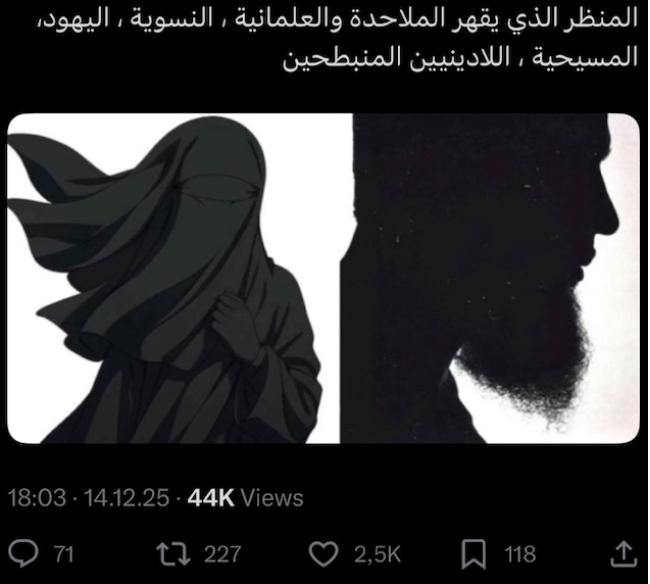
Post 1. Published on Dec 14, 2025, on X.
Numerous posts found on X in the days following the attack glorified the younger of the two attackers. Images of him combined with texts that describe him as the “hero” were posted, as post 2 suggests, underneath the image of the 24-year old attacker. The text itself reads: “Allah protects the mother that carried you and he rewards her for you with the highest reward”. The post contains the hashtag “Australia” in Arabic. It clearly violates X’s community guidelines of preventing the dissemination of content that glorifies violence. Further on X, posts circulated that stated that the younger of the two attackers was Jewish. These posts included an image which supposedly showed the Facebook profile of the attacker with his ‘real’ name. With posts like these, users sought to divert attention away from the Muslim community and shifted blame to the Jewish community.
Interestingly, the same account that had praised the attacker as a ‘hero’ on 14 December 2025, posted on 16 December 2025, that the attacker was in fact Jewish, citing the Facebook profile as ‘evidence’. Both posts are still online at the time of writing (Feb 1, 2026). On TikTok, a video suggested that one of the perpetrators’ names had been “searched on Google in Tel Aviv” prior to the attack, as shown in post 3. On 4 February, 2026, this video had 115.8K views, which clearly demonstrates the broad attention videos and statements like these receive. In another post from 14 December published on X, a user put the idea forward that the attack might have been planned in Israel, “just as other terrorist operations were”. The post also states that this “terrorist attack only serves Netanyahu’s interests”. While this post seems to condemn the attack, it does suggest that the Israeli government is to blame for it, yet without providing evidence for this assumption. Content like this furthers antisemitic conspiracy theories and may lead to increased tendencies of radicalisation.
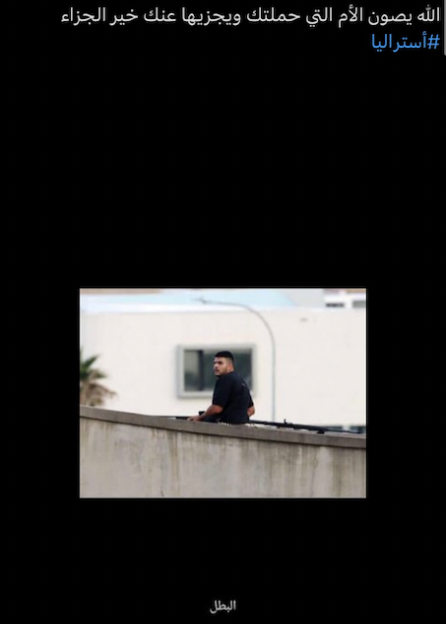
Post 2. Published on Dec 14, 2025, on X.
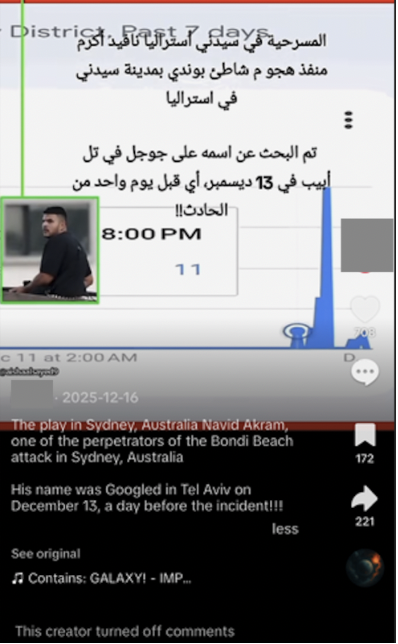
Post 3. Published on Dec 16, 2025, on TikTok.
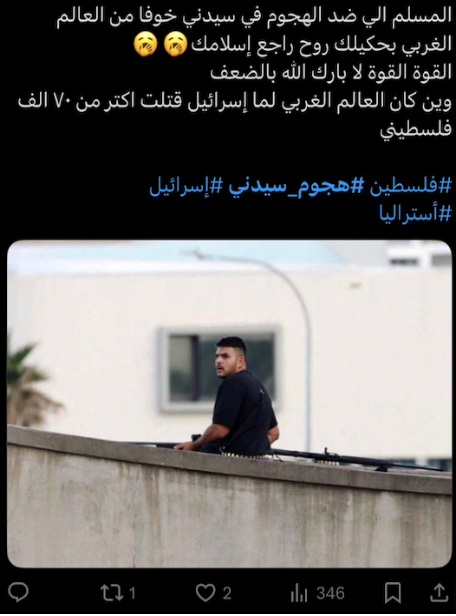
Post 4. Published on Dec 14, 2025, on X.
A large number of Arabic posts on X and on TikTok also declared the man who stopped one of the attackers a ‘hero’ and underlined that he is Muslim as well. Content like this seems to challenge in-group/out-group thinking and paints a more diverse picture.
The War in Gaza as Justification for the Attack
Aside from speculation about the attack’s perpetrators, several posts linked the attack to the broader political discourse. Post 4 states that “the Muslim who opposes the attack in Sydney is fearful of the Western world and I tell you, go back to your Islam.” The post also asks: “where was the Western world when Israel killed more than 70.000 Palestinians”, thereby directly connecting the attack to the war in Gaza. Multiple posts like these presented the attack as if it were a ‘logical response’ to dealing with the plight Palestinians experience. Since 7 October, Islamist messaging has frequently invoked the war in Gaza as a symbol of Muslim suffering, framing it as evidence of Western double standards and selective commitments to international law and human rights. By connecting individual attacks to broader political contexts, as posts like those cited do, these attacks gain significance and are portrayed as steps within a larger project.
Post 5 uses the hashtags هجوم_سيدني# (engl. “Sydney attack”) or إسرائيل الارهابية# (engl. “Terrorist Israel”), thereby again alluding to a connection between the two. The text in the image is attributed to a man called Usama Hamdan (thereby likely referring to a Hamas leader) who is quoted with the following words: “We do not take blood lightly, whoever it belongs to. But the world stands on one leg when 20 people are killed, and turns away when 80.000 of our people are killed and 150.000 wounded, and when millions of people are imprisoned in the biggest prison opened in the world”. The authors could not verify the originator of these words.
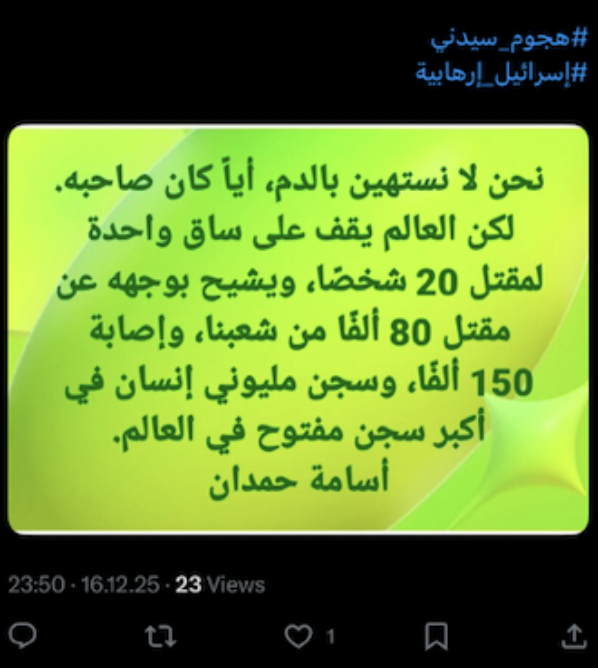
Post 5. Published on Dec 16, 2025, on X.
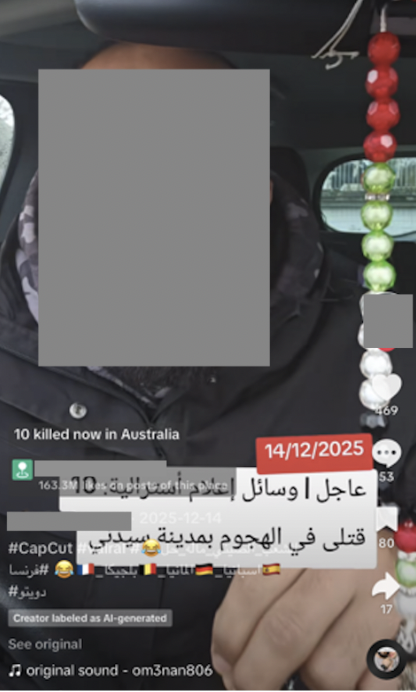
Post 6. Published on Dec 14, 2025, on TikTok.
A video posted to TikTok on 14 December 2025 shows a man speaking to the camera and informing the audience about the attack in Sydney (post 6). Seemingly delighted with the event, he asks God for the health of Gaza and Gazans and to “avenge our rights and our blood”. Again, the attack is rhetorically justified as a form of revenge for the war in Gaza.
Many posts on X used a specific spelling for the Arabic term for Jews or for Israel, for which they inserted a slash into the word or changed the spelling in different ways (as seen in post 7), likely to evade content moderation efforts – a practice which may be referred to as ‘algospeak’. However, many posts were found on X whose authors do not seem to see the need to hide their antisemitic messages or messages glorifying the attack in any way.
Post 7 uses the hashtags #Sydney and #Australia, while pointing to the potential demise of Lebanon if one is to surrender to America and Israel. This post suggests an even broader context which connects the attack on Bondi Beach with global politics.
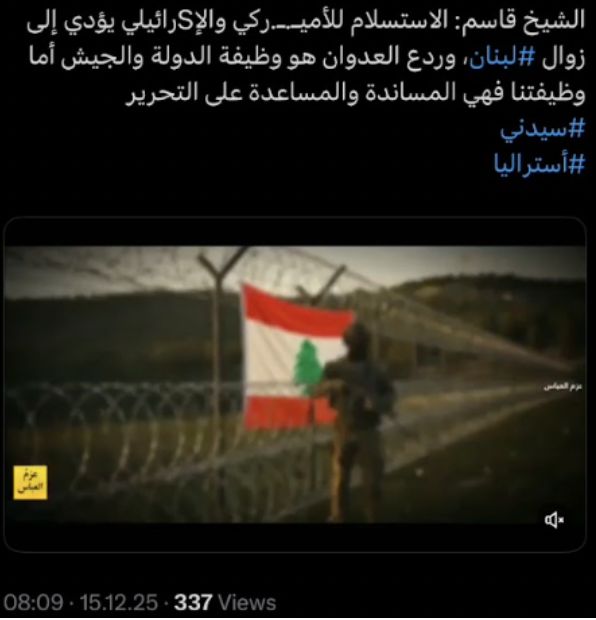
Post 7. Published on Dec 15, 2025, on X.
Conclusion and Recommendations
This brief analysis of Arabic content that was posted after the attack on Bondi Beach showed how numerous users seemed to openly glorify the attack or justify it by referring to the war in Gaza. The analysed posts furthermore clearly showed how common extremist narratives, such as that an out-group has to be fought, continue to be reproduced in connection with such attacks. The fact that otherwise non-extremist accounts praised the attackers shows how antisemitic content has proliferated and has become part of seemingly benign conversations. The majority of the accounts that published the content analysed for this Insight cannot be clearly classified as Islamist or right-wing extremist. In some cases, they have not shared other extremist content before or after the attack.
The number of posts that openly praised the murder of citizens and have been online for several weeks is alarming and once again stresses the need for content moderation in several languages. While extremist content may, in some cases, be discreet and difficult to decode – and grey zones do exist – the posts identified for this Insight are rather explicit and irrefutably violate, for example, TikTok’s principle of preventing Hate Speech and Hateful Behaviour. However, looking for common keywords that may otherwise help to detect extremist accounts may not be sufficient with content broadly disseminated across the different ideological spectra. More nuanced, linguistically diverse and informed moderation is thus needed.
–
Dr. Omar Mohammed, historian from Mosul and former anonymous blogger Mosul Eye, documented life under ISIS. He leads the Antisemitism Research Initiative at GWU’s Program on Extremism and hosts 36 Minutes on Antisemitism and Mosul and the Islamic State podcasts. His work includes cultural heritage projects, oral histories of Mosuli Jews, and the Green Mosul reforestation initiative. A former UNESCO consultant, he holds a Ph.D. from EHESS, an MA from Mosul University, and was named Iraq’s 2013 Researcher of the Year.
Dr. Margareta Wetchy: With a background in Arabic and Islamic Studies, Anthropology and English and American Studies, Dr. Margareta Wetchy has published several articles on extremist online content, especially with a focus on German and Arabic-language content. After working as a researcher and project coordinator in the extremism prevention sector, she joined Heritage of War and Peace as Academic Affairs Director in 2025.
–
Are you a tech company interested in strengthening your capacity to counter terrorist and violent extremist activity online? Apply for GIFCT membership to join over 30 other tech platforms working together to prevent terrorists and violent extremists from exploiting online platforms by leveraging technology, expertise, and cross-sector partnerships.