

Content warning: This Insight contains antisemitic language.
Although many stakeholders are concerned about identifying and characterising the online behaviours of violent extremists prior to their engagement in violence, little is empirically known about their online behaviours generally or differences in their behaviours compared to their non-violent counterparts. This three-part series summarises our research project on the online posting behaviours of violent and non-violent right-wing extremists in one online space. This Insight explores the key posting profiles identified in the dataset. Click here to read part I.
It has become increasingly common in the academic literature on violent online political extremism to evaluate the development of extremist content online or assess the levels of – or propensity towards – violent radicalisation online. But little is empirically known about the online patterns of different poster types, including those who persist or stop online posting behaviour. What is known comes from a handful of studies, most of which focus on the online presence of prolific posters. Berger and Morgan, for example, examined a sample of ISIS-supporting Twitter accounts and uncovered a small group of users who were the most active and influential in the online networks. Ducol, in his assessment of a French “Jihadosphere” community, also uncovered a small group of active members who drove the flow of online discussions – particularly the jihadi content. Baele and colleagues found similar patterns, identifying a handful of “hyperactive” posters in an Incel forum, and Shrestha and colleagues found a group of active users in a Swedish far-right forum who influenced online discussion. Most recently, Scrivens identified several sub-types of super-poster profiles within a sub-forum of a right-wing extremist (RWE) forum, including high-intensity posters, high-frequency posters, and high-duration posters. Kleinberg and colleagues measured changes in user activity and extremist language in an RWE forum and found a group of super users who accounted for most posts and extremist language. Scrivens and colleagues also found that a small group of super-posters drove high posting activity in two violent RWE forums. Baele and colleagues similarly identified a small clique of super-posters in a large sample of far-right, Jihadist, and Incel forums, but also identified several distinguishable classes of posters that made up the extremist communities.
This Insight contributes to this literature by exploring particular user types visible in the dataset, through analysis of their posting (or non-posting) behaviours. It details the research gaps in the literature and the current project’s contributions, including a unique method for collecting online information about known violent and non-violent extremists.
Ideologues, Low Profilers, and Modifiers
Empirical research on online posting patterns and behaviours of violent and non-violent RWEs has identified several posting characteristics and profiles, all of which have important policy and investigatory implications. For example, across the studies on online behaviours of violent and non-violent RWEs, it is clear that violent users tend to be much less active online than non-violent users or individuals who post on the same online platform generally, as illustrated in Tables 1-3 (see Appendix).
Research also finds that non-violent RWEs, rather than violent RWEs, display more potentially threatening online behaviours that law enforcement and intelligence agencies may deem worthy of further investigation – especially from a credible threat perspective. Not only do they post much more frequently than violent users, but the content they do post contains noticeably more indicators of extremism – i.e., ideological content and efforts to mobilise to extremist violence. In other words, non-violent RWEs tend to be the users posting the most ideological posts, especially those targeting their adversary groups, as well as posts containing efforts to mobilise others to extremist violence. As two examples of the content posted by non-violent users:
“ Every country in history has found it necessary to take drastic action against [the Jews].” (non-violent group post)
“The future for White youth is quite grim […] and we are runnning [sic] out of supportive votes daily. Let’s get the ball rolling, before it’s too late […] Let’s get off our comfy chairs and do something.” (non-violent group post)
Research suggests that online behaviours of non-violent RWEs tend to reflect one of an ‘ideologue’ wherein they likely perceive their role in and engage with the RWE movement as ideologues by providing “conceptual tools” that can be taken up by violent users. Empirical research has also supported this.
In addition, research suggests that violent RWEs are generally clandestine, often paranoid because of their violence and are concerned about revealing their identities as well as altering their online behaviours to avoid detection. The online behaviours of violent and non-violent RWEs also point to violent users modifying their online presence, which is reflected in their generally low profiles online, which is particularly the case for users who are members of violent extremist groups. Research involving in-depth interviews with former violent RWEs on their Internet usage during their involvement in violent extremism suggests that violent extremists are concerned about their on- and offline security, noting that they modify their behaviours to avoid detection and infiltration from law enforcement and anti-fascist groups. A newer generation of RWEs has adopted similar tactics, exploiting encrypted online platforms and messaging apps to avoid being tracked and detected.
Together, the unique posting behaviours of violent and non-violent RWEs identified in the empirical research may be of assistance to tech companies in developing their risk frameworks and/or crisis protocols. Investigating low-profile, low-frequency posters may be just as important as tracking high-frequency users, as those who post fewer messages – whether it be messages in general or those containing key indicators of violent extremism – may in fact be the violent users. Also worth pointing out is that the use of terrorist icons/flags/prominent figures/symbols/slogans was the top indicator for the violent group (see Table 3). Postings in this regard reflected the following sentiment:
“ if theres [sic] no hate the jews have no power! with hate , they keep the power! 88 [Heil Hitler]” (violent group post)
“We must become active because bitching on the pc [personal computer] will not get us anywhere. 14 words [a reference to a popular RWE slogan]” (violent group post)
“Drug addicts and un-educated Leftists who really dont know their asses from holes in the ground! R.O.A. [race over all]” (violent group post)
As such, identifying violent extremists online based on their posting patterns is a useful starting place for tech companies to scrutinise the online activities of those who tend to incorporate terrorist icons/flags/prominent figures/symbols/slogans into their postings. These are indicators that analysis should examine posting patterns in extremist online communities, especially in spaces with a high frequency of ideological posts, as in the current research project (see Table 1). However, as Brown and colleagues correctly point out in their examination of online behaviours of violent and non-violent RWEs, expressing extremist views alone does not signal mobilisation to offline action. Future research is needed to link the online and offline worlds of violent and non-violent extremists to better understand their behaviours, intentions, and capabilities – and not just their beliefs.
Desisters and Persisters
Research on online desisting and persisting behaviours among violent and non-violent RWEs, although still in its infancy, suggests that RWEs in the studies tend to decline or desist in online posting behaviour over time, with approximately half, on average, dropping out of posting (see Figures 1-2).
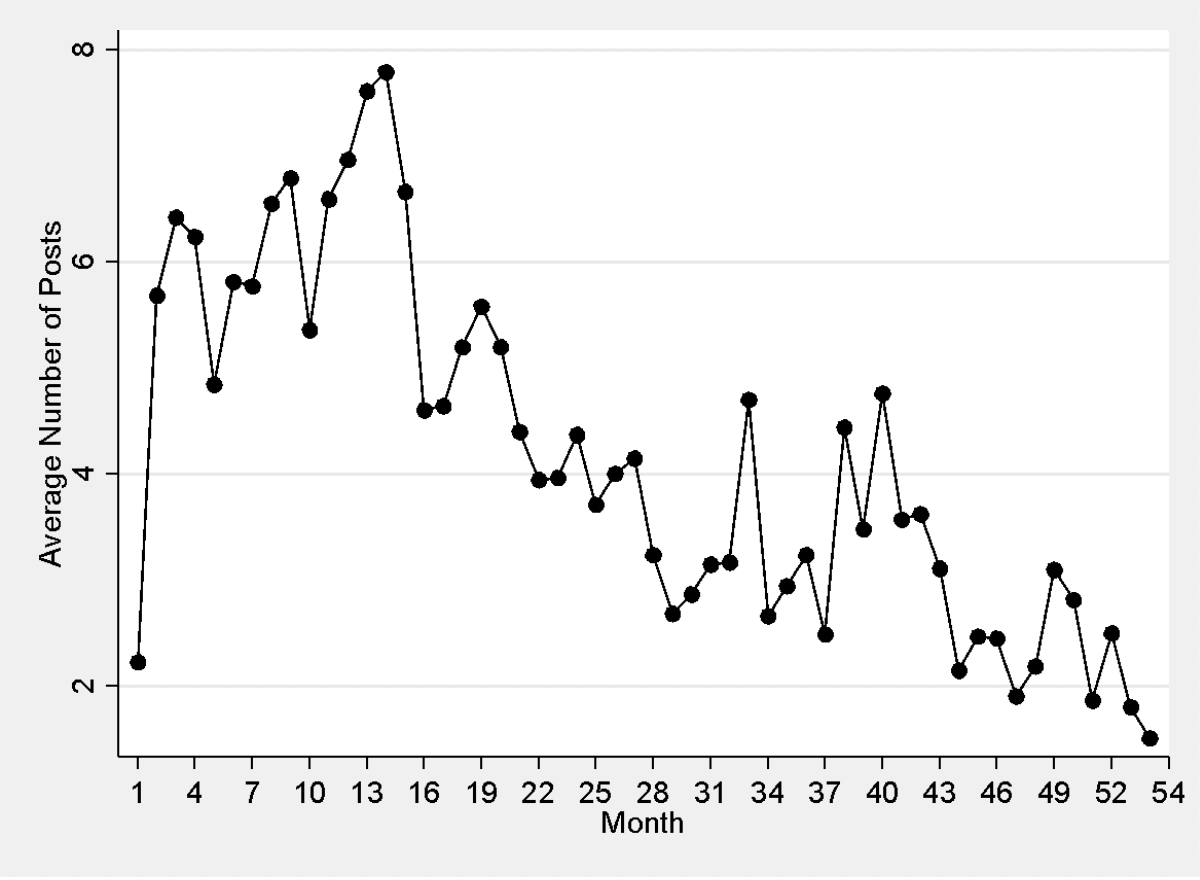
Figure 1. Average number of posts per month in the sub-forum for the full sample (i.e., violent and non-violent users).
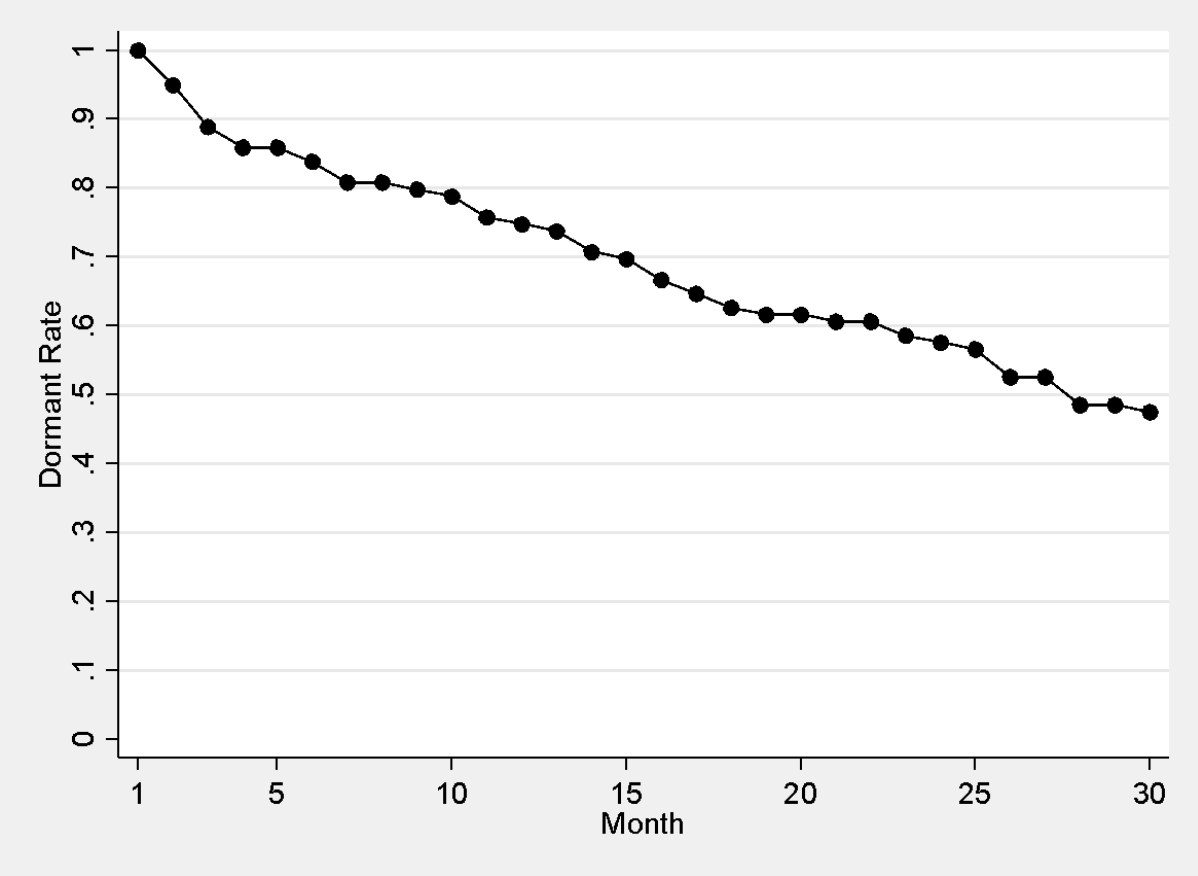
Figure 2. Survival analysis of the dormant rate in the sub-forum for the full sample (i.e., violent and non-violent users).
Importantly, this suggests that RWEs – whether violent or non-violent offline – generally do not increase in their posting behaviour over time. This contrasts with empirical research which found a steady increase in user participation in RWE online spaces as well as research conceptualising digital platforms of the extreme right as “hornet’s nests” or “lone wolf incubators” that polarise users’ opinions over time. Yet findings from the research on online posting behaviours of violent and non-violent RWEs align with recent empirical research suggesting that a majority of those who post in RWE online spaces, whether in collective extremist forums for a general audience such as Stormfront or violent RWE forums, tend to desist and tail off their posting behaviour over time. They may also become active elsewhere in the RWE online extremist ecosystem by migrating their extremist views from one space to another. At this stage of the project, it is unclear how much users desist from posting or migrate to other platforms.
On the other hand, recent work in this space identified and developed various posting sub-groups based on users’ online patterns: (1) non-violent persisters, (2) non-violent desisters, (3) violent persisters, and (4) violent desisters. Here, researchers found that violent and non-violent RWEs tended to decrease or tail off in posting behaviour on average, but also uncovered noticeable sub-groups of violent and non-violent persisters. In short, these sub-groups persisted in their online posting behaviours over time on average. For instance, these users may have been embedded in RWE groups offline and, in turn, had a greater stake in participating in online discussions for recruitment and radicalisation. Regardless, this posting pattern and subgroup is notable, and law enforcement and intelligence agencies should watch as they sift through myriad online discussions to identify potential credible threats.
Research also finds that non-violent RWEs are more likely to persist in their online behaviour than violent RWEs – in short, they tend to be active online longer. Importantly, they also post ideological and mobilisation content more often over time. In other words, these prolific posters are outspoken about their extremist beliefs and make numerous efforts to mobilise others to extremism. As an example of the posts made by a non-violent persister:
“If we do not meet, if we do not organize-we are lost. […] I know there are many of you here, or close to here-I am not asking for money, I am not asking you to do flyers with me, I am not asking for your daughters-I am just asking you to meet. Let us get to know one another; and then, perhaps, we can start the Holy work […] ” (non-violent group post)
From a pragmatic perspective, identifying individuals who adopt these active roles in the RWE movement and examining the ideological content they promote to the masses may help law enforcement and intelligence agencies gauge the extremist ideologies driving individuals to extremist violence.
Unassuming Opportunists
Uncovered in the empirical research on the online posting behaviours of violent and non-violent RWEs was a prominent sub-group of violent desisters who were low-profilers who posted few messages in general and ideological posts in particular. Particularly striking about this sub-group was that much of the content they did post when desisting encouraged others to mobilise to extremist violence. This sub-group also showed increased overall online activity, particularly in posting mobilisation content, immediately before they desisted. One example read:
“We must believe something can be done, we must try. I believe there are many more people out there who believe in what we do they just don’t admit to it because they are scared or because of the way they are made to believe it’s wrong. […] If you have already given up why are you here. We must never give up!” (violent group post)
While it is unclear whether this behaviour can be linked to last-ditch mobilisation efforts or real-world action, this is indeed a notable posting group that law enforcement and key stakeholders should be aware of.
Research examining the online posting behaviours of violent and non-violent RWEs during peak and non-peak posting days likewise found that violent users, though unassuming, were opportunists, based on an analysis of their online posting patterns. Striking was the extent to which the violent RWEs, not the non-violent RWEs, posted violent mobilisation messages during peak days. That is, unlike non-violent RWEs, the violent group posted a noticeably larger proportion of violent mobilisation posts on peak days than they did on non-peak days. Perhaps the violent group, who were generally the least active in the studies, saw peak posting days as opportune times to take advantage of the high online traffic to mobilise others to extremist violence. Such a finding was a surprise, as previous work has found that violent RWEs tend to post mobilisation messages at a much lower rate than their non-violent counterpart.
Yet other recent work suggests that the presumed positive association between posting frequency and risk of extremist violence may not be so straightforward. Scrivens and colleagues, for example, examined how RWE users’ initial time of activity/entry into the lifespan of an extremist online space influenced posting behaviour and found that non-violent users who were first active early in the lifespan of the online space tended to post more, while non-violent users who first became active later in the space posted less. On the other hand, violent RWEs who first became active early in the lifespan of the space tended to post less compared with violent users who became active later in the space, who posted more. These nuances have policy relevance and warrant investigation in future research.
Nonetheless, tech companies should be aware of the unassuming opportunists identified in the current project, i.e., violent users who tend to post few messages in general but actively post mobilisation messages on peak days. In short, this user group likely views peak days as opportune times to take advantage of the high online traffic to mobilise others to extremist violence – in other words, when they do post mobilisation content, they make it count. Analysts searching for signs of violent extremists online should focus on this posting pattern; analysing users who post during peak periods may help identify credible threats.
Appendix
Note: Posts were randomly sampled from the ‘Comparison’ group and did not include posts made by those in the violent and non-violent groups.
Table 1. Presentation of ideological posts across sample group.
| Non-violent | Violent | Comparison | |
| Anti-immigrant | 179 | 66 | 129 |
| Anti-Semitic | 240 | 190 | 154 |
| Anti-Black | 104 | 49 | 79 |
| Anti-LGBTQ | 50 | 42 | 25 |
| Anti-Muslim | 79 | 34 | 44 |
| Anti-government | 344 | 135 | 211 |
| Christian Identity | 17 | 9 | 13 |
| Male supremacy | 20 | 6 | 9 |
| Neo-folkish | 7 | 16 | 10 |
| Conspiratorial | 288 | 201 | 183 |
| Total | 1328 | 748 | 857 |
Table 2. Presentation of grievance posts across sample group.
| Non-violent | Violent | Comparison | |
| Loss of employment | 5 | 2 | 6 |
| Work performance | 2 | 0 | 1 |
| Intimate relationships | 1 | 0 | 3 |
| Personal relationships | 0 | 0 | 0 |
| Death in the family | 1 | 0 | 1 |
| Death of a friend | 0 | 2 | 1 |
| Health | 0 | 0 | 0 |
| Educational system | 15 | 7 | 16 |
| Criminal justice system | 18 | 13 | 7 |
| Target of an act of prejudice or unfairness | 37 | 19 | 65 |
| Victim of verbal assault | 0 | 2 | 1 |
| Victim of physical assault | 3 | 3 | 4 |
| Victim of sexual assault | 0 | 0 | 0 |
| Socially isolated | 5 | 0 | 3 |
| Total | 87 | 48 | 108 |
Table 3. Presentation of violent extremist mobilisation posts across sample group.
| Non-violent | Violent | Comparison | |
| End of life preparations | 0 | 0 | 0 |
| Seeking help to travel abroad | 0 | 0 | 0 |
| Planning a trip abroad | 0 | 0 | 0 |
| Seeking permission to engage in violence | 0 | 0 | 0 |
| Seeking to recruit others to mobilise | 49 | 9 | 20 |
| Asking to purchase/how to obtain illegal material | 0 | 0 | 0 |
| Includes terrorist icons/flags/prominent figures/symbols/slogans | 21 | 61 | 26 |
| Expressing goodbyes | 0 | 0 | 0 |
| Acceptance of violence as a necessary means to achieve ideological goals | 0 | 3 | 0 |
| Attempting to radicalise others/pushing others to action | 150 | 46 | 91 |
| Involved in a group that promotes violence to rectify grievances | 0 | 12 | 3 |
| Provides virtual simulations of an attack/assault | 0 | 0 | 0 |
| Discusses behavioural change | 0 | 1 | 0 |
| Linguistic expressions that reflect new sense of purpose | 0 | 0 | 0 |
| Advocates/encourages violence | 28 | 10 | 14 |
| Asks for information about specific targets | 0 | 0 | 0 |
| Asks for technical expertise | 0 | 3 | 0 |
| Contains a violent, ideologically motivated outburst | 4 | 3 | 16 |
| Blames external factors for failure in school, career, or relationships | 1 | 0 | 0 |
| Displays an unstable mental state (e.g., mental health, derailing) | 0 | 0 | 3 |
| Discusses operational security and asks about ways to evade law enforcement | 4 | 0 | 7 |
| Praises past successful/attempted attacks | 3 | 1 | 0 |
| Inappropriate use of what an individual perceives as doctrine to manipulate others | 17 | 8 | 9 |
| Total | 277 | 157 | 189 |
–
Ryan Scrivens is Associate Professor in the School of Criminal Justice at Michigan State University (MSU). He is the recipient of the 2022 Early Career Impact Award from the American Society of Criminology’s Division on Terrorism and Bias Crimes. He is also the recipient of the 2025 Rising Star Research Award from the College of Social Science at MSU.
–
Are you a tech company interested in strengthening your capacity to counter terrorist and violent extremist activity online? Apply for GIFCT membership to join over 30 other tech platforms working together to prevent terrorists and violent extremists from exploiting online platforms by leveraging technology, expertise, and cross-sector partnerships.
The views and opinions expressed in this Insight are the authors’ own and do not necessarily reflect those of GNET or any of its partners.