

As has long been recognised, terrorist organisations have moved from spreading propaganda through simple websites and forums to using multiple channels, including social networks and decentralised platforms, to create, connect, and deceive. As an outcome of their strategy, countries such as Spain have seen a surge in the radicalisation of minors for terrorist purposes; and from a European perspective, in 2023, 93 of the suspects reported for terrorism or extremism were aged between 13 and 20. This may explain why one of the methods used by terrorist organisations to achieve this objective is through gaming.
This Insight will analyse how jihadist aetiological material is used in Roblox games – both visual and audio elements – to make players feel identified with jihadist groups. In addition, the Insight will examine how this platform relates to TikTok in disseminating this type of content as part of an ecosystem of jihadist propaganda. This research used direct observation during a research stay at CITCO, the competent authority in Spain for removing illegal content, within the framework of the EU’s TCO Regulation, and gathered material from Discord communities where this kind of content is circulated and promoted.
Current Online Jihadist Radicalisation: Facts and Figures
Recent research published by GNET reveals that extremists take advantage of Roblox’s design flexibility and its largely under-16 audience. They normalise violence through playable ‘experiences’ that recreate ideological utopias, such as the Da’esh caliphate. These extremists also use gamification of propaganda – including virtual Da’esh-emblazoned clothing (Figure 3) and coded usernames – to attract young people and lower psychological barriers. These Insights already demonstrate the abusive transformation of Roblox as an entry point to extremism.
In 2025, this trend continued, and a 2026 EUROPOL report shows that extremists continue to use the internet for radicalisation and attack planning. Furthermore, a recent study published by GNET found that 200 of the approximately 700 messages examined from jihadist-inspired Discord servers contained explicit jihadist content or adapted official propaganda. This analysis identified several stages of radicalisation, including the validation of grievance, displacement of aggression, and normalisation.
A recent report by Elcano Royal Institute, written by Álvaro Vicente, is particularly illuminating. According to this data, increased internet use is directly connected to the fact that an increasing number of minors are being arrested for jihadist-related crimes. In Spain, between 2001 and 2011, 17.1 per cent of individuals convicted or killed as a result of jihadist activities began their radicalisation process when they were under 18 years old. This percentage rate increased significantly from 2012 according to the report, reaching 23.4 per cent in 2023.
However, the sharpest increase is not in age but in radicalisation environments. In 2001, only 5.5% of radicalisations took place online only. A majority, 54.5%, took place offline. More recent statistics show a rapid shift: 46.2% of radicalisations used ‘mixed methods’ between 2012 and 2023, combining online and offline radicalisation patterns. Online-only radicalisations soared to 40.4% of the total sample from 2012 to 2023.
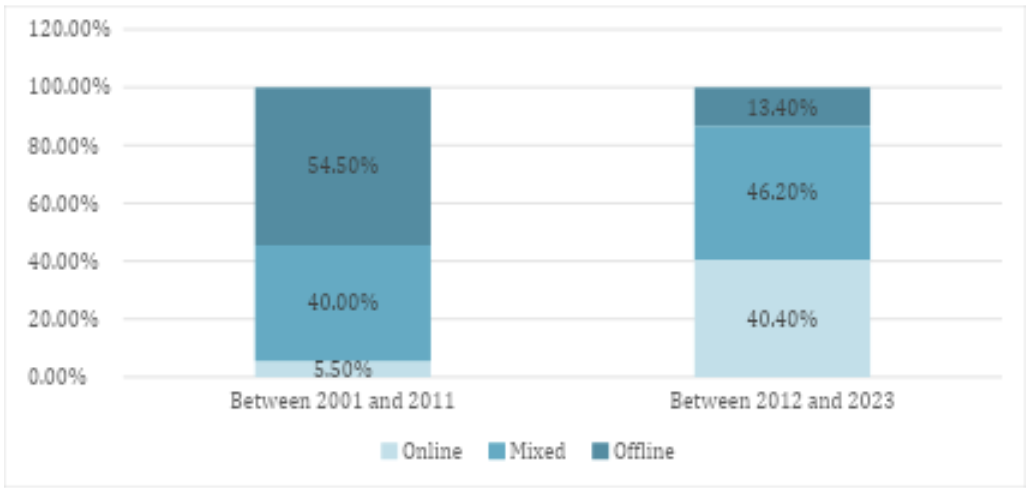
Figure 1: Jihadists convicted or killed in Spain, according to period of detention or death and area of radicalisation. Own elaboration based on Vicente (2024)
In addition, in the weeks leading up to an international Action Day, experts from the European Union Internet Referral Unit (EU IRU) monitored gaming and streaming platforms widely used by both minors and adults, where they detected 5408 links to jihadist content. The material identified ranged from the recreation of attacks and executions in video games to the misuse of streaming platforms and communities for recruitment, propaganda, and the dissemination of real-world violence.
While the data provide figures, a qualitative understanding of these ecosystems can be gained through more in-depth research. Young users are ideologically groomed before moving to more extremist platforms such as Discord or Telegram. Adding the TikTok factor to this research reveals an observed cycle of activity involving at least three platforms: TikTok, Discord, and Roblox. First, recruiters spread game-related propaganda through Discord links in TikTok comments. Once potential recruits express interest, recruiters introduce them to games that simulate terrorist activities. They share material from the games on TikTok, transforming Roblox and its related content into a Trojan horse to introduce and normalise violent ideologies in the minds of minors.
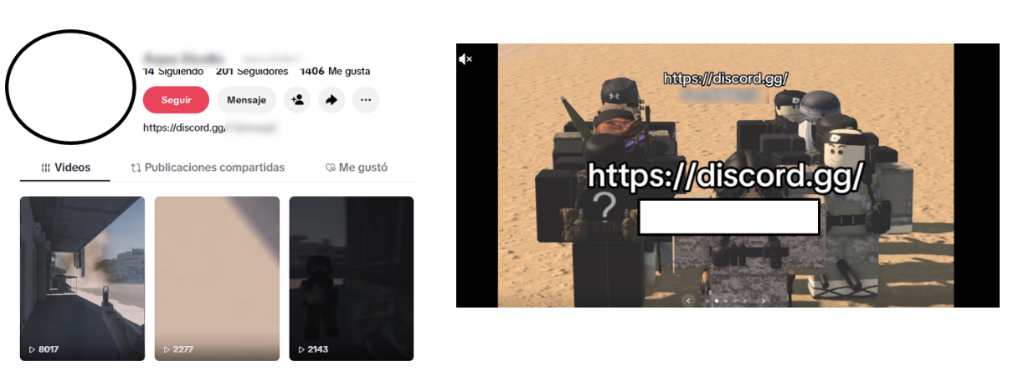
Figure 2. Link to the Discord community in an exemplar extremist-aligned TikTok profile bio and in a TikTok post itself from the same user.
Visual Elements Related to Jihadist Groups
In the various Discord communities accessed, the predominant visual element alluding to jihadist terrorism is variations of the Da’esh flag, which is also present in some cases in its original form. Shared files containing game recordings show this element in Roblox games, where players choose their character’s identity and appearance. This can include the profile of a Da’esh fighter, or a prisoner of the same terrorist organisation, as identified by the use of an orange jumpsuit, both of which appear in the most visible and well-known propaganda outputs from the group itself.
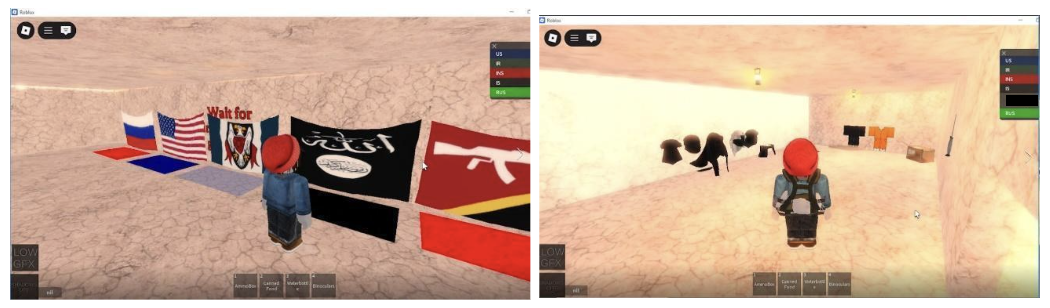
Figure 3: Scenes at the beginning of a Roblox game where the player is given a choice of their identity and clothing.
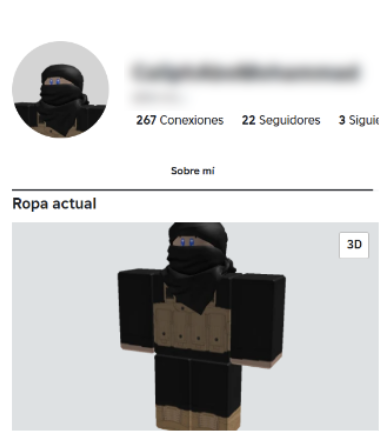
Figure 4: Example of clothing available for players from one of the Discord groups observed to play on and promote jihadist Roblox games.
Moreover, visual elements integrated into the game scenery, such as a Da’esh flag, imitate real-world contexts where extremists deliberately frame footage and images to promote their group. Specifically, in one of the videos detected, wilayas created a top 10 ranking of video games, which includes the flags of the wilayas of India, the Caribbean, Khorasan, America, Iraq and Mauritania. Each shows war scenes recreated in Roblox, with elements intentionally blurred in video editing to evade monitoring hashes. These wilayas are the provinces that Da’esh regards as part of the Caliphate. However, there are many – such as those in the Caribbean or America – that are imitations of others and may not represent officially sanctioned wilayas as assigned by the group.
A TikTok account promoting these kinds of Roblox features via a Discord link indicates that the ecosystem developed across platforms to establish gamified pro-jihadist communities.
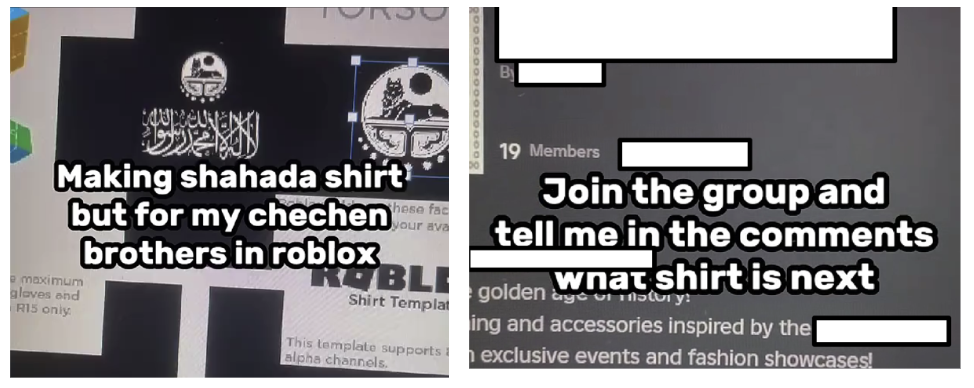
Figure 5: An example of a post from the TikTok account in question promoting shahada T-shirts for the Roblox skin.
Visuals are effectively affiliated with the terrorist organisation, not only because of their use of official anasheed, but also because of comments such as those from a user who describes it as a faction of Da’esh “in the Modern gamemode [sic]”. Further examples of this include modifications of the first-person shooter video game Arma 3, in which this flag is visible both on game maps and on clothing.
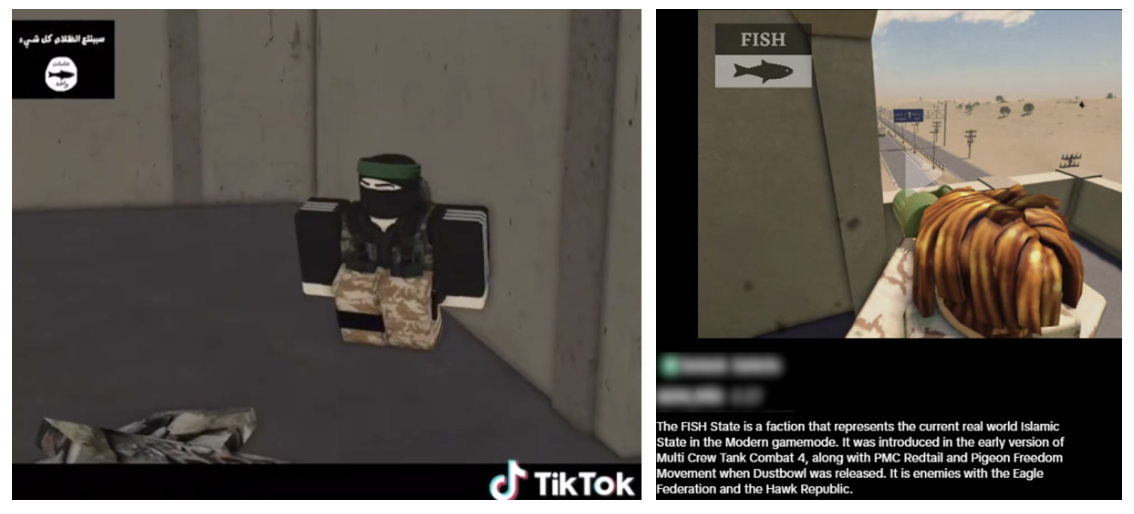
Figure 6: An example of a flag modelled on that of Da’esh, and a user’s justification claiming it is a faction – both being Roblox clips posted to TikTok.
Likewise, the concept of wilayas has been transferred to the design of games specialising in combat maps. This is the case with a Roblox game where one faction available to the player is Jama’a Nusrat ul-Islam wa al-Muslimin (JNIM), a branch of Al Qaeda in the Sahel. Upon entering the game, players must choose a faction; if they join the JNIM, their in-game opponents are made up of the United Nations Multidimensional Integrated Stabilization Mission in Mali (MINUSMA), civilians, or the Tuareg people.
Audio Elements Related to Jihadist Groups and Use of TikTok
In addition to visual and gameplay content, sound elements – sometimes independent of any visual content – identify particular instances of content with a terrorist organisation. Examples of this may include speeches by terrorist leaders or official Da’esh anasheed.
One example of the former shows a community leader in a room alongside seated ‘fighters,’ explaining the game’s purpose. This video is accompanied by audio of a speech by Abu Muhammad al Adnani, the now-deceased spokesman for Da’esh, which is superimposed on the picture with his voice distorted. It is worth mentioning that, in one of these earliest speeches, Adnani called for the internationalisation of jihad in a speech at Al Furqan (2014), in which he encouraged the killing of citizens of countries forming part of the US-led coalition
The audio content, subtitled in both English and Arabic in the published video, tells viewers:
“If you don’t like it, so they butted the mountain or destroy it or plow the sea. Whenever you want, drink it. And if you don’t like it. Your naughty people: So they want a tunnel in the ground. Or a ladder in the sky. And if you don’t like it. Die in your range. Die in your range. We will do what we want. We don’t have after the Qu’ran and Sunnah red lines [sic]”
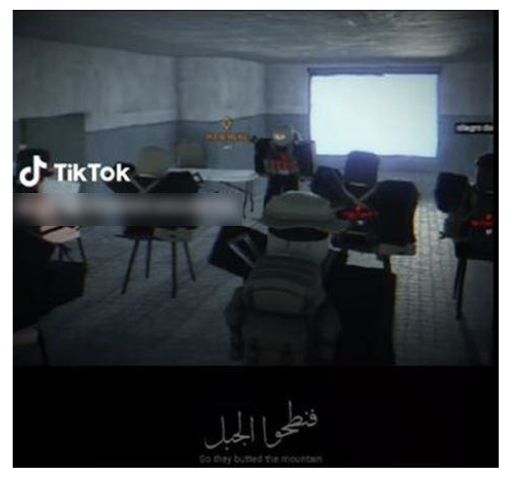
Figure 7: Screenshot of the TikTok showing the ‘leader’ appearing in Roblox, giving a lesson to players imitating fighters.
This same community also post videos on TikTok. In this case, they are accompanied by an anasheed. Among them is one of Da’esh’s best-known, which was an official production of the group and has a markedly enthusiastic tone. The song is accompanied by a still image of Roblox characters in combat, in which the lyrics describe the terrorists as an ‘army of lions who fear neither the world nor the ordinary’.
In 2024, TikTok was also the subject of a study which found that the problem lies not only in detecting and removing extremist videos, but also in preventing their reusable elements – particularly the audio – from continuing to circulate after the original content. The ‘original sounds’ feature on the platform, therefore, continues to represent a vulnerability that allows hate speech and calls for violence to remain on the platform and reach new audiences, as evidenced by its use in these cases of jihadist content.
As CITCO’s latest transparency report (pages 11 and 14) shows, TikTok is experiencing a recent resurgence of extremist content that incorporates identifiable sound elements. As an example of how this connects in practice to real-world extremist events, a Discord community may post videos of its games on TikTok that feature both identifying visual elements, such as the Da’esh banner, and recordings composed exclusively of the organisation´s official anasheed. These anasheed (created at an undetermined date) come from the wilaya of Raqqa, by the production company Ajnad (2014), and another anasheed from the wilaya of Furat (2017), which is also used in Roblox content. These official chants are sometimes accompanied by visualisations of the Da’esh banner incorporated into the clothing of the soldiers depicted in the Roblox games. In addition, the videos feature the wilaya logo in the top right corner as a means of ‘branding’ the content.
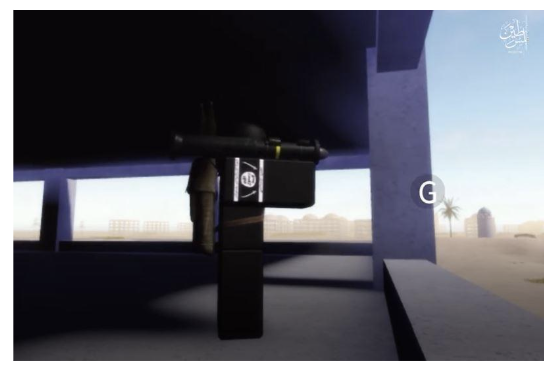
Figure 8: Screenshot of Roblox game recordings with identifying and audio elements
Conclusions
The analysis in this Insight extends understanding of how online gaming environments such as Roblox are increasingly integrated into broader digital radicalisation ecosystems targeting young audiences through in-game ideological markers and symbols. Extremist references appear through avatars, skins and game assets featuring terrorist symbols, combatant-style clothing and military imagery, contributing to the normalisation and gamification of extremist imagery among minors.
Such Roblox content is repurposed on TikTok, where gameplay recordings are combined with speeches, logos and anasheed associated with Da’esh. This cross-platform dynamic increases the reach of extremist material and makes detection more difficult because content often relies on imitation and adaptation rather than direct redistribution of official propaganda. This forms a reality where terrorist organisations and sympathetic users can spread and create jihadist propaganda on other platforms as part of a circular multi-platform ecosystem.
This trend highlights the need for a coordinated response across platforms, policymakers, educators, and civil society. Spain already provides examples of preventive digital-literacy initiatives, such as INCIBE’s Internet Segura for Kids and the digital-safety training developed by INTEF, INCIBE and the AEPD, which promote critical and responsible engagement with online content. However, these initiatives should complement, not replace, platform-level interventions. Platforms should strengthen safeguards against the recommendation and cross-platform circulation of extremist content, improve reporting and referral mechanisms, and provide greater transparency on how their systems amplify potentially radicalising material.
Finally, as extremist actors increasingly rely on imitation, gamification and user-generated content rather than the direct dissemination of official propaganda, moderation systems will need to evolve accordingly. Detecting these indirect forms of extremist expression across platforms such as Roblox and TikTok is essential to reducing opportunities for online radicalisation and protecting vulnerable young audiences, particularly minors who may be exposed to this content through seemingly recreational online activities. A potential path forward requires an integrated understanding of terrorists’ extremist content as it appears on gaming platforms. More specifically, Roblox should expand automated detection systems capable of identifying terrorist symbols, uniforms and role-play scenarios that explicitly glorify designated terrorist organisations as a priority. This should include stronger review of user-generated assets, tighter control on extremist avatar items, specialised moderation teams and improved information-sharing with researchers and relevant authorities.
For social media platforms such as TikTok, measures should build on existing cross-platform initiatives. GIFCT’s Hash-Sharing Database, for example, enables member platforms to share digital fingerprints of known extremist content, while its Incident Response Framework facilitates coordinated responses to emerging extremist activity across platforms. Building on these mechanisms, TikTok could strengthen the detection and rapid review of extremist propaganda, including content embedded in gaming-related material, and improve information-sharing with other platforms.
–
Paula M. Núñez-Guerra has been a PhD candidate at Complutense University of Madrid in the Doctoral Programme in Political Science and Administration and International Relations since 2022. Her research interests include jihadist terrorism, which has been the focus of several national and international conferences in which she has participated and articles and chapters she has written.
—
Are you a tech company interested in strengthening your capacity to counter terrorist and violent extremist activity online? Apply for GIFCT membership to join over 30 other tech platforms working together to prevent terrorists and violent extremists from exploiting online platforms by leveraging technology, expertise, and cross-sector partnerships.
The views and opinions expressed in this Insight are the authors’ own and do not necessarily reflect those of GNET or any of its partners.