

On the morning of 22 June 2026, police responded to a report of a gun barrel visible in a hotel window in the Côte-des-Neiges neighbourhood of Montreal, Canada. Ensuing gunfire between police and the perpetrator left one civilian, one police officer, and the attacker dead. The shooter, Seth Scott Hatfield, left behind a 104-page manifesto that was published in full by Rebel News, a far-right online publication based in Canada. In it, he outlines beliefs consistent with the incel (involuntary celibate) subculture of the Manosphere.
This Insight will examine the manifesto of the 2026 Côte-des-Neiges shooter, finding that it repackages online incel-related extreme misogyny to present it in a more sanitised form. The document reveals the attacker’s extreme misogynistic motivations, but it presents the incel worldview in a unique way, framing it as an academic critique of Western capitalism and liberalism. In the process, the attacker touches on strategies for future misogynistic attacks and outlines desirable technological and political outcomes.
Situating the Attacker’s Beliefs
The Côte-des-Neiges attacker’s beliefs are situated within the Manosphere, a diffuse online ecosystem of extreme misogyny that comprises a variety of subcultures, including incels, Men’s Rights Activists (MRAs), and Men Going Their Own Way (MGTOW). Although these communities differ in their beliefs, there is overlap and migration between their userbases, and they are connected by their opposition to feminism and perceived victimisation at the hands of women. Members of the Manosphere, especially incels, have committed previous acts of extremist violence, including one incel attack for which the perpetrator was convicted of terrorism-related charges.
The Côte-des-Neiges shooter outlines a worldview that is most consistent with that of the incel subculture. Incels believe that there is a hierarchy in the sexual marketplace and that women are hypergamous, meaning that they are biologically driven to seek male partners with higher social, physical, and financial status. They argue that the majority of women are intimate with a minority of men, leaving less attractive men without sexual and romantic partners. Because incels believe that physical characteristics such as height and facial structure determine one’s chances of sexual success, they feel that they are biologically disadvantaged, unable to change their situation, and, therefore, doomed to a life of celibacy. These beliefs are articulated in the Côte-des-Neiges manifesto, in which the attacker provides “evidence” from evolutionary psychology that women are hypergamous and argues that the resulting “sadistic deprivation” of intimacy is traumatic for young men.
Unlike MRAs, who try to conceal their misogyny by claiming to be advocates for legitimate men’s issues, the incel subculture has not tried to mainstream its views. Instead, incels have formed an insular counterculture marked by explicit misogyny, exclusive terminology, and a satirical, ‘edgy’ meme culture (outlined in books such as Men Who Hate Women and The Incel Rebellion). The Côte-des-Neiges shooter, however, diverges from this tradition and uses his manifesto to sanitise and intellectualise the incels’ extreme misogyny.
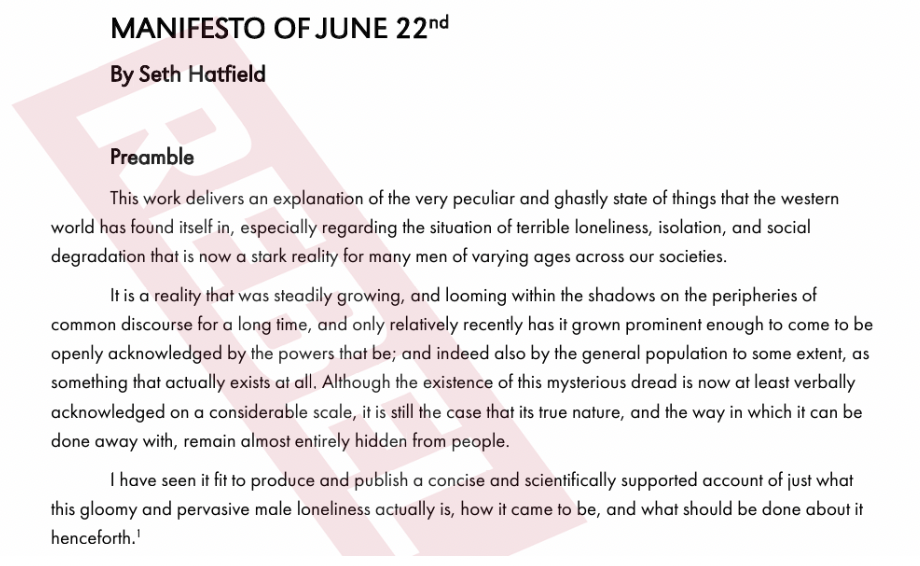
Figure 1: Opening paragraphs of the attacker’s manifesto, which outline the purpose of the document. (Source: Rebel News)
Sanitisation of Incel Language
Notably, the attacker’s language differs from that of most incels. He avoids incel terminology, only retaining words that appear scientific, such as “hypergamy” and the “biological imperative.” He also creates new nomenclature; the attacker replaces the incel-term “Chad,” which refers to attractive, sexually successful men, with “favoured males.” He even refers to celibate and sexually unsuccessful men as “the dispossessed,” completely avoiding the term “incel.” In fact, the phrase “involuntary celibacy” only appears twice in the entire manifesto.
In addition to substituting incel and Manosphere terms, the perpetrator avoids expletives and overt references to internet subcultures. He uses academic language, including footnotes, and removes swear words from quotes included in the manifesto. The attacker’s tone differs drastically from that of the 2014 Isla Vista shooter, 2018 Toronto van attacker, and 2026 San Diego shooters, who dehumanised women using language such as “whore” and “foids” (female humanoids) and/or explicitly engaged with meme culture when discussing their inceldom. Aside from one reference to a woman as a “humanoid” and “whore,” the Côte-des-Neiges shooter subdues his explicit misogyny, not using meme references or the edgy tone that is common in incelosphere spaces, like those on 4chan. His avoidance of incel terminology in favour of academic language allows him to present incel-related extreme misogyny with a veneer of respectability that is atypical for the subculture.
An Intellectual Framing of Misogyny
The perpetrator’s analysis of the causes of involuntary celibacy in the West borrows from existing ideologies to appear intellectually valid. He blames Western capitalism and liberalism, upheld by the ruling classes, for what he views as an unequal distribution of intimacy. The manifesto argues that feminism is promoted by these elites to increase labour participation and maximise their profits. According to the attacker, this economic shift undermined monogamy and created a “hypergamy state” by reducing women’s financial dependency on men. To this end, he draws on existing anti-capitalist critiques by Karl Marx and Friedrich Engels to give his misogyny a semblance of intellectualism.
The perpetrator also provides pseudoscientific evidence to support his anti-capitalist theory. Unlike previous incel attackers who included personal anecdotes as evidence of women’s malicious nature, the Côte-des-Neiges attacker separates his writing from his own inceldom and supports his arguments with academic studies from sociology and psychology, alongside anecdotal evidence from Reddit. It is not new for extreme misogynists to (mis)use academic studies and theories to support their beliefs, but incels do not typically connect their ideas to form a clear ideology. By borrowing Marxist language and class critiques, the perpetrator links the incel worldview to an established ideology, giving his manifesto an intellectual veneer. As a result, the attack has been incorrectly characterised by some media outlets as a far-left terrorist incident rather than a misogynistic one, largely due to the perpetrator’s use of language associated with left-wing movements.
Shifting Targets and Tactics
The manifesto outlines targets that differ from those of previous incels. Most incel attackers use violence to seek revenge against women and so-called sexually successful men. However, the Côte-des-Neiges perpetrator downplays the centrality of misogyny in his worldview, replacing it with a pseudo-intellectual critique of how capitalism feeds into the worst parts of biologically driven female behaviour. He therefore shifts his focus away from women as direct targets and, instead, argues for violence against what he believes to be degeneracy, the bourgeoisie, and the capitalist system he believes undermines monogamy.
Police are investigating whether the shooter was targeting Alyo, a company that owns adult entertainment brands like Pornhub. This would be consistent with his manifesto, in which he identifies a wide variety of possible targets. These potential targets included those deemed responsible for the “hypergamy state,” such as large banks, corporations, private equity funds, and the pornography industry, as well as Manosphere influencers like Andrew Tate who profit off “dispossessed” men. In the manifesto, the perpetrator purposely sets himself apart from mass incel attackers like the 2014 Isla Vista attacker, stating that universities and locations with innocent people are not legitimate targets. In doing so, he falsely presents his and future attackers’ actions as targeted, reasonable resistance against a corrupt state rather than as extreme misogynistic violence aimed at subjugating women and establishing enforced monogamy.
Beyond physical targets, the manifesto details ways to utilise technology to establish and maintain women’s sexual loyalty. The attacker calls to replace women in the workforce with robots to make them financially dependent on men and to create technology-enhanced morality police to punish those who engage in perceived degeneracy. He also argues for limiting internet access, eradicating most social media platforms, and abolishing cars to prevent free movement.
In addition, the Côte-des-Neiges shooter’s manifesto is unique in that it proposes concrete tactics for incel violence. The attacker borrows language from insurgents, such as the concept of the critical mass and the vanguard, and quotes revolutionaries like Maximilien Robespierre. His advice highlights how technology can augment attack execution, such as by luring victims using fake social media accounts in a similar style to paedophile hunters, creating 3D printed guns to bypass gun controls, and equipping First-Person-View (FPV) drones with explosive payloads. He acknowledges some of the limitations of his suggestions, including the challenge posed by identity verification requirements on social media platforms, and suggests ways to bypass these measures. By providing operational guidelines that resemble an insurgent manual and borrowing from trends seen in other extremist movements, the perpetrator attempts to professionalise incel violence and unite future attackers under the banner of a revolutionary vanguard.
Same Online Misogyny, New Veneer
The attacker presents the incel worldview in a sanitised and intellectualised form, but ultimately, his belief system is a repackaging of existing incel-related extreme misogyny. He claims that women are “lecherous concubines” who exploit unattractive men for money while allowing “favoured males” to “sodomise” them. He also describes his ideal future in which a totalitarian government upholds monogamy by forcing women out of the workforce and restricting speech, travel, and women’s political rights. Although he draws on Marxist ideas about the exploitation of workers and moral decay under capitalism, the attacker uses these critiques to explain how women have been able to allegedly engage in hypergamy through their participation in the labour market.
The Côte-des-Neiges perpetrator participated in similar online spaces as previous incel attackers; he quotes from Reddit, discusses men’s forums, and addresses Manosphere subcultures with whom he disagrees. His connection to online extremist culture is further supported by a digital trail uncovered by the Canadian Broadcasting Corporation. His YouTube account, which has been deleted, subscribed to an alt-right conspiracy theorist and featured a “Favourites” playlist containing videos by Infowars host Paul Joseph Watson and a Q&A on fascism created by an account displaying neo-Nazi imagery.
The attacker intellectualises his beliefs, drawing on Marxist ideas, avoiding internet references and incel-language, and arguing that social media encourages degeneracy and female hypergamy. However, his ideas align with the incel worldview, and he was clearly engaged with a variety of online extremist subcultures, including far-right communities, alt-right conspiracy theories, and forums for the “dispossessed” (incels).
Implications for Trust & Safety
The Côte-des-Neiges manifesto does not represent the entirety of the incel subculture, nor its violent circles, but it does represent a new, unique expression of the incel worldview. Incel-inspired attackers typically display high levels of negative emotions and justify their violence through their negative experiences in society. This manifesto, on the other hand, uses a formal academic tone and Marxist ideology to manufacture a veneer of intellectualism and ideological validity. Although it remains to be seen whether his beliefs and tactical recommendations will be adopted by the violent incel community, the manifesto offers an example of how a formerly self-isolated subculture can sanitise its extreme misogyny for an external audience.
Any further attempts to intellectualise incel-related extreme misogyny and portray it as a valid ideology will make it harder for social media platforms to identify and moderate misogynistic content. Content moderation uses a variety of detection tools to identify violent and hateful speech, including machine learning classifiers and large language models (LLMs). Because the manifesto explicitly advocates for violence, it violates most major platforms’ terms of service. However, the Côte-des-Neiges attacker substitutes Manosphere language with pseudoscientific terms and situates his beliefs in established Marxist political theory. Therefore, posts that mimic the manifesto’s terminology may be able to bypass traditional moderation tools and conceal their violent implications by presenting extreme misogyny as an anti-capitalist critique or scientific debate.
Other Manosphere communities, such as those on Reddit, remain active because their posts portray misogynistic rhetoric as legitimate discussions about domestic violence, gender differences, and men’s issues. Incel forums, on the other hand, have been continuously banned for violating platforms’ terms of service. If the manifesto’s intellectualised version of the incel worldview is adopted by members of the wider incel subculture, this may enable their misogyny and bypass trust and safety guidelines. The sanitisation and intellectualisation of incel ideas not only represent a repackaging of a formerly isolated online subculture in mainstream terms, but it also demonstrates possible vulnerabilities in trust and safety frameworks.
–
Claire Birch is an MA candidate in Terrorism, Security & Society at King’s College London. She holds an Honours Bachelor of Arts in International Relations and Psychology from the University of Toronto. Her research interests focus on the ideological landscape of the Manosphere, the weaponisation of online extreme misogyny, and the construction of meaning in far-right propaganda. Claire currently works at the Repository of Extremist Aligned Documents (READ) housed at the Centre for Statecraft and National Security at King’s College London.
–
Are you a tech company interested in strengthening your capacity to counter terrorist and violent extremist activity online? Apply for GIFCT membership to join over 30 other tech platforms working together to prevent terrorists and violent extremists from exploiting online platforms by leveraging technology, expertise, and cross-sector partnerships.
The views and opinions expressed in this Insight are the authors’ own and do not necessarily reflect those of GNET or any of its partners.