

On Indonesian TikTok, figures associated with past Jemaah Islamiyah (JI) terrorist attacks are quietly reentering public view, not through active news coverage or historical documentaries, but through short, stylised video edits designed for entertainment. Indonesia offers a particularly revealing case study for observing this trend, given its TikTok user base of roughly 100 million adult users as of early 2025 and a demographic profile heavily weighted towards younger audiences. For many of these users, the 2002 Bali bombings and subsequent JI attacks are not lived memories but distant historical episodes, encountered primarily through social media.
The format used for these videos is known locally as “Jedag Jedug”, a popular editing style characterised by rapid transitions, flashing visual effects, and high exposure imagery, typically produced through mobile application editing tools such as CapCut templates. The term itself is onomatopoeic, mimicking the percussive beat drops that synchronise with each visual cut. The widespread adoption of this format across Indonesian TikTok makes it a particularly effective vehicle for repackaging sensitive historical content within an entertainment framework.
It is important to recognise that “Jedag Jedug” is, at its core, a mainstream creative practice. Millions of Indonesian users employ the format to produce fan edits of celebrities, sports highlights, comedic skits, and personal content. The editing style is not inherently extremist, nor does its use signal ideological intent. What makes the cases examined in this Insight significant is not the format itself, but the way it is co-opted: when “Jedag Jedug” is applied to convicted terrorists, it operates as a “memefication” mechanism that strips historical context from its subjects and reconstitutes them within the visual grammar of internet meme culture, where aesthetic appeal and shareability override factual accuracy or moral weight. It is precisely because the format is so deeply embedded in mainstream youth culture that its appropriation to glorify JI figures is analytically significant and difficult for moderation systems to detect.
This Insight will analyse how two TikTok accounts transform JI figures into emotionally engaging digital content through the “Jedag Jedug” format, examine how audiences interact with these videos, and assess the moderation challenges posed by this memefication trend. It concludes with practical recommendations for technology platforms seeking to address the grey zone between historical representation and implicit glorification of extremism.
Two Accounts, Two Formats
Two accounts observed during the research period, between December 2025 and February 2026, were identified by searching TikTok using the names of prominent JI figures as keywords. Accounts were selected for analysis based on their consistent production of edited content featuring these individuals and their relatively high engagement metrics. These two accounts illustrate how edited footage of JI figures circulates through broad entertainment formats, such as the TikTok For You Page, rather than explicit ideological channels. Account A, which had accumulated approximately 4,940 followers and more than 581,300 likes at the time of observation, regularly shares short-form edits featuring former JI figures set to cinematic transitions and emotionally evocative sound templates. Account B, with approximately 6,801 followers and around 419,800 likes, operates in a similar format, though its content tends to open with humorous or meme-style framing before transitioning into edited archival footage.
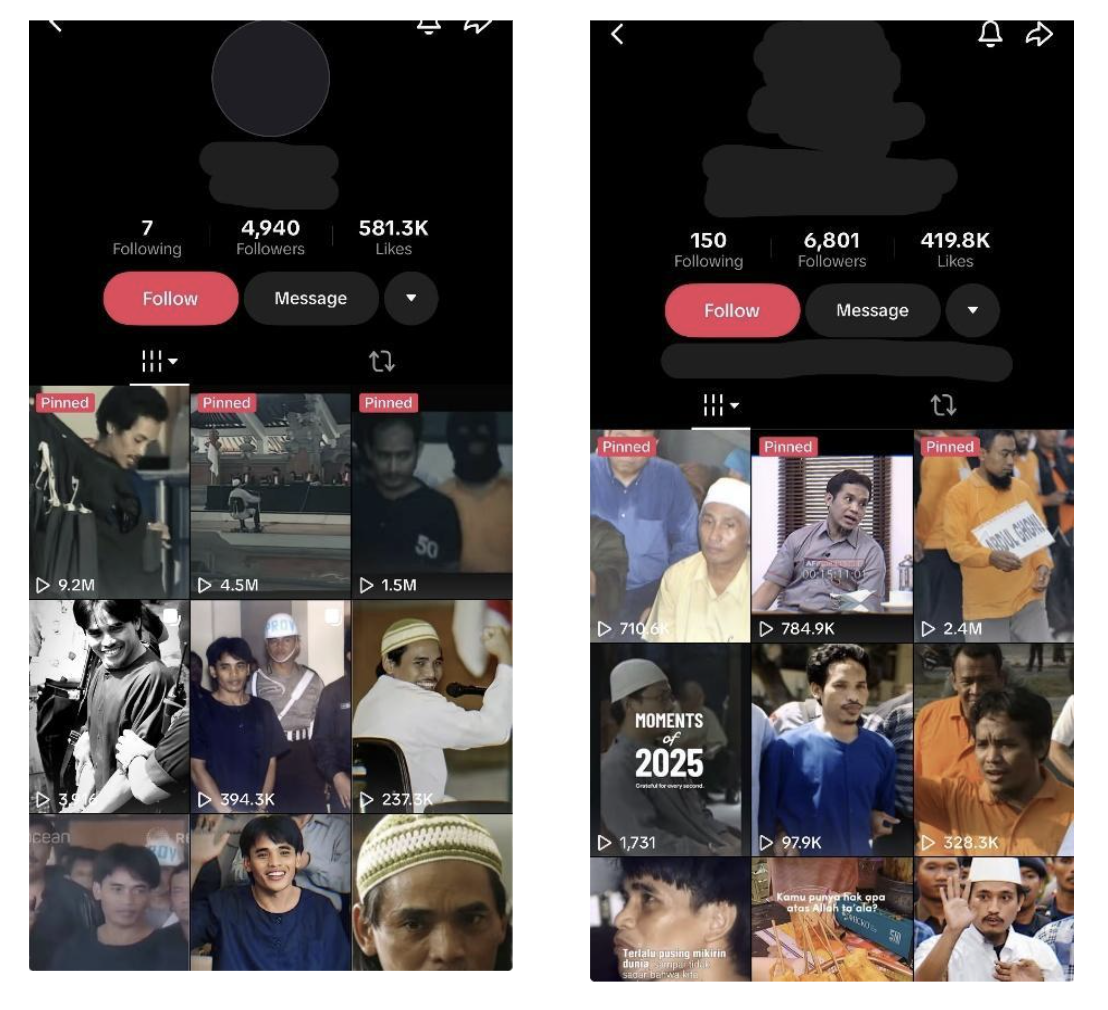
Figure 1. Left: Profile of Account A showing edits featuring former JI figures. Right: Profile of Account B showing edits featuring former JI figures.
Nostalgic Framing and Meme Templates
The editing techniques employed by both accounts follow recognisable patterns within Indonesian TikTok culture. One video shared by Account A, for example, features archival footage of Amrozi (one of the three perpetrators of the 2002 Bali bombings, executed in 2008) edited using a Jedag Jedug meme template widely circulated among TikTok users. The overlay text reads, in Indonesian, “were you even this handsome when you were young?”, a format commonly used in nostalgic comparison content. The caption adds: “imitate the mullet hairstyle, not the actions.” While the statement ostensibly distances the visual from the violent act, the edit nonetheless reintroduces a convicted terrorist within an entertainment scrolling environment where context collapses into aesthetics. The memefication at work here is not incidental; when the “Jedag Jedug” format is applied to such subjects, it actively reframes them as figures worthy of visual spectacle, regardless of the disclaimer attached.
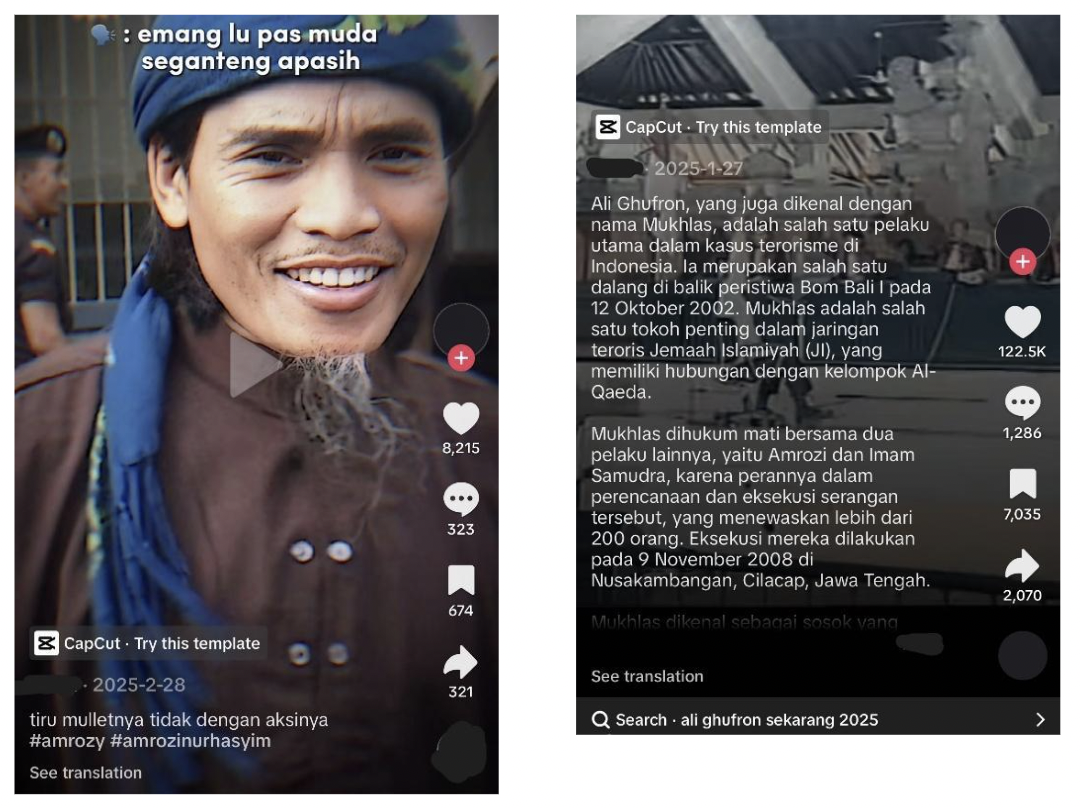
Figure 2. Left: Meme-style edit of Amrozi using nostalgic humour framing. Right: Biographical narration of Ali Ghufron embedded within a TikTok edit.
A separate post by Account A overlays biographical information about Ali Ghufron, also known as Mukhlas, describing his role in the 2002 Bali bombing and his execution alongside Amrozi and Imam Samudra. The video does not frame this information critically. It presents it within the same cinematic template used for entertainment content, effectively blending historical narration with visual formats designed to generate emotional engagement.
Meme Hooks and Militant Montages
Account B operates through a slightly different mechanism. For example, one video opens with scenic background footage and the overlay text: “A repentant person says little, yet suddenly ends up with three idols.” The phrase functions as a meme-style hook before the video transitions into edited portraits of three individuals associated with the Bali bombing cases: Imam Samudra, Ali Ghufron, and Amrozi, presented sequentially through slow zoom effects and visual filters standard in the “Jedag Jedug” format. The structure mirrors fan edit montages commonly produced for celebrities or fictional characters, reinforcing the memefication dynamic in which convicted terrorists occupy the same visual register as pop culture icons.
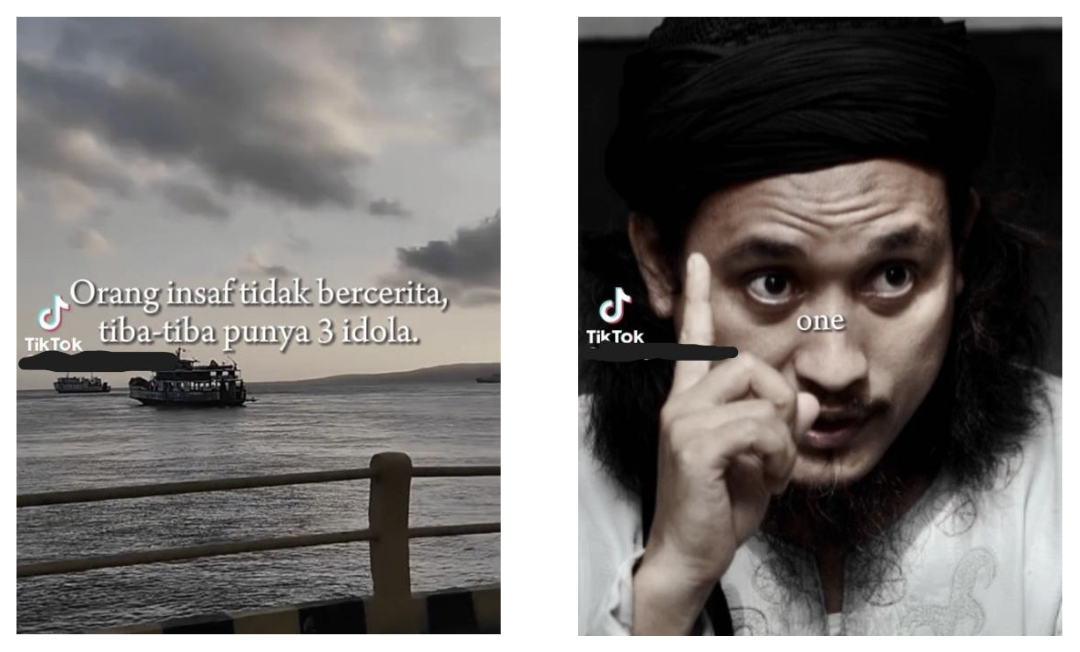
Figure 3. Left: Opening frame of TikTok edit by Account B featuring meme-style text. Right: Edited archival images shown sequentially within the transition sequence.
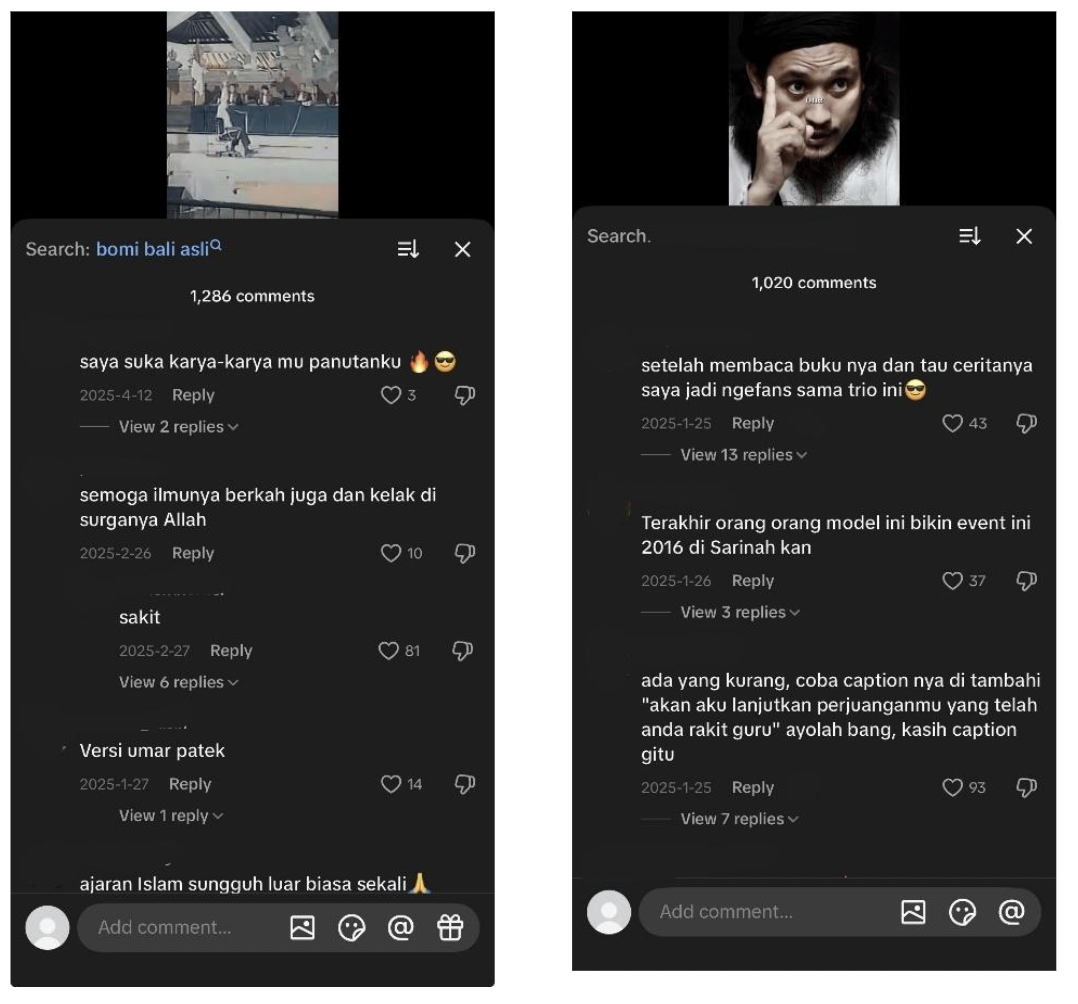
Figure 4. Left: Comment section reactions to nostalgic edits shared by Account A. Right: Audience responses mixing admiration, humour, and religious references under Account B.
Humour, Admiration, and Religious Expression
Comment sections across both accounts reveal a spectrum of audience responses, many of which express sympathy or admiration for the featured individuals, complicating straightforward categorisation. Rather than producing either uniform endorsement or clear rejection, these spaces host overlapping registers of humour, admiration, religious expression, curiosity, and casual engagement.
Under Account A’s posts, one commenter writes: “I like your works, you are my inspiration,” while another offers a prayer: “may his knowledge be blessed and may he be in God’s heaven.” Others post short reactions or reference related figures, suggesting familiarity with the broader network of individuals involved in the Bali bombing cases.
Under Account B’s content, one commenter writes: “After reading the book and knowing their story, I became a fan of this trio.” Another references the 2016 Sarinah attack in Jakarta, connecting archival JI figures to more recent incidents in a casual tone. A third user suggests adding a caption reading “I will continue the struggle you have built, teacher,” indicating active participation in the narrative framing. The cumulative effect of these overlapping responses confirms that when “Jedag Jedug” is co-opted for extremist content, it does not merely generate passive viewership; it actively cultivates emotional identification with individuals convicted of mass murder.
These interactions demonstrate that comment sections serve as spaces where appreciation of editing, emotional identification, religious sentiment, and ironic detachment coexist. The absence of a single dominant interpretive frame is precisely what makes this content difficult to moderate. Individual comments may not cross a clear violative threshold, yet the cumulative effect normalises the glorification of figures historically responsible for mass violence.
Moderation Blind Spots in Platform Governance
Neither account observed during the research period reveals identifiable personal information about the creators. Motivations remain opaque, and it is plausible that some creators simply participate in popular editing trends without perceiving their content as promoting extremist narratives. This ambiguity, however, does not reduce the urgency of the governance challenge it poses. Repeated exposure to aestheticised portrayals of convicted terrorists gradually familiarises audiences with individuals linked to mass violence, regardless of the creator’s intent.
A further dimension of this challenge concerns algorithmic amplification. TikTok’s recommendation engine prioritises content that generates high engagement, measured through metrics such as watch time, shares, and comment volume. The cases examined above demonstrate that “Jedag Jedug” edits featuring JI figures consistently attract substantial interaction, precisely because they provoke a mixture of curiosity, humour, admiration, and controversy. The platform’s algorithm does not distinguish between engagement driven by entertainment value and engagement driven by the glorification of designated terrorists. Consequently, content that aestheticises extremist figures is not merely tolerated by the platform architecture; it is actively surfaced to broader audiences through the same recommendation logic that promotes any other high-engagement material. This means that the governance challenge extends beyond content detection to encompass the structural incentives embedded within platform design itself.
From a policy perspective, TikTok states that it prohibits violent individuals on the platform and content that glorifies violence, as per its community guidelines. Furthermore, according to the platform’s most recent Community Guidelines Enforcement Report, TikTok removed 11,351,024 videos from users based in Indonesia between October and December 2025, with a proactive removal rate of 99.9%. The report states that the region’s 24-hour removal rate was 98.4%.
From a scenario planning perspective, the core difficulty lies in the regulatory grey zone between historical representation and implicit glorification. In Indonesia, responsibility for addressing such content sits between platforms such as TikTok and government authorities, including the Ministry of Communication and Digital Affairs (Komdigi). Current moderation systems remain largely calibrated to detect explicit propaganda, direct incitement, or organisational recruitment material. Aesthetically framed content that repackages extremist memory through entertainment formats rarely triggers these thresholds. The challenge is compounded by the fact that “Jedag Jedug” is a legitimate, widely used creative practice; any moderation response that targets the format itself rather than its specific application to designated terrorist figures risks overcorrection and the suppression of legitimate cultural expression.
Conclusion
Nostalgic edits circulating on Indonesian TikTok reveal how extremist memory persists long after the organisations responsible for past violence have weakened. Through the “Jedag Jedug” editing style, individuals associated with JI attacks reappear as stylised figures embedded within youth digital culture. The format itself is not the problem; “Jedag Jedug” remains a legitimate and widely practised form of creative expression among Indonesian youth. The analytical concern arises when this mainstream cultural practice is co-opted to repackage convicted terrorists as objects of aesthetic admiration, stripping them of their violent historical context and embedding them within entertainment-driven scrolling environments. In these formats, extremist narratives travel less through ideological persuasion than through repeated exposure within everyday entertainment.
What remains underexamined in current efforts to counter online extremist content is precisely this category of aesthetically mediated glorification. Platform moderation systems calibrated for explicit propaganda or direct incitement struggle to identify content that implicitly glorifies terrorism through entertainment aesthetics. Closing this gap in online content governance requires closer cooperation between platforms, researchers, and regulators, alongside investment in contextual moderation tools, regional expertise, and digital literacy programmes that equip younger audiences to interpret nostalgic portrayals of political violence with greater critical awareness.
For platform moderators, a practical starting point would involve monitoring Indonesian language searches that combine the names of designated JI figures with editing-related terms such as “Jedag Jedug,” “edit,” or “tribute.” Moderators could also flag content that pairs archival images of convicted terrorists with popular sound templates or meme formats, particularly when such content generates high engagement in comment sections. These contextual signals, combined with regional expertise in Bahasa Indonesia, would strengthen the detection of glorification content that currently evades keyword-based moderation systems.
–
Nauval El Ghifari is a Master of Science student in Strategic Studies and a Graduate Student Research Assistant at the S. Rajaratnam School of International Studies (RSIS), Nanyang Technological University (NTU), Singapore. He is an alumnus of the United Nations Office of Counter Terrorism (UNOCT) Young Leaders Programme for the Online Prevention and Countering of Violent Extremism (PCVE) in Southeast Asia.
–
Are you a tech company interested in strengthening your capacity to counter terrorist and violent extremist activity online? Apply for GIFCT membership to join over 30 other tech platforms working together to prevent terrorists and violent extremists from exploiting online platforms by leveraging technology, expertise, and cross-sector partnerships.
The views and opinions expressed in this Insight are the authors’ own and do not necessarily reflect those of GNET or any of its partners.