

Trust-and-safety teams, school-safety staff, and prevention practitioners are increasingly asked to make sense of online content that appears violent but does not fit the categories designed to detect it. Content that may not recruit for a named group, rarely declares an intention, and seldom presents a worldview coherent enough to be called an ideology. Instead, it arrives as a meme, an edit, a doomer caption, a gore-tinged joke, or a knowing reference to a past attacker. It is unsettling yet ambiguous about whether anything is actually meant. The reviewer faces a two-sided risk: treat performance as imminent danger and you over-escalate; wave it all away as edgy noise, and you may miss the post where style has begun to harden into something nearer to intent.
This Insight analyses nihilistic violence aesthetics (NVA) as a form of ambiguous online violent signalling and explains how platform safety and prevention teams can distinguish transgressive performance from content reflecting warning-behaviour concern. It draws on the Aesthetic-to-Risk Framework of Nihilistic Violence Aesthetics (ART-NVA), developed by the author, and on a protocol for testing it through content analysis of public Reddit posts.
Why the familiar categories fall short
The difficulty with NVA is that it withholds the very signals that familiar review categories are built to find. Frameworks for extremist propaganda expect a cause to be sold, a doctrine, a movement, or a call to join, yet much NVA-related material advances no programme at all. Frameworks for direct threats expect a stated target or intention, but these posts rarely declare either, working instead through mood, allusion, and shared reference. Reading everything as dark humour fails in the opposite direction: much taboo joking is genuinely just joking and labelling it violence-relevant both overreaches and erodes user trust. Even ordinary so-called doomerism, the bleak, defeated register common across younger user cultures, is a poor fit, because despair alone is not the concern; the concern is despair fused with dehumanisation, indifference to harm, or admiration of killers. The live illustration is the set of networks now grouped under subcultures of nihilistic violence, including 764, the broader Com network, and offshoots such as No Lives Matter. Canadian security services have recently named this movement a new threat. An ISD report published by GNET describes these communities as organised around violence for its own sake, “with no specific political, ideological, or religious goal.” They cohere through a shared aesthetic far more than through belief, a hybridised dynamic that can still function as a gateway to violence, which is exactly what ideology-led models struggle to see.
What the aesthetic actually is
NVA can be described as public online communication in which violent meaning is carried by style as much as by statement, packaged through meaning collapse, anti-human indifference, dehumanisation, irony, collapse imagery, gamified framing, stylised violence, or identification with past perpetrators. Four key markers keep the definition operational. First, it is communicative: it concerns observable public posts rather than a person’s inner life or group membership. Second, it is aesthetic: the edit, filter, caption, audio, or meme format does part of the communicative work and cannot be dismissed as decoration. Third, it is nihilistic: moral order and human significance are treated as void, so that harm reads as trivial, amusing, or inevitable. Fourth, it is violence-related: the content normalises, glamorises, trivialises, or symbolically glorifies harm. This describes content, not people, and should not be used to diagnose individuals, infer mental state, establish affiliation, or predict behaviour.
Five dimensions, read as observable features
What moves this from an impression to a method is that each element can be read as an observable feature of a single post, present, absent, or unclear, supported by specific evidence rather than a hunch. That discipline sits at the centre of the Reddit content-analysis protocol and maps directly onto the structured review trust-and-safety teams already perform. Five dimensions organise the reading.
- Meaning collapse looks for framing in which the future or moral order is rendered void, with cues such as ‘nothing matters’, end-times imagery, and finality language, used so that harm appears weightless.
- Anti-human orientation looks for people rendered as disposable units, NPCs, pests, or targets, with contempt often generalised rather than aimed at one out-group.
- Aesthetic packaging looks for violence presented as an edit, spectacle, joke, or identity rather than merely reported.
- Irony and ambiguity look for the humour, absurdity, or disclaimer that lets violent meaning travel while keeping its author deniable, the single feature that most frustrates automated moderation.
- Proximity to warning-behaviour signalling asks whether these aesthetic frames sit close to the indicators threat assessment already tracks: fixation, identification, leakage-like language, last-resort framing, or operational detail. The crucial rule is that this fifth dimension is read as a content feature, never as a verdict about a person; communication can support prioritisation, but it cannot establish intent or capability. What matters analytically is co-occurrence, which features clusters in the same post, not the presence of any one alone.
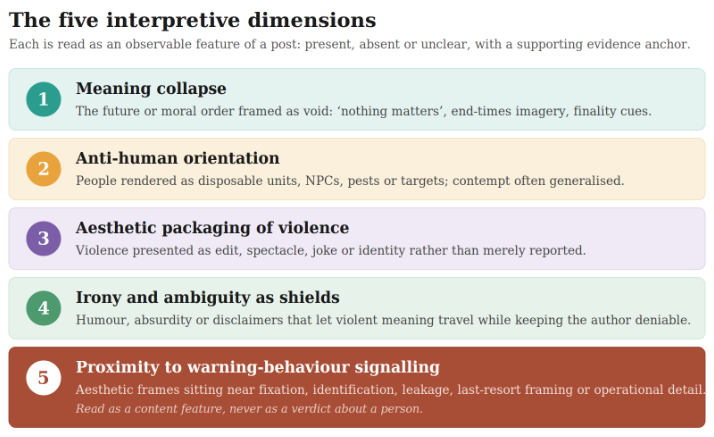
Figure 1. The five interpretive dimensions, each read as an observable, evidence-anchored content feature. Source: author.
A three-part typology for proportional response
In practice, those co-occurrence patterns fall into three broad types that serve proportional response rather than user classification. The examples below are intentionally hypothetical and non-searchable: they illustrate thresholds, not templates.
- Performative nihilistic transgression covers content that is ironic, taboo, or doomer-inflected but shows weak or absent warning-behaviour proximity; it may be offensive, but its function is performance, and over-escalating it wastes scarce review capacity and invites accusations of policing edginess. A generic doomer meme that says nothing matters, uses bleak imagery, and avoids targets, admiration of perpetrators, leakage-like language, or operational details would typically remain Type 1.
- Aestheticised anti-human violence covers content where dehumanisation, indifference to harm, or stylised violence becomes central to the post; this warrants closer contextual review without being treated, in isolation, as a threat. A stylised edit that frames people as disposable “NPCs” or suffering as spectacle, but contains no target, timeline, capability signal, or last-resort language, would sit closer to Type 2.
- Escalatory nihilistic signalling covers the narrower set in which nihilistic aesthetics co-occur with the warning behaviours above, and it is here, and only here, that careful escalation and human assessment are clearly justified. A Type 3 example would be a post that pairs the same aesthetic with fixation on a past attacker, identification language, last-resort framing, leakage-like statements, or concrete target, time, or place cues. One principle runs through all three: Type 1 should never be handled as though it were Type 3, and Type 3 should never be dismissed as though it were Type 1. Most practical failures in this space are one of those two mistakes, and an explicit spectrum makes both harder to commit by accident.
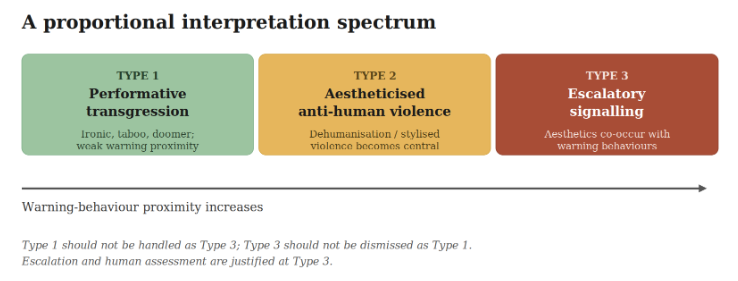
Figure 2. A proportional interpretation spectrum: performative transgression → aestheticised anti-human violence → escalatory signalling, with warning-behaviour proximity rising left to right. Source: author.
Recommendations for platforms and prevention teams
NVA would not spread as it does without specific platform affordances, which is why the response cannot be purely cultural. The same features that make these communities sociable also make them dangerous: semi-private servers and channels lower the barrier to entry and enable identification, grooming, and broadcasting to occur in a single environment, while gaming and short-form video widen the surface on which young users are first reached. The aesthetic is adapted to those conditions: compressed, multimodal, in constant lexical churn, and routed through disposable accounts and shifting in-group codes that defeat fixed keyword lists. That adaptability is at the heart of the moderation problem: the very qualities that make NVA hard to interpret are the same qualities that make it hard to detect at scale. Therefore, interpretation, not only classification, has to sit at the centre of any platform response.
Several recommendations follow. First, do not treat aesthetic markers as standalone triggers: a dark edit, a violent meme, or nihilistic phrasing should inform review, not by itself drive enforcement or referral. Second, keep ambiguous violent signalling within human contextual review, because the problem is interpretive before it is technical, and keyword or symbol detection reliably misses irony, multimodality, and subcultural meaning. Third, build review rubrics that explicitly separate offensive transgression from warning-behaviour proximity, so that taboo humour is not collapsed into the same bucket as fixation, leakage-like language, identification, or operational detail. Fourth, train moderation and safety staff in multimodal reading, since the meaning of these posts lies in the interaction among image, caption, audio, edit style, meme format, and cumulative posting patterns rather than in text alone. Fifth, borrow two habits from research practice: require a short, de-identified evidence anchor for any escalation decision, and review co-occurrence rather than isolated markers, since both improve consistency and leave a defensible record. Sixth, hold a firm line against amplification when documenting examples: avoid linking to violence-glorifying content, omit usernames and handles, and use redacted screenshots only where necessary and never with searchable quotations. Finally, ensure Type 3 content has somewhere to go: clear internal pathways into existing trust-and-safety, threat-assessment, crisis-escalation, or lawful law-enforcement channels, so that the rare genuinely concerning post is not left sitting in a moderation queue.
Conclusion
The point is not that nihilistic or disturbing content, as a class, is dangerous; most of it is performance, and treating it otherwise does real harm of its own. The point is that a growing share of online violent communication is aesthetic, ironic, multimodal, and ideologically unstable, and that the categories built for propaganda and explicit threats do not give analysts the language to read it well. ART-NVA offers that language, a way to ask, post by post, whether violent style remains performance or is beginning to move towards warning-behaviour concern, without converting aesthetic markers into surveillance signals or predictive labels. The practical task is narrow and worth stating plainly: not to treat every unsettling meme as a threat, but to recognise the smaller set of cases where style is starting to shade into signalling, and to respond to those proportionately.
–
Heath N. Landress, DHS, is an independent researcher and PhD candidate at Walden University, where his work focuses on the intersection of online extremism and youth exploitation. He is the originator of the Aesthetic-to-Risk Framework of Nihilistic Violence Aesthetics (ART-NVA), which underpins this Insight, and of the Youth Online Exploitation– Extremism Interface (YOEEI). His research develops observable, evidence-anchored methods for distinguishing transgressive online performance from content moving towards warning behaviour concern, with applied interests in child protection and platform trust-and-safety practice. After serving 23 years in the military, Dr. Landress is committed to research that advances protection for youth online.
—
Are you a tech company interested in strengthening your capacity to counter terrorist and violent extremist activity online? Apply for GIFCT membership to join over 30 other tech platforms working together to prevent terrorists and violent extremists from exploiting online platforms by leveraging technology, expertise, and cross-sector partnerships.
The views and opinions expressed in this Insight are the authors’ own and do not necessarily reflect those of GNET or any of its partners.