

In a pro–Islamic State Rocket.Chat (TechHaven) channel, a lengthy post appeared on 11 February 2026 under the title: “Operation Ghost Protocol: The 2026 Telegram Hardening Manual.” At first glance, it reads like yet another operational security reminder encouraging supporters to use encrypted messaging applications. But the substance of the post goes further. It does not simply recommend using secure apps; it proposes reshaping how those apps are accessed, configured, and controlled.
The post outlines a layered approach to making Telegram activity more difficult to trace. It encourages routing internet traffic through anonymising networks, altering the way Telegram’s web interface is accessed, generating independent access credentials, and reducing reliance on SIM-linked phone numbers by experimenting with alternative identity mechanisms. The overall message is clear: do not trust the platform to protect you. Instead, attempt to rebuild parts of the communication pathway yourself.
While the technical suggestions themselves are not entirely new, their framing within a pro–Islamic State technical space is significant. This post reflects a maturing strand of operational security thinking within Islamic State-supporter ecosystems, one that signals a broader shift from platform reliance to infrastructure-level evasion.
As such, this Insight examines what this “Ghost Protocol” playbook reveals about the evolving operational security culture, assessing how these discussions reflect a broader shift toward infrastructure-level evasion and what this may mean for technology platforms seeking to detect and disrupt extremist activity online.
Post-Caliphate Adaptation and Digital Resilience
Since the territorial collapse of the Islamic State’s so-called caliphate in 2019, the movement has undergone a profound transformation. Deprived of territorial control and the centralised media infrastructure that once defined its propaganda machine, IS has increasingly relied on decentralised supporter networks to sustain its digital presence.
In the years following its territorial defeat, pro–Islamic State ecosystems have demonstrated repeated cycles of adaptation:
- Migration from one platform to another in response to moderation pressure
- Development of unofficial media amplification channels
- Creation of backup archives and mirror repositories
- Use of smaller or self-hosted communication platforms
This decentralisation has not only been organisational but technical. Supporters have increasingly taken on roles once performed by centralised media wings: archiving content, redistributing material, translating propaganda, and experimenting with new dissemination channels.
“Operation Ghost Protocol” should be understood within this broader trajectory. It represents not a sudden innovation, but a continuation of post-caliphate digital resilience, now extending beyond content distribution into infrastructure manipulation.
From Platform Trust to Platform Circumvention
For much of the past decade, extremist communities treated encrypted platforms, particularly Telegram, as relatively stable havens. The emphasis was on choosing the right platform rather than redesigning the technical architecture behind it.

Screenshot 1: Introduction of Operation Ghost Protocol
This Rocket.Chat post reflects a shift in mindset. It assumes that platforms may cooperate with law enforcement, log metadata, or alter privacy practices. Rather than debating whether Telegram is “safe,” the author proposes reducing reliance on Telegram’s default configuration altogether.
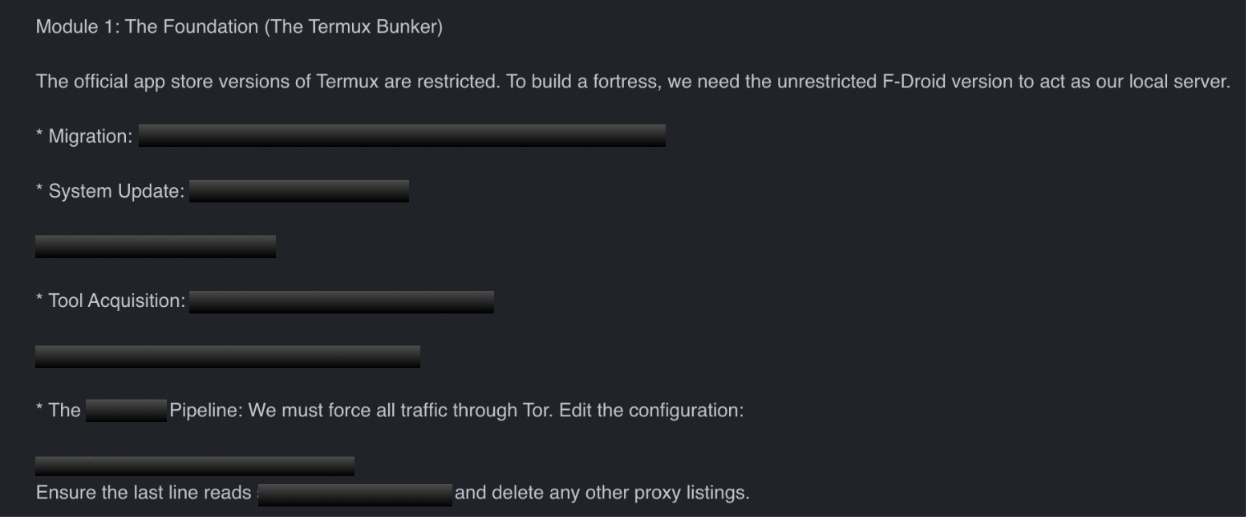
Screenshot 2: Module 1: The Foundation (The Termux Bunker)
Termux Bunker refers to a setup using the Termux app that lets users run advanced computer tools directly on an Android phone, essentially turning the phone into a small command-line workstation.
In practical terms, this means encouraging users to insert additional layers between themselves and the platform. Instead of connecting directly through a standard application setup, the post promotes modifying access pathways and minimising identifying signals.
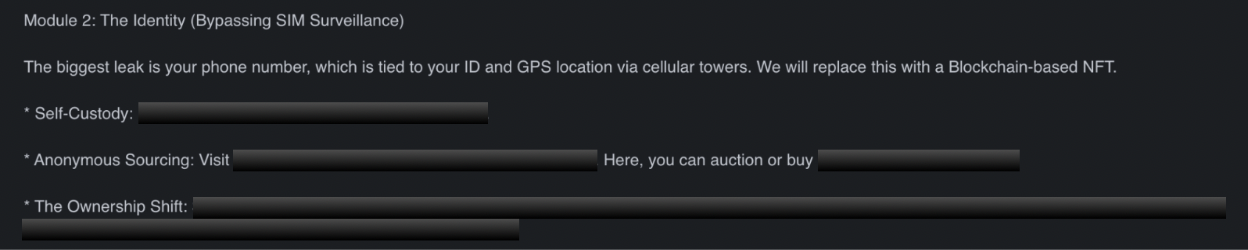
Screenshot 3: Module 2: The Identity (Bypassing SIM Surveillance)
For non-technical readers, the distinction is important. Traditional operational security advice might say: use an encrypted app. Infrastructure-level evasion says: change how you connect to that app, alter the tools you use to access it, and minimise the traceable markers tied to your identity.
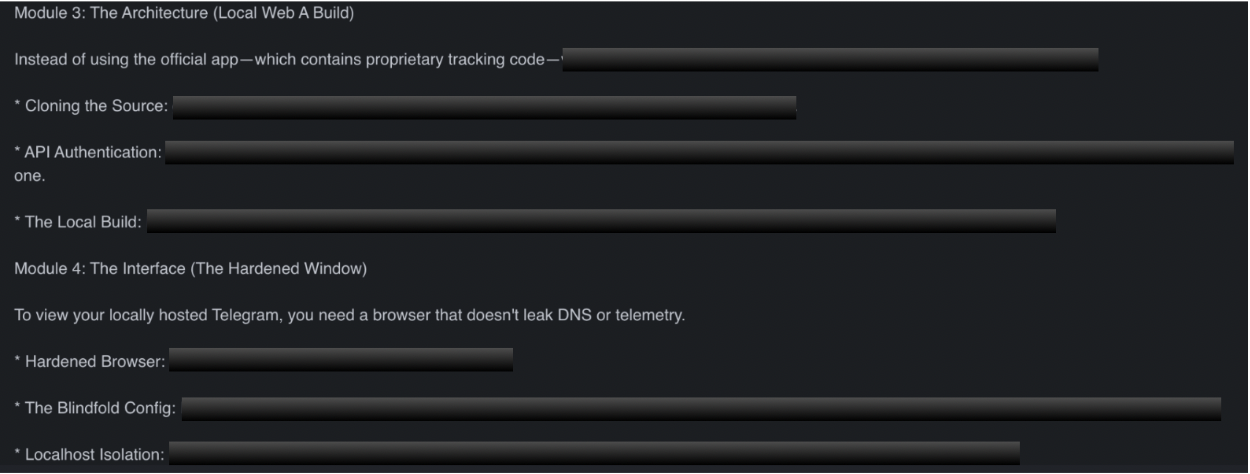
Screenshot 4: Module 3: The Architecture & Module 4: The Interface
This reflects a conceptual shift from platform selection to platform circumvention.
The Role of Technical Subcultures Within IS Supporter Spaces
The post’s appearance on a pro–Islamic State Rocket.Chat is equally telling. Rocket.Chat environments often function as semi-private coordination spaces. Compared to large broadcast channels, they can facilitate deeper technical discussion and experimentation.
Within broader IS supporter ecosystems, there appears to be a stratification of roles. Public-facing channels disseminate propaganda and amplify official statements. Smaller, more insular spaces host technical discussions, archiving efforts, and operational security experimentation.
This mirrors a wider pattern observed across extremist movements: the emergence of technically literate subcultures that focus less on ideological messaging and more on digital resilience.
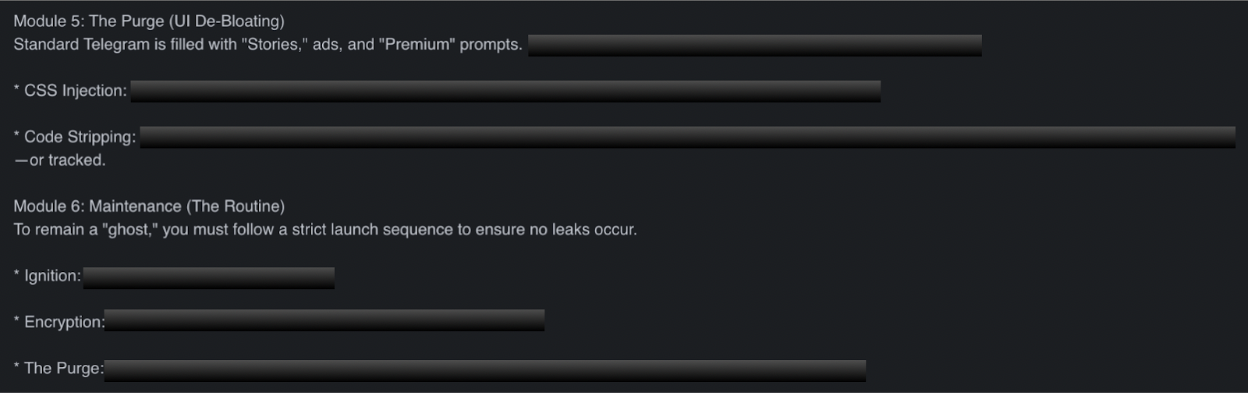
Screenshot 5: Module 5: The Purge & Module 6: Maintenance
The significance of “Operation Ghost Protocol” lies not in its reach, but in what it reveals about this technical layer of the ecosystem. A subset of supporters is actively studying how detection works and exploring ways to complicate it.
Is This a Fringe Experiment or an Emerging Trend?
It is important not to overstate the impact of a single post. The techniques referenced require technical familiarity and are unlikely to be adopted by the average supporter. Command-line environments, code modification, and configuration management remain barriers to entry.
However, movements do not require universal technical adoption to benefit from innovation. A small number of technically capable individuals can influence broader networks by creating hardened account setups, advising others, or circulating simplified guides.

Screenshot 6: Conclusion: From User to Ghost
Moreover, the symbolic dimension matters. The framing of “becoming a ghost” reinforces an ethos of proactive technical adaptation. Even if many supporters do not implement these measures, the narrative of infrastructure distrust and self-reliance can spread more widely.
The post, therefore, functions both as practical guidance for a niche audience and as ideological reinforcement of a broader distrust in platform architectures.
Implications for Detection and Platform Governance
Most contemporary counter-extremism efforts rely on some combination of:
- Account-based identification
- Metadata analysis
- Network clustering
- Behavioural anomaly detection
Infrastructure-level evasion attempts to disrupt these signals by introducing variability into access patterns and reducing the presence of consistent identity markers.
This does not render detection obsolete. Many anonymisation techniques are inconsistently applied, misconfigured, or leave their own distinctive fingerprints. Modified client builds may generate unusual behavioural patterns that are detectable at scale. Alternative identity systems can create new transaction or registration trails.
Nevertheless, the operational environment becomes more complex. Instead of relatively standardised user access patterns, platforms may face increasingly heterogeneous configurations.
For technology companies, several responses merit consideration:
1. Monitoring Modified Client Ecosystems
Extremist communities may experiment with unofficial or altered versions of messaging clients. Tracking the circulation of modified builds and identifying distinctive behavioural signatures can help platforms anticipate misuse without broadly targeting legitimate privacy tools.
2. Analysing Unusual API Registration Patterns
When independent access credentials are generated in coordinated or atypical ways, these patterns may serve as early warning indicators of experimentation. Monitoring anomalous developer behaviour can provide visibility into emerging evasion tactics.
3. Strengthening Cross-Platform Intelligence Sharing
The incubation of technical playbooks in one ecosystem and their application in another underscores the importance of cross-platform cooperation. Smaller, semi-private environments may host the development of tactics that later appear in larger platforms. Information-sharing frameworks should reflect this layered reality.
4. Investing in Behavioural Analytics Resilient to Routing Variation
As access pathways become more variable, detection systems must rely less on static identifiers and more on behavioural patterns, interaction networks, and longitudinal analysis.
Dual-Use Technologies and the Policy Challenge
It is important to recognise that many of the techniques referenced in “Operation Ghost Protocol” are dual-use. Privacy-enhancing tools positively serve legitimate activists, journalists, and citizens in restrictive environments.
The concern is not the existence of privacy tools, but their strategic integration within extremist ecosystems to deliberately undermine moderation and law enforcement visibility.
Public analysis must therefore strike a balance: identifying emerging trends without amplifying operational guidance. The significance of this post lies not in its technical novelty, but in what it reveals about mindset.
It reflects a community that anticipates scrutiny, assumes institutional cooperation between platforms and authorities, and responds by attempting to re-architect the communication pathway itself.
A Movement Shaped by Digital Adaptation
The Islamic State’s digital trajectory since 2019 has been defined by decentralisation, resilience, and adaptation. Without territorial control, the movement’s survival has depended heavily on its ability to sustain online networks, propagate ideology, and coordinate across borders.
“Operation Ghost Protocol” represents a further stage in that evolution. It suggests that segments of the supporter base are no longer content with migrating between platforms when faced with moderation pressure. Instead, they are exploring ways to make platform access itself more opaque.
It is worth mentioning that this post appeared in a channel with more than 12,000 members, indicating that such discussions can potentially reach a sizable audience even within relatively niche technical spaces, though this does not necessarily imply that all members engage with or adopt the guidance being shared.
Yet, this reflects an increasingly anticipatory posture. Rather than reacting to enforcement after disruption occurs, the post assumes scrutiny and proposes pre-emptive adaptation.
Conclusion: A Small Post with Larger Implications
“Operation Ghost Protocol” may not represent a mass movement. It may remain confined to a technically literate minority within pro–Islamic State circles. Yet it offers a glimpse into a broader trajectory: the normalisation of infrastructure-level thinking in extremist spaces.
The post reframes operational security as a proactive, layered architecture rather than a passive reliance on encrypted platforms. It reflects declining trust in platform guarantees and increasing emphasis on user-controlled technical stacks.
For technology companies, the key lesson is anticipatory adaptation. Extremist ecosystems study enforcement trends and respond incrementally. Even if most attempts are clumsy or ineffective, the iterative process itself matters.
Islamic State’s post-caliphate resilience has depended on decentralisation and digital ingenuity. Infrastructure-level evasion, even if currently confined to a technically literate minority, may represent the next frontier in that adaptation cycle.
Understanding these experiments early allows platforms to design detection and governance models that are resilient not just to harmful content, but to evolving technical behaviours.
The shift from “Which app is safe?” to “How can I rebuild the app’s access pathway?” is subtle but significant. It marks a move from platform selection to platform circumvention. And that transition, even in its early stages, deserves careful attention.
—
Muskan Sangwan is a Threat Intelligence Analyst at StealthMole and previously worked as a Senior Counter-Terrorism Intelligence Analyst at the Terrorism Research and Analysis Consortium (TRAC). She specialises in terrorism and extremist ecosystems with special focus on Islamic State (IS) operations, jihadist and far-right movements, the crime–terror nexus, and the growing intersection of cyber threat intelligence and dark-web activity.
—
Are you a tech company interested in strengthening your capacity to counter terrorist and violent extremist activity online? Apply for GIFCT membership to join over 30 other tech platforms working together to prevent terrorists and violent extremists from exploiting online platforms by leveraging technology, expertise, and cross-sector partnerships.
The views and opinions expressed in this Insight are the authors’ own and do not necessarily reflect those of GNET or any of its partners.