
Over the last few years, a clear and troubling pattern has crystallised: where the state fails to manage water and energy scarcity, violent non-state actors step in. Although the link between climate stress and violence is mediated by pre-existing socio-economic fragilities (climate as a threat multiplier), a deeper structural shift is now underway. This is particularly evident across the Sahel and Yemen, where these dynamics have accelerated following the withdrawal of international forces from Mali and the intensification of the Yemeni conflict.
This Insight analyses the emergence of what this author terms “Dark Green Governance”: a model in which organisations such as Jama’at Nasr al-Islam wal Muslimin (JNIM) and the Houthis move beyond predatory extraction to consolidate legitimacy by acting as de facto administrators of scarce environmental resources. Reports suggest that tens of millions of people worldwide live under non-state armed actors who determine land use and taxation — and who decide, in practice, whether civilians can access water or markets at all. Through digital tools and alternative regulatory systems, these groups fill the void left by weakened state institutions, transforming environmental resilience into a tool of control and sovereignty.
Theoretical Foundation: From Threat Multiplier to “Dark Green Governance”
The effects of climate change can function as a “threat multiplier” in certain conflicts, intensifying existing socio-economic vulnerabilities and exacerbating competition over land, water, and livelihoods. When weak institutional capacity intersects with economic shocks, declining agricultural output, soil degradation, and climate-induced displacement, the risk of instability increases. Climate stress reshapes the environment in which authority is contested rather than directly producing insurgency.
Recent empirical analyses reinforce this interpretation. A 2026 study by the Global Centre on Adaptation found that socio-economic vulnerability indicators, including large rural populations, low foreign direct investment, and high numbers of people in need, are strongly associated with conflict incidence. Hydro-climatic stress variables, such as prolonged drought and recurrent flooding, further correlate with instability where recognised state institutions lack the capacity to provide adaptation mechanisms or basic environmental services.
This is not simply the erosion of state authority, a process well-documented elsewhere. Systems of resource governance have long existed in both state and non-state forms. What distinguishes “Dark Green Governance” is the deliberate institutionalisation of environmental management as a source of political legitimacy in climate-fragile contexts. Armed extremist groups regulate access to water points, grazing corridors, fisheries, markets, and energy infrastructure, while simultaneously establishing dispute resolution mechanisms and taxation systems linked to resource control. Climate adaptation, in their hands, becomes an instrument of rule.
Where recognised state authority has receded, armed extremist groups move to fill the gap. Control over scarce environmental resources generates what analysts have termed “negative sovereignty”: the capacity to restrict or condition access to essential goods to secure compliance. Such governance may produce short-term stability, but it rests on coercion rather than consent, and collapses quickly when drought deepens or external funding dries up.
The Sahelian Context: JNIM and the Administration of the Rural Commons
Examining the Sahel illustrates how climate tension intersects with insurgent governance. Growing rainfall variability, soil degradation, and declining pasture quality have disrupted traditional transhumance routes across Mali and the wider Liptako-Gourma region. Pastoralists’ movement into agricultural areas has intensified competition for land and water, contributing to inter-communal violence and militarised clashes. Several extremist groups operate across the Sahel; however, JNIM – an al-Qaeda affiliate – provides the clearest example of structured environmental governance.
In this turbulent ecological environment, JNIM has established itself not only as a major military actor but also as an enforcer of rural common property rights. The group has established Sharia-based courts to rule on disputes over pastoral land, irrigation canals and cattle theft, offering swift and predictable judgements in areas where government judicial institutions are non-existent or widely perceived as corrupt. JNIM positions itself, in short, as a guarantor of order in a context of environmental turmoil.
The fall of Farabougou in the Segou region in 2025 illustrates this transition in governance. After years of siege, JNIM consolidated control over local water reserves and agricultural markets, regulating access and extracting taxes in return for protection. Environmental administration thus became entangled with social regulation, including restrictions on certain economic practices and public ceremonies considered incompatible with the group’s ideologically driven perspective.
In addition to local mediation, JNIM also exploited environmental and economic dependence on a larger scale. Starting in mid-2025, the group reportedly targeted fuel convoys along key supply corridors from Senegal and Côte d’Ivoire, contributing to a severe fuel shortage in Bamako and exposing Mali’s structural dependence on energy imports. JNIM has expanded its ability to impose tax regimes and regulate trade flows through disrupting transit routes.
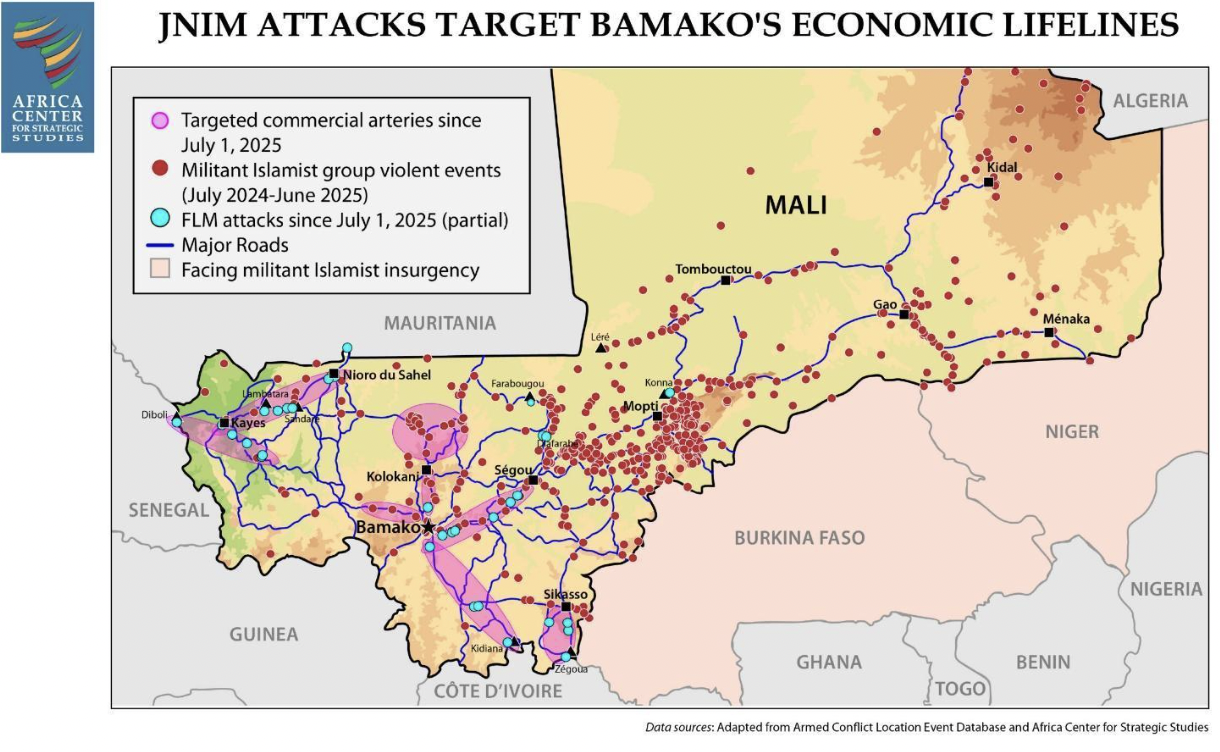
JNIM attacks targeting Bamako’s supply corridors (Source: Africa Center for Strategic Studies, 2025)
Yet this model of “green governance” presents a structural contradiction. In areas such as W National Park, a major national park in West Africa, restrictions imposed by JNIM on external commercial actors are presented as environmental protection measures, while unregulated artisanal mining continues under rebel supervision. The environmental regulation is thus applied selectively: conservation measures coexist with profitable extraction practices that contribute to long-term ecological degradation. Environmental discourse thus functions less as stewardship and more as a mechanism of territorial consolidation.
Yemen: Water, Energy, and the Politics of Environmental Control
While the Sahel illustrates the management of rural commons, Yemen shows how environmental governance can be integrated into critical urban infrastructure. Chronic water scarcity, aggravated by depleted groundwater reserves and prolonged conflict, has turned access to water into a central instrument of power. In cities such as Taizz, control over the al-Hawban water basins has allowed the Houthis to regulate the supply to government-controlled districts, while restrictions on independent water wells have forced civilians to rely on water distribution networks linked to Houthi-affiliated actors. Environmental control thus becomes a mechanism of political and social domination, embedding the group into the most essential dimensions of daily life, from drinking water to domestic energy.
Energy governance follows a similar model. The collapse of Yemen’s national electricity grid has accelerated investment in decentralised solar infrastructure. Houthi authorities have promoted large-scale solar projects, including plants inaugurated in 2025 that are reported to generate tens of megawatts of energy. Despite being framed as measures to strengthen resilience, these initiatives also consolidate regulatory authority over tariffs, distribution, and licensing. At the same time, ongoing disruptions to oil exports and fiscal fragmentation have weakened the internationally recognised government’s revenue base, a dynamic reflected in recent International Monetary Fund (IMF) assessments of Yemen’s financial system.
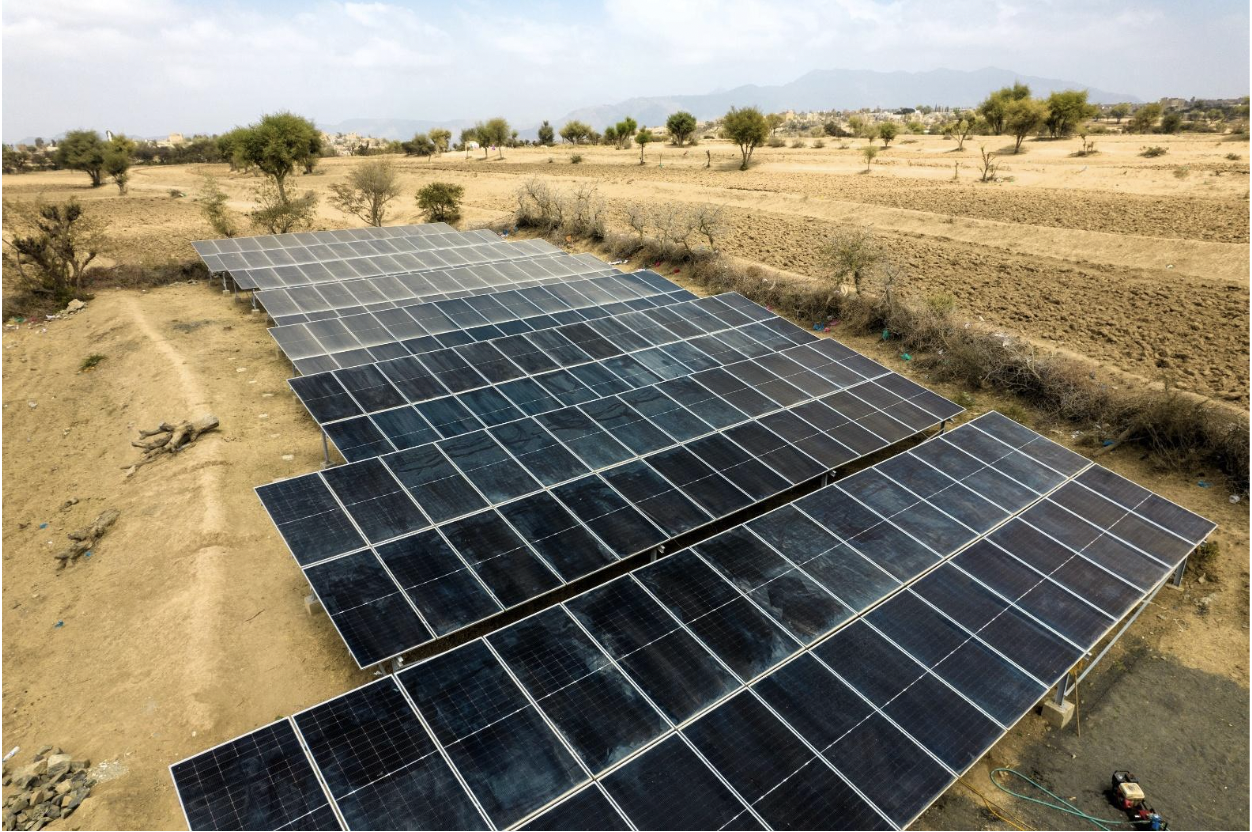
Decentralised solar infrastructure in rural Yemen (Source: UNDP, 2025)
The pattern extends beyond territorial resource control. Recent analyses of Houthi attacks on commercial vessels in the Red Sea have revealed a nexus between maritime rerouting and heightened emissions, characterised by significant fertiliser spillages, and the use of ecological rhetoric to portray these actions as forms of “ecocide“. This framing embeds military operations within a broader environmental narrative of legitimacy.
In Yemen, as in the Sahel, water and energy have become instruments of political control and social coercion. The specific mechanisms differ — rural commons management in one case, urban infrastructure in the other — but the underlying logic is identical: scarcity, governed by armed actors, becomes sovereignty.
The Global Geography of Rebel Environmental Governance
Recent research documents a geographical expansion of rebel environmental governance beyond the Sahel and Yemen. In Somalia, for example, Al Shabaab has instituted and enforced a formal ban on single-use plastic bags, explicitly citing their lethal threat to livestock in pastoral areas, a vital economic resource for communities under their control.
In north-eastern Syria, the DAANES (Democratic Autonomous Administration of North and East Syria) has also embedded ecological principles into its governance framework, moving away from the chemical-intensive monocultures that degraded soils during the Assad era, as part of a broader project of democratic confederalism grounded in social ecology.
In the Lake Chad basin, Boko Haram has institutionalised ecological stress into its governance model by issuing fishing permits, monopolising access to declining lake resources, and extracting revenue from communities already impoverished by environmental degradation and insecurity. What these cases share is not ideology but function: environmental management has become a recognised lever of territorial sovereignty for non-state armed actors across contexts far removed from the Sahel or Yemen.
The Technological Infrastructure of Dark Green Governance
Environmental governance in climate-fragile contexts is, crucially, an information problem: who knows where the water is, who taxes access to it, and who controls the narrative around both. Digital infrastructures and dual-use technologies are how ‘Dark Green Governance’ answers that problem, extending territorial control into the informational domain.
Both JNIM and the Houthis operate within an ecosystem of commercially available dual-use technologies, originally developed for civilian, development or environmental monitoring purposes. The availability of satellite imagery, open-source geospatial mapping platforms and relatively inexpensive drone components has lowered the barrier to entry for non-state actors seeking to monitor agricultural production, track water resources, and assess land conditions during droughts or floods.
While there is no public evidence that rebel groups independently operate advanced hydrological models (computational systems used to simulate water availability, drought onset, and groundwater distribution), open-source investigations and conflict monitoring analyses suggest that non-state armed actors increasingly draw upon commercially available satellite imagery and externally produced environmental data to inform taxation, territorial positioning, and resource control. Under climate stress, even partial access to such data can improve an armed group’s ability to locate strategic wells or identify which agricultural zones are worth taxing — and which transit routes are worth cutting.
Digital governance operates on the same principle. In Yemen, investigations conducted by organisations such as Citizen Lab and Recorded Future indicate that Houthi authorities have employed network monitoring tools — including deep packet inspection technologies capable of surveilling internet traffic, blocking VPN usage, and identifying dissenting users — and filtering technologies that can restrict online communications and monitor digital traffic.
This digital infrastructure enables the Houthis to regulate information flows, suppress dissenting narratives, and reinforce both environmental and moral claims to authority.
Encrypted platforms such as Telegram serve not only as channels for propaganda dissemination in the Sahel, but also as virtual administrative spaces. JNIM’s media wing, Az-Zallaqa, uses these channels to disseminate rulings and governance decisions to networks of supporters, projecting an image of fair justice. As Zelin (2020) has documented, “Az-Zallaqa functions on an ad-hoc basis by temporarily creating or maintaining closed Telegram channels to diffuse a media product across a designated network, which in turn disseminates the item to supporters and subscribers” (Nsaibia, Beevor and Berger, 2023, pp. 30–33).
As Wassim Nasr, a Sahelian conflict analyst, has observed, the medium matters as much as the message: a ruling posted on Telegram reaches not just the disputants but the entire community watching. Claims can be digitally recorded, decisions disseminated online, and compliance enforced through public messages. The result is a semi-formalised architecture in which governance, communication, and coercion reinforce one another. Technology does not replace violence here; it extends its reach. By embedding environmental management within digital infrastructure, violent extremist organisations (VEO) make their claims to authority both more visible and harder to displace.
Strategic Assessments: Durability, Contradictions, and the Risk of Entrenchment
To assess the implications of Dark Green Governance, its structural drivers deserve scrutiny. By providing predictable dispute resolution and resource allocation, VEOs generate forms of dependency that can reinforce what can be described as a conflict trap (Collier and Hoeffler, 2004): communities facing severe scarcity may prioritise stability over ideology, gradually reducing the prospects for state-led stabilisation. Decentralised adaptation infrastructure carries a parallel risk: where insurgents already hold territory, solar networks, irrigation schemes and water committees can become revenue streams rather than community assets — taxed or co-opted before external funders have even left the room.
These governance frameworks also contain an inherent contradiction. Measures to protect the environment, such as restrictions on commercial actors in areas like W National Park, can coexist with lucrative informal extraction under insurgent oversight. Eco-rhetoric thus risks functioning as a tool for territorial consolidation rather than genuine stewardship. Finally, territories administered by VEOs remain vulnerable to systemic shocks: governance based on scarcity management rather than structural resilience can be severely tested by prolonged droughts, floods or financial disruptions.
Policy Implications: Reclaiming Environmental Governance
To ensure P/CVE strategies remain effective in fragile climate contexts, environmental governance must be treated as a core security variable, not a development afterthought. Climate and humanitarian assistance should be structured to circumvent insurgent fiscal systems. Decentralised delivery mechanisms, supported by satellite verification and traceable digital payments, can reduce diversion risks. Strengthening pastoral associations and customary mediation structures offers communities credible alternatives to insurgent courts. Limiting armed actors’ monopoly over geospatial data requires sustained support by local authorities and civil society — through open-source mapping tools and cybersecurity capacity-building. Climate security gains will also depend on economic intelligence: disrupting illicit resource flows while enabling responsible private investment in resilience.
Across climate-vulnerable regions, the capacity to govern scarcity is becoming a pivot of sovereignty. Reclaiming environmental commons through legitimate and inclusive governance is not a peripheral concern — it is central to any serious strategy against extremist entrenchment. Policy responses must mainstream the Women, Peace and Security framework: women and young people are disproportionately exposed to climate shocks, and locally rooted adaptation can both reduce recruitment incentives and weaken insurgents’ control over scarce resources.
Reclaiming these commons is not just a matter of development; it is a tactical necessity that the international community has, so far, largely failed to grasp.
–
Fabrizio Minniti is an international security expert with extensive experience in strategic analysis and field advisory. As a researcher for the Military Centre for Strategic Studies, he authored key reports on intelligence, international terrorism, nuclear doctrine, and European defence policy. His operational background includes serving as an External Consultant for EUBAM-Rafah and as a Political Advisor within the NATO Resolute Support Mission in Afghanistan.
–
Are you a tech company interested in strengthening your capacity to counter terrorist and violent extremist activity online? Apply for GIFCT membership to join over 30 other tech platforms working together to prevent terrorists and violent extremists from exploiting online platforms by leveraging technology, expertise, and cross-sector partnerships.
The views and opinions expressed in this Insight are the authors’ own and do not necessarily reflect those of GNET or any of its partners.
