



Content warning: This Insight contains mentions of suicide, rape, and hateful language.
On 8 July 2026, a 16-year-old armed attacker entered his former high school in Schongau, Germany, seriously injuring two 13-year-old girls with a knife before being subdued by police and teachers. In the immediate aftermath, a multifaceted digital footprint emerged: the perpetrator had posted and consumed edits glorifying previous violent attackers on TikTok, attempted to livestream the attack via Discord, had been an active user of a notorious misogynistic online incel forum, and left behind a 19-page manifesto. However, the sheer variety of targets and tropes mentioned in his writings has led to uncertainty regarding his motivation.
This Insight examines the perpetrator’s manifesto and an archive of his 135 pre-attack posts on the incel forum to examine how he synthesised disparate grievances from various online spaces into a generalised misanthropy – a core characteristic of Nihilistic Violent Extremism (NVE). Guided by Hart’s four narrative dimensions derived from previous NVE-adjacent attacker manifestos, the following section first examines the perpetrator’s motivation for the attack. The analysis then delves into how misogyny, anti-Muslim hatred and antisemitism emerged as master frames towards a universal misanthropy. Finally, we discuss how the perpetrator relied on multiple online platforms and subcultures to “cherry pick” his highly personalised extremist worldview.
Degeneracy: Society as doomed beyond repair
The Schongau manifesto repeatedly includes depictions of societal and institutional decay. The author portrays his immediate environment in rural Southern Germany as populated by “subhumans, r******, degenerate trash and insufferable scum”. He targets overweight people as a particularly visible symbol of decay, and views body positivity as a so-called elitist plot for promoting more obesity. This theme also appears in his forum posts, where he mocks “unintelligent” people for consuming “slop” food. However, his disdain for society extends beyond specific groups. Most people are dismissed as “dead weight that needs to disappear off the face of the earth”. Institutions fare no better: School and religion are depicted as hypocritical systems exacerbating human suffering, while broader society – derogatorily referred to as “Jewrope” (in the manifesto) or “Germanistan” (in his forum posts) – is condemned as degenerate for widespread compliance with authorities. However, his overarching conclusion is that there is no better system, as “no system works”, and “life is inherently bad and unjust”. This renders any political ideology or form of societal organisation futile. By framing society as irredeemably broken beyond repair, he lays the groundwork for justifying violent actions against that society.
No lives matter (but some matter less): Universal misanthropy with hierarchies
Against the background of a fundamentally corrupt society, the perpetrator develops a generalised misanthropy, claiming that his hatred “goes for everyone”. At the same time, he acknowledges that some “deserve to be wiped off this earth” more than others, thus including hierarchical distinctions. Substantial sections of the manifesto are dedicated to rants against loud children, religious individuals, rural residents, and trans people. Muslims are targeted particularly often throughout the manifesto, often described using racialised language. The author even mentions that he initially considered a Mosque as a target, before shifting focus to his former school. A similarly strong disdain for women is also evident in both the manifesto and his forum posting history, often expressed through violent rape fantasies. Nevertheless, the author repeatedly stresses the universality of his hatred. This universal yet graduated devaluation of human life rationalises his broad targeting (“I won’t discriminate when picking my targets”). It also marks an evolution from more focused grievances (gendered, racist, or niche grievances such as fatphobia), toward a generalised rejection of humanity.
Self-hatred: Internalised worthlessness and suicidal ideation
Self-hatred is pervasive throughout the manifesto. The perpetrator portrays his life as “hopeless” and “doomed from the start”. A central theme in his manifesto is his traumatic childhood. He directs his resentment towards his parents, dedicating a section of the manifesto to addressing them directly, accusing them of making the attack “completely your fault”. His father is characterised as largely absent, alcoholic and hyper-religious, while his mother is depicted as emotionally abusive. His frustrations are exacerbated by chronic social rejection, especially his repeated inability to find a girlfriend. According to the manifesto, all this accumulated trauma led to rapidly declining mental health, and an “ever increasing wish to commit suicide”. Suicidal ideation appears as a constant companion throughout his writings, ultimately integrated into the “Zero Day” plan. Inward hostility is converted into motivation for a “day of retribution” against those whom he sees as responsible.
Veneration of Violence: Gamification and Saint Culture
Within the perpetrator’s writings, interpersonal violence is seen as both personal liberation from a “hellish nightmare” and a contribution to a larger tradition of attackers. The author expresses euphoria upon first watching the livestream of the Christchurch Mosque shooting, stating that it made him realise that “there was only one solution” (…) “I had to kill”. The manifesto contains numerous references to previous violent perpetrators, and he explicitly positions himself on a continuum with them. He criticises perpetrators with ‘low’ casualty numbers, and sets himself the goal of reaching a “score” of “at least 4 kills” to surpass the recent San Diego attackers. The planned act is placed within a violence-fixated online culture: he urges readers to share his manifesto “alongside the stream”. The document is meant both as an explanation for his acts and as a potential inspiration for others who can “relate”.
The perpetrator’s fixation on violent acts and perpetrators is also evident from his forum posting history. He frequently participated in threads glorifying Elliot Rodger, for instance, sharing his favourite quote of the incel terrorist.
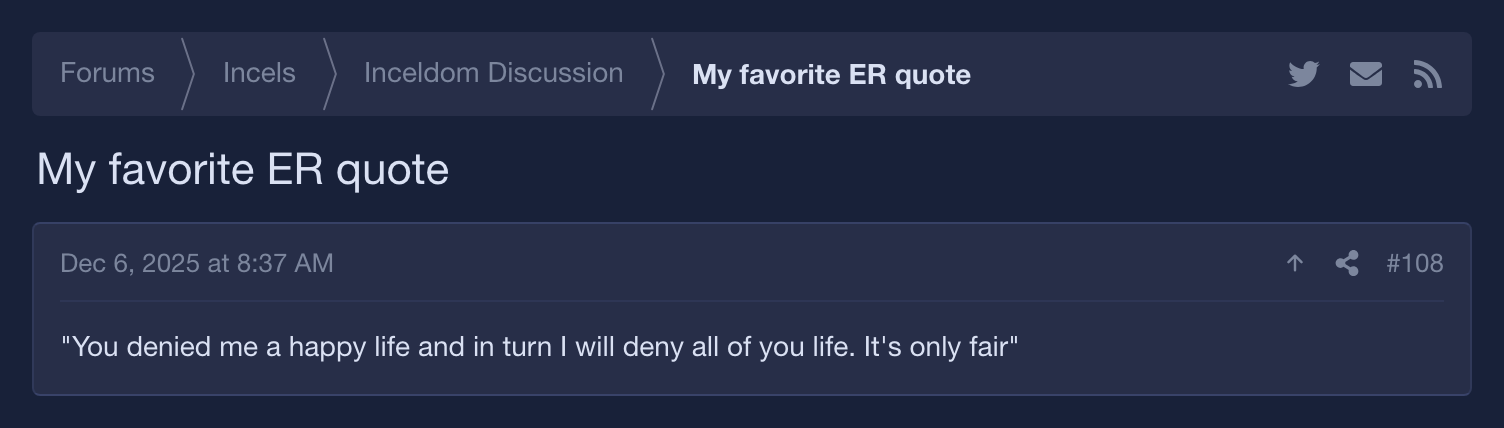
Figure 1: The perpetrator glorified Elliot Rodger in multiple postings on the forum. Here, he shares his favourite quote from Rodger’s manifesto (screenshot is a recreation from dataset).
He also discussed violent action on the platform – often under the guise of “self-defence”. For instance, he advised another user to arm himself with a knife – the same weapon the perpetrator later used for his stabbing attack. In another thread, he told a user complaining about being bullied: “You should have retaliated”, arguing that it was better than “letting normies bully you”.
Ideological bricolage: From Gendered Grievances to Misanthropy
Hart’s four narrative dimensions help to systematise the general themes underlying the perpetrator’s worldview, justifying violence against a society he regarded as fundamentally corrupt. Next, we break down how the perpetrator engages with incel narratives and wider extremist ideologies to become a self-declared “misanthrope”.
Typical for NVE-related attacker cases, the perpetrator presents an ideological bricolage that mixes various beliefs – sometimes in highly contradictory ways. Blackpill-inspired grievances provide the primary foundation for this bricolage, anchoring other, more niche frustrations. Substantial sections of his manifesto and posting history feature incel-typical motifs: he describes developing sexual desires at a young age, yet feeling consistently “looked down upon” by girls, whom he characterises as overwhelmingly “hypergamous” and “gold diggers”. His discovery of the blackpill “around 2023–2024” provided what he perceived to be a coherent explanation for his romantic rejection. The absence of a girlfriend remains a central and recurring grievance that also fed into other localised frustrations. For instance, his documented resentment toward rural life partly stems from a disdain for “hypergamous” local women and the small dating pool in his village.
Nevertheless, his engagement with incel ideology highlights the fluid nature of his grievances, as it remains deeply contradictory. In the manifesto, he explicitly rejects the “incel” label, arguing that some “good women” exist. He furthermore gives his experience with e-dating as an example of having been desired by women (thereby ruling out the possibility of being an incel). In forum posts, he similarly frames incelhood not as an ideology, but as having a condition – comparable to hunger. Yet, simultaneously, he discusses solutions to female “hypergamy” with other users, such as arranged marriages as a supposedly less violent option.
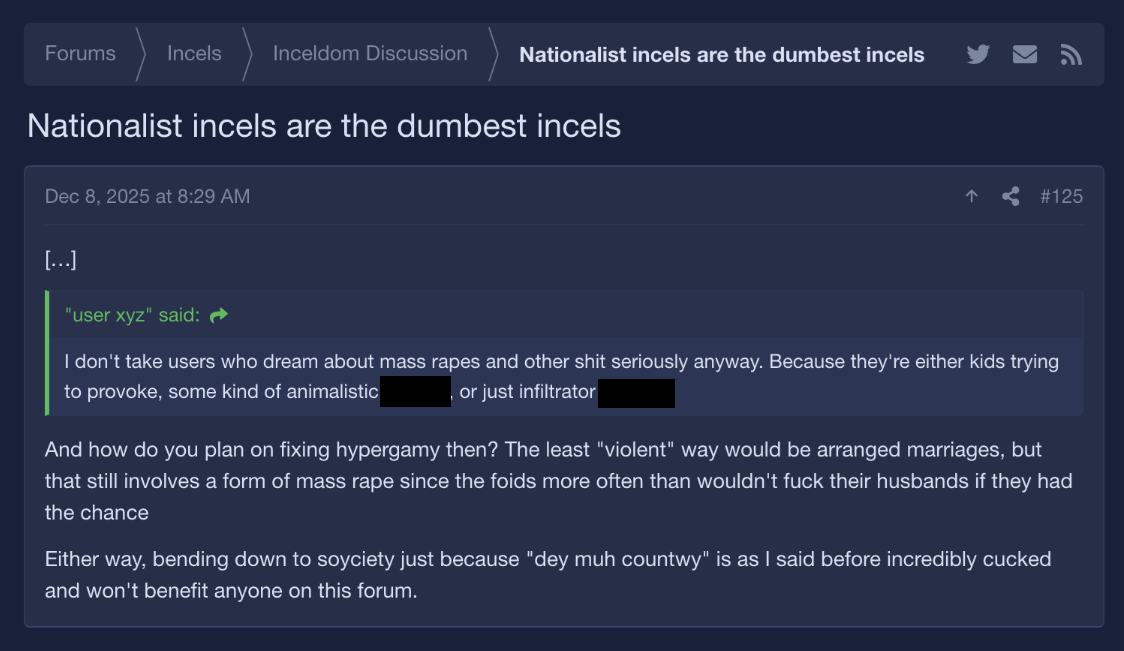
Figure 2. The perpetrator in a heated debate with a user that accused him of being an infiltrator after he shared violent fantasies. He then proceeds to discuss “non-violent” ways of fixing hypergamy (screenshot is a recreation from dataset).
Besides these gendered narratives, hatred towards Muslims and Jews emerge as central frames in his reasoning. The Christchurch attack is described as a pivotal channelling event for his hatred towards Muslims, initially rooted in personal experiences of being bullied at school. However, while expressing numerous racist beliefs towards immigrants, he also targets conservative and far-right voters, and dismisses support for any political party. Instead, antisemitism functioned as a highly fluid lens to integrate otherwise unrelated frustrations into conspiratorial narratives. For instance, the promotion of obesity and body positivity in Western countries is explicitly framed as a deliberate Jewish plan to create a degenerate “Jewrope”.
Ultimately, the analysis shows that the perpetrator did not adhere to any traditional cohesive ideological system but mixed a multitude of grievances. Failed attempts at e-dating then mark the final turning point, after which he describes “truly giving up”. At this moment, his resentment expanded from women, Muslims and Jewish people to “anyone I perceived a normie and everyone around me”. It was at this point that he declares becoming a “misanthrope”. Therefore, his gendered grievances remain fundamental to understanding the misanthropy and motivations of the perpetrator.
Mélange of Extremist Information Spaces
The various ideological influences of the perpetrator stemmed from disparate extremist ecosystems with which he engaged. Rather than radicalising in a single environment, he navigated both niche and mainstream platforms that collectively reinforced a violent worldview.
An early, foundational fascination with graphic violence and gore content is evident throughout the manifesto, which begins with a still from a gore video. In his writings, he details his activity on violent gore platforms and describes being eventually “shadow banned” – a decision that prompted him to directly address the forum moderations within the closing paragraph of his manifesto. He also shared and discussed gore-related content on the forum. Here, the perpetrator created 135 posts in November and December 2025, before self-banning his account.
In both his manifesto and his forum posts, the perpetrator details his fascination with creating and consuming edits of mass shooters on TikTok. He saw himself as an active member of the True Crime Community (TCC), and acknowledges other TCC users in his manifesto, explicitly asking them to share it. On his TikTok account – which was terminated by the platform in the aftermath of the attack – the perpetrator also announced a livestream of “realistic COD (referring to the popular shooter videogame Call of Duty) in around 30 mins” and encouraged viewers to join his Discord. While details are still emerging, it is likely that the perpetrator only managed to stream for about a minute, with no violent action being visible. Discord subsequently actioned the incident by disabling his account. Activity by violent extremists is expressly prohibited on both TikTok and Discord.
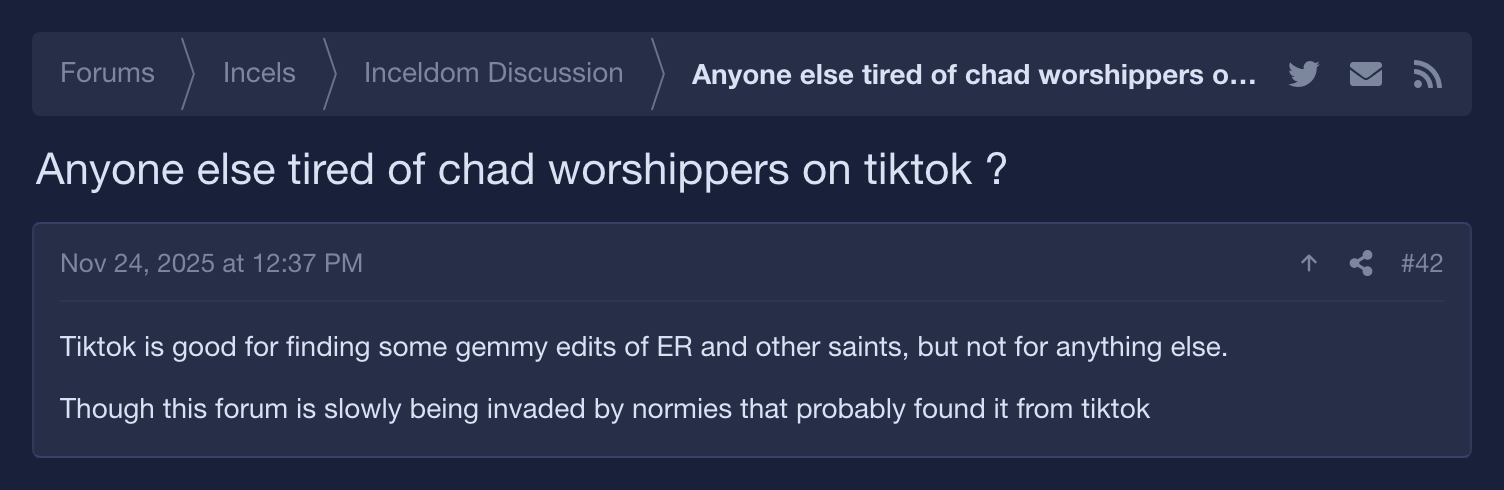
Figure 3: The perpetrator used TikTok to both upload and consume edits of violent perpetrators (screenshot is a recreation from dataset).
Conclusion
In summary, our analysis of the Schongau manifesto and the forum posting history of the attacker provides three central takeaways. First, it reveals how four central narrative dimensions provide a larger rationale for mass violence in NVE-adjacent attackers. Second, it demonstrates how a variety of grievances are mixed to provide the building blocks towards a generalised misanthropy. Third, it showcases how both niche and mainstream spaces are used to blend blackpill fatalism, desensitising gore content, and shooter fandom into a personalised worldview.
These takeaways directly underscore the limitations of relying on traditional siloed P/CVE frameworks and reactive content moderation. When radicalisation occurs across fragmented, cross-platform pathways, effective prevention will require a broader, multi-layered approach. At the platform level, the detection of hybrid signals (such as the intersection of blackpill language, attacker admiration, and self-hatred markers) is central. This is particularly important, as NVE-adjacent attackers rely on similar linguistic patterns. Furthermore, greater transparency around algorithmic amplification of True Crime and gore-related content, along with improved age-appropriate safeguards, should be prioritised. Schools, youth services, and mental health providers need clearer guidance and resources to recognise early signs of leakage, such as fascination with previous attackers or escalating misanthropic rhetoric. Coordinated, multi-stakeholder efforts are the most promising avenue to tackle these challenges.
–
Christopher V. David is a researcher and PhD candidate at the Neu-Ulm University of Applied Sciences, Germany. His work examines online extremism through a socio-technical lens, with a particular focus on how extremist communities communicate, learn, and adapt across digital environments. Holding degrees in Psychology (M.Sc.) and Peace and Security Studies (M.A.), his interdisciplinary background bridges behavioural science, information systems, and security studies. Before entering academia, he worked with political foundations in Berlin and Brussels, informing policy dialogue on digital security and hybrid threats. BlueSky: https://bsky.app/profile/dsrc.bsky.social
Nils Riekers is a researcher and PhD candidate at the Neu-Ulm University of Applied Sciences, Germany. His work focuses on AI-driven methods for multimodal hate speech detection, combining a socio-technical perspective with machine learning approaches. He holds degrees in Computer Science (B.Sc.) and Cognitive Science (M.Sc.), and is a scholarship holder of the BIDT Graduate Center (Bavarian Research Institute for Digital Transformation). Alongside his studies, he gained practical experience in the IT industry as a software developer.
Marten Risius is Professor for Digital Society and Online Engagement at Neu-Ulm University of Applied Sciences, Germany and Adjunct Senior Fellow at the School of Psychology at the University of Queensland, Brisbane, Australia. His work focuses on online Trust & Safety issues such as online extremism, disinformation, and hate speech. His position receives generous funding support from the Bavarian State Ministry of Science and the Arts through the Distinguished Professorship Program as part of the Bavarian High-Tech Agenda. He has been recognised with various national and international awards such as the Australian Research Council Discovery Early Career Researcher Award, the Early Career Award from the Association of Information Systems, and the German Academic Association for Business Research Young Talent Award. BlueSky: https://bsky.app/profile/risius.bsky.social
–
Are you a tech company interested in strengthening your capacity to counter terrorist and violent extremist activity online? Apply for GIFCT membership to join over 30 other tech platforms working together to prevent terrorists and violent extremists from exploiting online platforms by leveraging technology, expertise, and cross-sector partnerships.
The views and opinions expressed in this Insight are the authors’ own and do not necessarily reflect those of GNET or any of its partners.