

The US capture of Venezuelan President Nicolás Maduro and his wife, Cilia Flores, generated a short but intense disruption in the online information space, followed by sustained narrative competition involving both state and non-state actors. Across popular, fringe, and encrypted channels, terrorist and violent extremist (TVE) networks embedded content into existing narratives claiming global disorder, Western coercion, and declining international norms.
Using the Maduro capture as an empirical anchor, this Insight analyses a trend in which geopolitical events are used as symbolic reinforcement and ideological advancement within TVE narratives online, specifically within jihadist ecosystems. This is indicative of a second-order effect that should be taken into greater account: tactical successes strategically weaponised by militant non-state actors to signal legitimacy in online communities with overlapping areas of grievance.
This trend is increasingly relevant in a globalised system experiencing compounding geopolitical shocks, where narrative alignment can proliferate well before authoritative accounts are established. These dynamics have implications for disrupting TVE’s use of the internet, which has traditionally prioritised identifying explicit content and organisational signalling.
In a hybrid conflict environment, narrative opportunism, leveraged by emerging technologies, offers TVE actors a low-barrier entry point into the wider discourse. The ability of TVE-aligned narratives to circulate in conversations outside traditional counterterrorism monitoring frameworks suggests a need for greater analytical attention to narrative convergence, rather than treating TVE’s use of the communication platforms as self-contained.
Geopolitical Disruption and Narrative Opportunism
Breaking geopolitical incidents compress attention cycles and generate demand for rapid updates and explanations. In the early stages of these events, unverified claims, recycled imagery, and speculative commentary often circulate faster than authoritative confirmation. This creates opportunities not only for state-led competitive discourse but also for TVE actors to embed content into broader geopolitical discussions. Periods of uncertainty can lower barriers to narrative entry, particularly when audiences are primed by polarisation, distrust in institutions, or both.
As competing content circulates, the lack of stable reference points can allow narratives that simplify events and reinforce existing worldviews to gain traction online. For TVE actors, weaponising this does not require creating new grievances among a target audience. Instead, aligning narratives, albeit subtly and symbolically, with existing frames can be sufficient to establish presence and relevance within popular discourse.
Case: The Capture of Nicolas Maduro
On 3 January 2026, the US captured Venezuelan President Nicolás Maduro and his wife, Cilia Flores, in a high-profile intervention following months of escalation between the two countries. Widely interpreted as an assertion of US coercive power, global discourse proliferated, ranging from discussions surrounding rising great-power confrontation to claims of Western overreach. The Maduro capture provides an exemplary case, as the operation functioned less as a discrete incident and more as a narrative catalyst for TVE exploitation in the aftermath of the event.
As state and non-state actors moved to address the capture of Maduro, the immediate online impact was driven largely by speed and symbolic value, with narrative alignment outweighing factual detail. TVE actors and affiliated networks positioned themselves in the discourse, using the event as an opportunity to align with and amplify broader narratives of global resistance and competition.
Jihadist networks were particularly active, with reference to and exploitation of the event shifting across different platforms and channels at different levels of engagement over time. As the attention cycle normalised, however, the narrative opportunity presented by Maduro’s capture moved from attention seeking and audience capture toward ideological consolidation. In the extended aftermath, a series of releases from affiliate jihadist channels, such as al-Qaeda in the Arabian Peninsula (AQAP) and Hezbollah, seized the opportunity to recast the incident for broader ideological purposes.
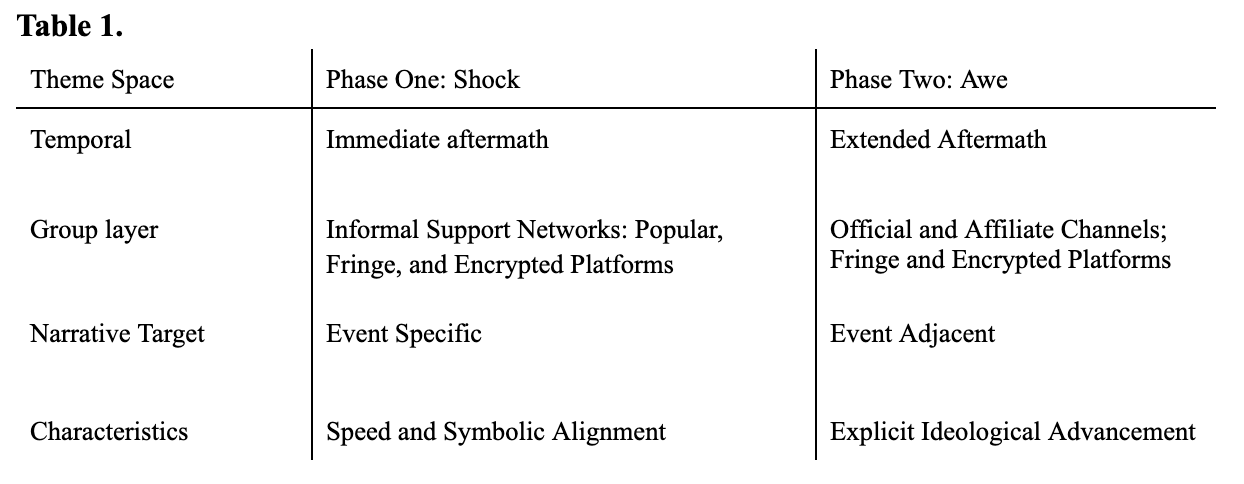
The following presents these two distinct phases as ‘Shock’ and ‘Awe,’ distinguished by temporal frame, group layer, narrative targeting, and content characteristics. The ‘Shock’ phase occurred in the immediate aftermath of the capture (hours and days); it was largely populated by informal support networks, positioned content within event-specific discourse, and was characterised by speed and symbolic alignment with selected outside causes and movements. The ‘Awe’ phase began in the extended aftermath (days and weeks); saw increased official and affiliate channel narratives emerge; positioned ideological content within broader narratives of global resistance adjacent to the event; and was characterised by explicit ideological advancement (see Table 1).
Shock: Informal Support Networks
Within these online spaces, best characterised as a loosely connected network of unofficial but ideologically-aligned accounts, the geopolitical catalyst—Maduro’s capture—was treated as confirmation of existing grievances rather than a distinct development. The incident was juxtaposed with other disruptions and repurposed to suggest a global systemic breakdown and great-power overreach. Content drew selective parallels with outside conflicts or movements to reinforce perceptions of systemic instability and global resistance, adapting existing narratives rather than producing original and ideologically explicit material (Figure 1).
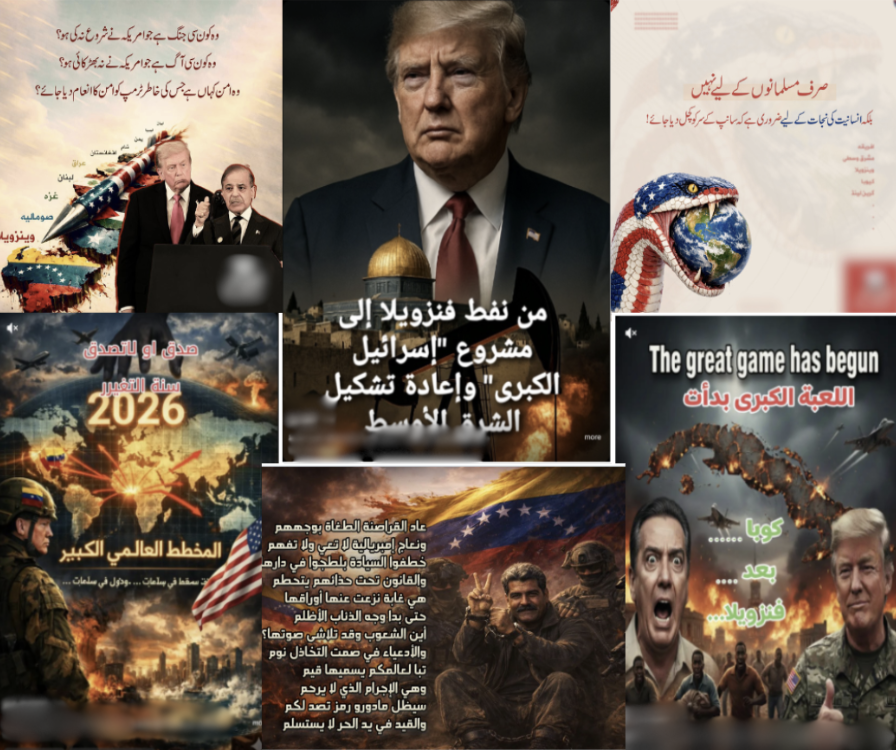
Figure 1: Informal support network content collected through qualitative monitoring on popular social media platforms (TikTok and X) from 3–12 January 2026 by Sam David. Content embedded subtle jihadist-aligned messaging within broader geopolitical discourse.
Crucially, most observable activity occurred below the level of official jihadist channels, with online informal support networks providing early amplification of extremist-aligned interpretations within the broader conversation. The language and imagery employed, however, are not incidental. Terminology such as “pirate” and “Zionist-Crusader” mirrors verbiage from recent official AQAP and Islamic State (IS) channel releases (see Figure 2), signalling narrative alignment without explicit organisational affiliation. Further qualitative review of the posting accounts identified additional content consistent with jihadist supporter ecosystems, for example, AQ and IS communications, as well as legacy militant jihadist-aligned branding.
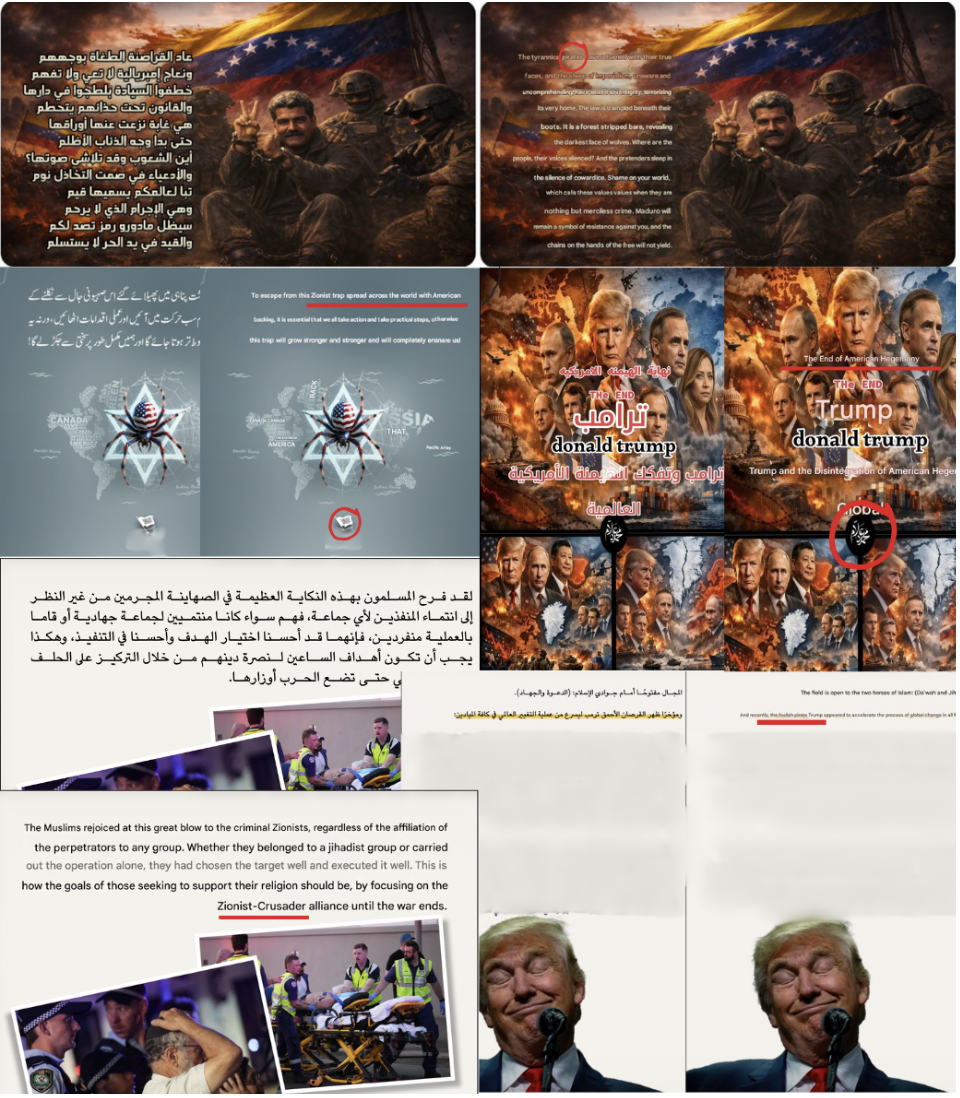
Figure 2: Informal support network content and official/affiliate channel content collected through qualitative monitoring on popular (X and TikTok) and fringe (Chirpwire) social media platforms from 3–22 January 2026 by Sam David. Content from informal support networks (Top Right/Left and Middle Right/Left) mirrors verbiage from recent AQAP-released documents (Bottom Right/Left and Middle Left) as well as legacy AQ and IS-aligned branding.
In this initial phase, informal support networks embedded content within anti-imperial, anti-war, and anti-Western discussions. Through selective mobilisation of overlapping areas of grievance, content subtly advocated symbolic alignment with causes and movements unconnected to jihadist ideology and activity; in this case, US involvement in Venezuela. This behaviour is significant in that it removes the use of ideologically explicit content in audience capture, potentially creating new radicalisation pathways. On the surface, the content appears largely innocuous, with the exception of some lawful-but-awful tropes, but it carries the potential to expose users to further harm through algorithmic radicalisation or cross-platform migration.
The use of AI-generated content is also notable, as it allowed a loosely connected network to circulate and tailor narratives to the Maduro capture without overt group branding or ideological focus. This reduced exposure to existing moderation techniques while also exploiting existing narratives of distrust and polarisation, particularly surrounding Western coercion.
Awe: Official and Affiliate Releases
In the fallout from Maduro’s capture, content continued to frame the event as evidence of global systemic disorder, but official and affiliate channels, such as AQ-aligned Shahed Media and Shahada News Agency, explicitly positioned their movements as well placed to exploit enduring and emerging crises for ideological and strategic gain. Content across fringe and encrypted platforms, such as Chirpwire and Telegram, claimed jihadist alignment with historical revolutionary struggles, presenting them as unified resistance against Western hegemony and the moral and social degradation of international populations.
These included references to Latin American revolutionary movements, pan-Arab socialism, and anti-apartheid activism, as well as claims to the role of jihadist figures in collective struggles against perceived imperialism (Figure 3). By drawing on a broad tradition of resistance movements, the framing enabled convergence with non-jihadist grievance narratives, extending reach without requiring overt ideological specificity. With an alleged narrative connection established, official communications then integrated jihadist messaging more explicitly.
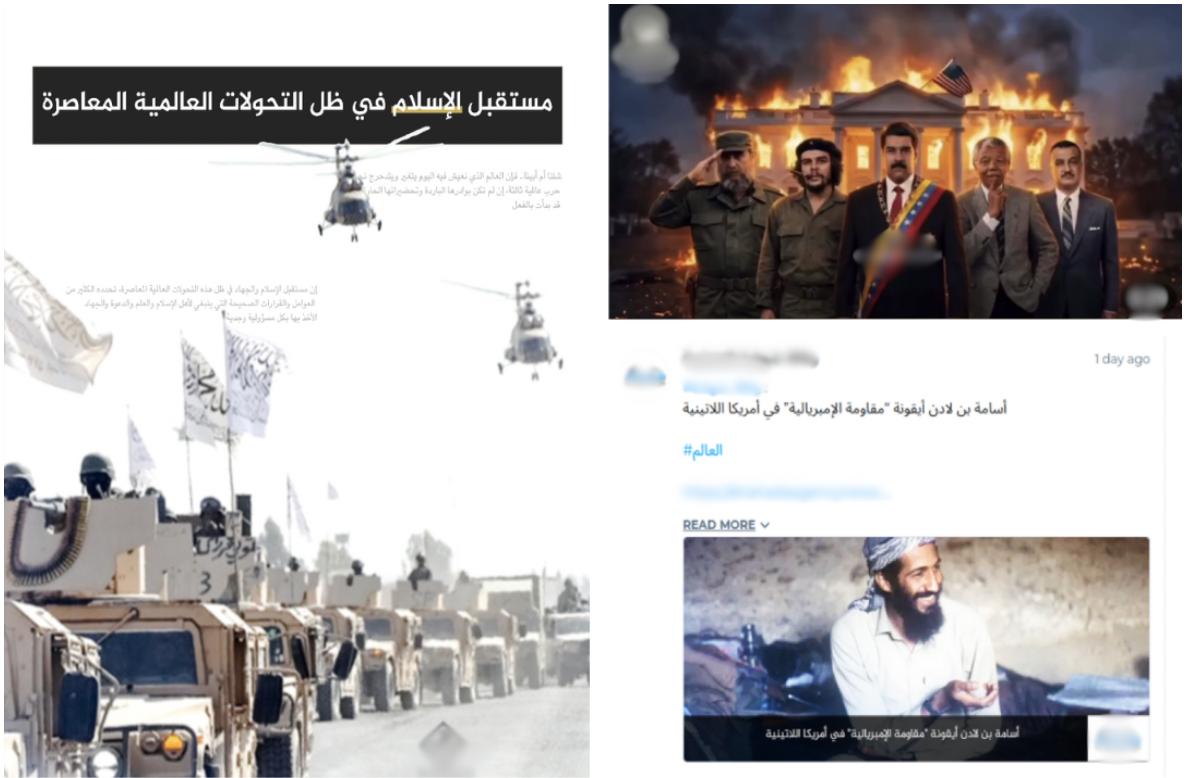
Figure 3:Official and affiliate channel content collected through qualitative monitoring on fringe and encrypted social media platforms (Chripwire and Telegram) from 3–12 January 2026 by Sam David. Clockwise from Top Right: Video still from a Hezbollah-aligned Telegram channel depicting Maduro alongside non-jihadist revolutionary figures; Editorial from Shahada News Agency (AQ-aligned) on Chirpwire positioning Osama bin Laden as an “Icon Of The Resistance Of Imperialism In Latin America” and AQAP-aligned Shahed Media (via Shahada News Agency), “The future of Islam in light of contemporary global transformations.”
Familiar narratives of Western-led decadence and moral and spiritual degradation were present; however, emerging themes surrounding geopolitical chaos and systemic instability were given greater attention (Figure 4). State powers were depicted as self-interested and hostile, pursuing the “law of the jungle,” and global populations were portrayed as increasingly detached from institutional authority in the face of compounding political, economic, and environmental crises. These conditions were framed in conjunction as opportunities to exploit weakened Western and Eastern powers and purported popular discontent with “Zionist-Crusader arrogance.”
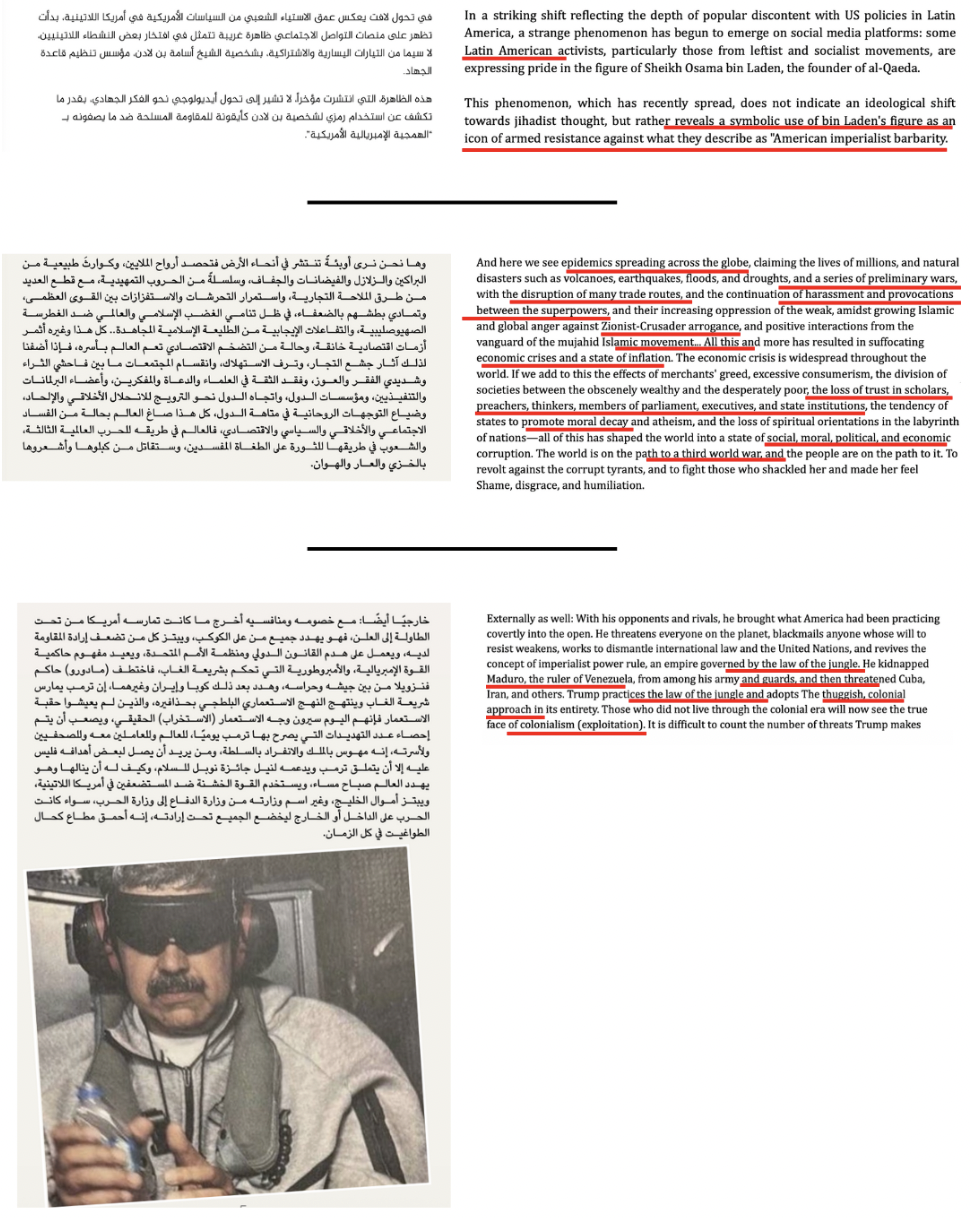
Figure 4: Communications from Shahada News Agency and Shahed Media (AQ-affiliated) framing the Maduro capture within broader geopolitical events and purported jihadist alignment with historical revolutionary struggles.
Implications For Disrupting Terrorist and Violent Extremist Online Activity
For practitioners and policymakers, several implications emerge. First, monitoring efforts that focus narrowly on designated organisations may miss meaningful activity occurring in informal spaces. In times of compounding global crises, both encrypted and popular platforms can present opportunities to exploit grievances for ideological dissemination.
Second, TVE narratives increasingly exploit existing information disorder rather than creating it independently. With recent releases from AQAP and Islamic State channels calling for strategic and tactical exploitation of geopolitical instability, greater attention is warranted in this space. While there has been sustained focus, rightfully, on state actors weaponising regional instability and historical grievances to support strategic objectives, less attention has been paid to TVE actors employing similar tactics.
Third, geopolitical crises outside traditional theatres can still shape radicalisation environments by exploiting grievance narratives. In the contemporary conflict environment, emerging hybrid fronts present vulnerable domains of contestation, particularly those that lack defensive posturing, experience a digital divide, and hold legitimate historical grievances. Effective responses require attention to the wider information environment, including both popular and online grey zones.
For academic researchers, there are several lines of inquiry for investigation. First, further research is warranted to expand the findings presented here. While the Maduro capture was exemplary in the understanding of jihadist narrative opportunity, investigation into the similarities and differences with other TVE actors might provide a fruitful agenda, particularly among recently designated and widely debated groups.
Second, the use of terrorist events in state narrative campaigns is under-researched. In contested regions, localised militant activity often intersects with local governance and external security dynamics, and further research could expose predictable narrative patterns that offer opportunities for targeted intervention in localised contexts.
Third, the means through which legitimate historical or existing grievances are selectively reframed, abstracted, or instrumentalised within extremist narrative ecosystems is a worthy agenda. With rising levels of youth radicalisation coming into focus alongside decreasing levels of institutional trust amidst compounding global disruptions, an investigation into these mechanisms’ exploitation by TVE actors provides a high-impact avenue for researchers.
Lastly, there are important considerations for technology companies encountering the proliferation of this content on their platforms. First, content moderation and monitoring should extend beyond explicitly terrorist material to narrative overlap in lawful spaces that might share some overlap in grievance. Acute monitoring in under-observed spaces is likely to enhance efforts aimed at interdicting online harm. Second, increased monitoring should include consultation with impacted communities, both to ensure culturally and contextually appropriate standards and to support community awareness and resilience against potential narrative exploitation.
Together, these considerations underscore the need for strengthened public–private collaboration within a contemporary conflict environment where geopolitical competition and TVE activity increasingly intersect. Effective responses will depend on coordination between technology platforms, public safety institutions, and not-for-profit research organisations, the latter of which are often uniquely positioned to identify, contextualise, and map these dynamics across platforms and ecosystems. This constitutes a holistic security approach, enabling better online harm detection and reducing the risk of fragmented or siloed responses.
Conclusion
Beyond geopolitical and grand strategy implications, Maduro’s capture is significant in how it was absorbed into existing narratives of global disorder and systemic degradation increasingly perpetuated by TVE actors. The case reflects a shift in TVE use of the internet as affiliated and supporter networks rapidly embedded geopolitical narratives within crowded information spaces through subtle and symbolic alignment before content was escalated to more traditional and ideologically explicit official channels.
This approach allows for blurred boundaries between TVE and geopolitical discourse, targeting emotional resonance in the audience versus ideological alignment. It is indicative of a maturing and adaptive online ecosystem well-equipped to exploit geopolitical shocks using tactics that outpace current moderation. The result is not dominance of the narrative, but persistence within it, creating opportunities for more explicit ideological instruction downstream.
–
Sam David is Director for the Canadian Association for Security and Intelligence Studies (CASIS) Vancouver and former graduate fellowship holder in Political Science at the University of British Columbia for research in human security and conflict. His work focuses on counterterrorism and counterextremism, with emphasis on mobilisation and online radicalisation within contemporary information environments.
–
Are you a tech company interested in strengthening your capacity to counter terrorist and violent extremist activity online? Apply for GIFCT membership to join over 30 other tech platforms working together to prevent terrorists and violent extremists from exploiting online platforms by leveraging technology, expertise, and cross-sector partnerships.
The views and opinions expressed in this Insight are the authors’ own and do not necessarily reflect those of GNET or any of its partners.