


On 1 May 2026, Marvin Aneer Jalo was sentenced in Phoenix, Arizona, in the United States for an Islamic State (IS)-inspired plot. A year prior, while still a minor, he planned a complex attack on the Phoenix Pride Parade; intending to first use triacetone triperoxide (TATP) and C-4 explosives on a building, he would then use a “bomb drone” to attack the fleeing crowd. Whether this refers to a kamikaze-style drone or a dropper-style drone equipped to release one or more improvised explosive devices (IEDs) onto the crowd is still unclear. What this plot does demonstrate is how rapidly the threat posed by lone actors using drones as attack vectors has grown with access to new technologies in recent years.
Drones have become a hot topic among radicalising individuals. Like explosive materials and IEDs before it, the technical know-how for drone attacks has spread to isolated actors in the digital space. Alarmingly, IS actors demonstrate an increasing focus on publishing guides explaining different aspects of planning and conducting attacks using drones. The first six issues of Modern Warfare, the primary series by IS’s “lone wolf” tactical advisors, have already been discussed by analysts and researchers.
This Insight investigates how IS-affiliated publications are increasingly bridging the gap between online instruction and operational use. By analysing the Modern Warfare series of drone manuals, including the latest, seventh issue, the three drone guides thus far released by the Al Saqri Foundation for Military Sciences, and contextualised commentary from IS supporters online, the Insight will reveal how this information is framed, shared, and adapted. Additionally, it will examine the technical gaps seen in the guides, their targeted purpose, and what has been demonstrated in IS plots thus far. Such a comprehensive analysis, which builds on previous research, allows for more attuned policy recommendations aimed at preventing future potential drone plots.
The Evolution of Drone Guides
Since GNET first documented IS’s growing drone instruction ecosystem in January, new materials have already surfaced. These materials continue to provide coherent step-by-step formatting and develop higher levels of knowledge, complexity, and capability. The structured and accretive nature of the manuals helps to lower the barrier to entry for IS supporters interested in using drones to plan or conduct attacks. Despite these manuals’ progressive capability-building, the knowledge that is transmitted is not sufficient alone to prepare the reader to conduct operations. Ultimately, there remains a gap between intent and capability that the manuals fail to bridge.
There are currently two sets of IS-affiliated instructional guides, oriented toward lone actors, on drones. The bilingual Modern Warfare series is the oldest and most robust, produced by a popular tactical advisory channel (The Kitchen) available on encrypted messaging platforms, while the Al Saqri Foundation for Military Sciences’ Arabic-language guides have emerged on their social media channels over the past six months.
The sixth edition of Modern Warfare, the last available to earlier analyses, told readers how to build and install a dropper mechanism. The seventh issue of Modern Warfare, released in April, further expands on dropper mechanisms by providing instructions for a radio-controlled dropper mechanism. The appendix goes into greater detail, focusing on visual aids to anticipate potential problems faced by builders. The series also features progressively sophisticated 3D-printed components, from landing gear to a camera mount to the rotary drum.
The three Al Saqri Foundation guides focus on the components and construction of a First-Person View (FPV) quadcopter drone. The first edition, titled Quadcopter Drone Guide, is a high-level overview and guide to building a quadcopter drone, focusing on concepts such as correct propeller orientation, how different controller inputs affect the drone’s flight behaviour, and the placement of components like flight controllers and electronic speed controllers on the drone’s frame. The second issue, The Ukrainian Aircraft, progresses by providing a more visual manual of drone components, assembly tools, and the construction of a quadcopter drone. Titled Fixed-Wing Drones, the third issue delves into the construction of a small, styrofoam, fixed-wing type drone that will provide users with greater flight range and loiter time than the quadcopter type drone discussed in the first two issues.
Both sets of instructional guides follow similar paths, initially focusing on the basics of small drones, expanding to detailed overviews of specific parts, and graduating to drone assembly. The Modern Warfare series has a broader range, with early editions covering very high-level types of drones, and later editions covering specific methods of weaponisation, both subjects not yet broached by the Al Saqri Foundation series. The two series remain oriented toward pre-attack stages and have yet to address operational knowledge of drone tactics, techniques, and procedures.
The Evolution of Drone Knowledge Transfer
There is a significant difference within IS networks between those spreading technical capabilities aimed toward lone actors and those distributing more operational, conflict-zone-derived knowledge. The former includes The Kitchen and Al Saqri Foundation. The latter consists mostly of news channels, many of which are tied to IS’s West Africa and Sahel Provinces, as they have been the dominant IS regions engaged in modern drone warfare, including coordinated intelligence, surveillance, target acquisition, and reconnaissance (ISR) and FPV drone attacks. Individual IS supporters have promoted both technical and operational knowledge online. Plots appear – based on observation of these networks – to increasingly strive to utilise drones in attacks, rather than in ISR capacities.
Despite prior claims that The Kitchen stopped publishing links to public file-sharing sites in October 2024 and thus significantly changed its networking strategies, links to Just Paste It and Media Fire were shared in November 2024 on one forum and as recently as June 2025 on another platform. Further, the group’s main contact shared a personal Facebook page and multiple Instagram pages. The Facebook profile suggests this explosives specialist was in Syria during the establishment of the caliphate.

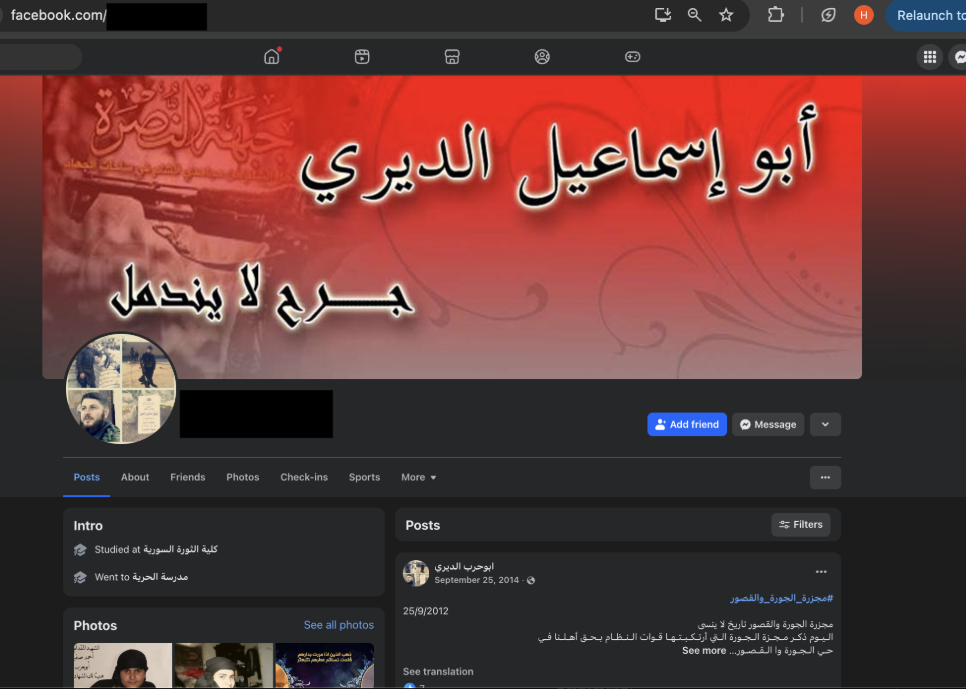
Screenshots of The Kitchen administrator’s Instagram and Facebook pages (8 October 2025) before deletion.
After the October 2024 arrest of Telegram CEO Pavel Durov, The Kitchen expanded its direct, secure messaging to Threema and Element, even moving away from Proton Mail. The move away from public links was less a network shift and more a tactical retreat amidst greater digital scrutiny. All links on one forum were reported and removed from the respective file-sharing site within hours, if not minutes, of being posted, indicating increased opportunities for P/CVE actors to interfere with information-sharing practices.
The Al Saqri Foundation, meanwhile, maintains a variety of methods of promoting its materials across platforms. The group launched its Element channel at the beginning of January 2025, posting a multitude of its previous publications before expanding to newer manuals, including the first drone manual in December 2025. The foundation has remained consistent in how it shares guides, using direct PDF uploads, file-sharing dead drops, and direct, secure messaging.
Individual IS supporters have continuously looked for the simplest path to growing drone knowledge. In an October 2024 conversation, members of one forum promoted 3D-printing drone parts for assembly and integrating cheap computers like the Raspberry Pi. They repeatedly highlighted the importance of learning from drone usage in Ukraine and by IS in the Sahel, for ISR, attacks, and development. Notably, they also emphasised the context of electronic warfare.
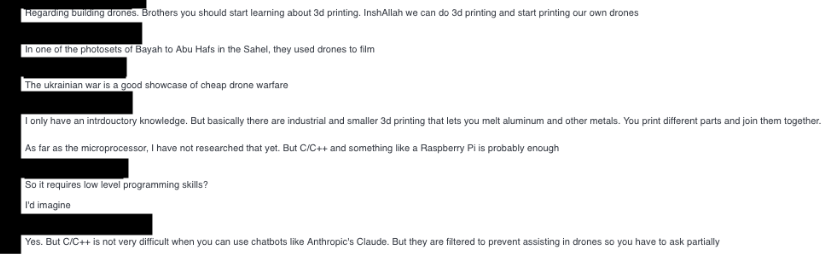
Screenshot of IS supporters discussing the importance of developing drone capabilities – with potential avoidance of barriers to AI assistance – on an IS-affiliated forum (1 October 2024).
The discussion also placed responsibility on supporters in the West to learn such skills, mostly due to financial circumstances, emphasising that this is also safer than learning to manufacture explosives.

Screenshot of IS supporters discussing the development of drone capabilities in the West on an IS-affiliated forum (1 October 2024).
One supporter subsequently shared a few PDFs of textbooks on aerodynamics, drone design, and programming.
More recently, supporters have discussed how to obtain drone knowledge. IS’s Sahel and West Africa Provinces ultimately were agreed upon as the simplest option, if conducting hijrah to IS-controlled territory. Ukraine was again highlighted as the conflict with the most to learn from, evident in the infiltration efforts of Mexican cartels. It is worth noting that cartels often print stabilisation fins for drone munitions similar to Modern Warfare Issue 6. IS supporters seek out any path to gaining knowledge of drone conflict, regardless of source.
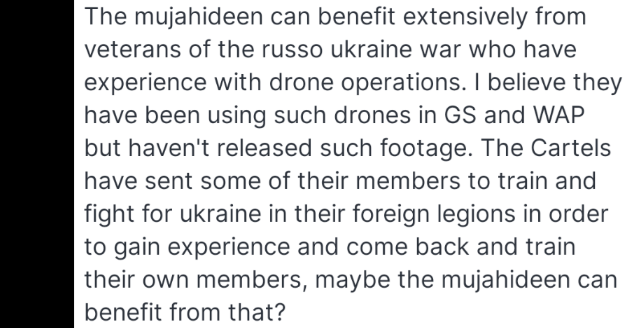
Screenshot of IS supporters discussing how to acquire knowledge of drone capabilities on an IS-affiliated forum (27 April 2026).
Offline, the occurrence of IS-connected plots using drones for ISR or the attack itself has been gradually escalating, with perpetrators no longer possessing specialised knowledge such as military training or higher education. Early plots in Hawaii in 2017 and in Michigan in 2019 both involved active duty or former US military members and ISR drones. A long-time IS supporter was arrested in Michigan in 2017, possessing multiple commercial drones and drone kits, as well as explosive material. The 2019 Michigan plot, as well as a 2020 plot in Germany, planned to use drones to facilitate attacks on military targets. More recently, assailants – such as the 2020 Barcelona and 2025 Paris plots, both targeting football matches, as well as the 2024 Arizona plot mentioned previously – lacked greater training.
There have been two thwarted attacks combining drones and 3D-printing. In 2023, a Birmingham IS supporter created a fixed-wing drone with 3D-printed components in order to carry an explosive or chemical weapon. The October 2025 plot to assassinate the Belgian premier was to be conducted with an IED-laden drone. A 3D printer was discovered at one of the suspects’ residences, although there are no details about what components may have been printed.
The main producers of drone manuals for IS supporters have shifted their dissemination methods in light of greater digital counterterrorism efforts. Such operational adjustments have not inhibited their objectives, as drones are increasingly featured in attack plots, and by more isolated and less trained supporters. Considering the above plots, those attempting to use drones in attacks follow the broader trend amongst IS supporters – increasingly young in recent years, and, in this case, less often possessing prior scientific or military training.
Interestingly, one group in Russia’s North Caucasus, Nabd al-Salaf al-Qawqazi, claimed to possess drone capabilities last September. This case is one of the only examples of sustained drone usage by a cell outside of IS provinces and not intended for attacks. In the 6th September issue of their magazine, the group announced it had obtained an armed quadcopter, belonging to its alleged Field Security Department.
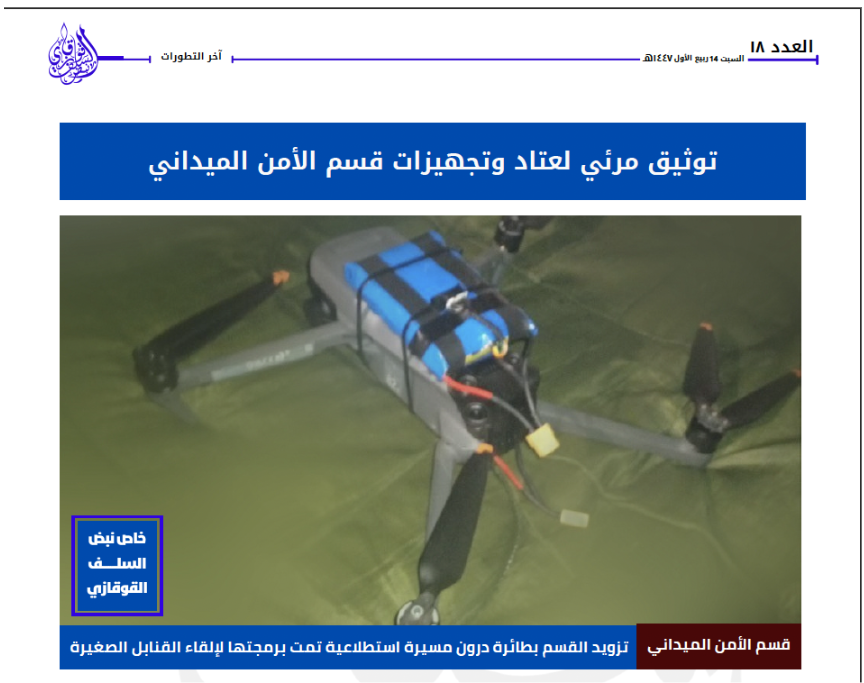
An image showing Nabd al-Salaf al-Qawqazi’s first quadcopter was published on 6 September 2025.
The following week, it announced the addition of three more quadcopters armed with dropper mechanisms, suitable for both ISR and attack missions, for its Field Security Department.
Conclusions and Recommendations
Overall, these instructional series help to lower the barrier to entry for IS supporters interested in utilising drones for ISR or attack purposes. The rapid emergence of new materials shows how quickly the knowledge ecosystem is developing, in response to both external developments and supporters’ demands. Despite counterterrorism pressure shifting the dissemination networks, knowledge transmission has not been severely inhibited. This is evident in the increased inclusion of drones in attack plans, with those IS supporters becoming younger and less experienced. As long as the technology is considered dual-use and commercially available, IS supporters will attempt to exploit such gaps. As such, it is crucial to develop robust policies and procedures to track and address extremists’ efforts to share drone instructions and to build drones themselves.
Currently, law enforcement’s counter-drone efforts are largely responsive and focused on unmanned aerial systems, including the implementation of no-drone zones or signal-jamming capabilities. The resilience of these networks and the continued circulation of pre-attack planning information indicate the insufficiency of current approaches to suppress the growth of drones as an attack vector. Social media, encrypted messengers, and file-hosting platforms must better utilise moderation and content detection to stop the spread of manuals, especially in open sources. Law enforcement and intelligence agencies need faster responses to evolutions in IS supporters’ use of encrypted platforms and messengers, coupled with the continued monitoring of pro-IS spaces online.
Additionally, these agencies could aim to foster better relations with online hobbyist communities for drone DIY and 3D-printing. This might help alert authorities to terrorism supporters seeking technical knowledge from outside of their ideological communities. A secondary consequence of this is the recognition of the technical gap between hobbyists’ projects and the capabilities utilised in terrorist plots. This would improve the balancing of monitoring and intervention activities, and the knowledge of the realistic signs of readiness in terrorist supporters’ preparation for an attack.
–
Carl Peterson is a researcher focused on drone warfare, autonomous systems, private military companies, and violent non-state actors. He is a contributor at Militant Wire and holds a JD from the University of Washington School of Law. A licensed FAA Part 107 Remote Pilot, he writes on non-state actor drone usage and autonomous systems in irregular warfare, and has published peer-reviewed work on private military companies and special jurisdictions.
Harold Chambers is an independent journalist and researcher focused on extremism, conflict, organized crime, and authoritarianism. He has written for various media outlets and think tanks, including the Foreign Policy Research Institute, the Jamestown Foundation, Newlines Magazine, Militant Wire, Riddle, and Tech Against Terrorism. Additional comments can be found in the Associated Press, BBC, The Times, and more.
–
Are you a tech company interested in strengthening your capacity to counter terrorist and violent extremist activity online? Apply for GIFCT membership to join over 30 other tech platforms working together to prevent terrorists and violent extremists from exploiting online platforms by leveraging technology, expertise, and cross-sector partnerships.
The views and opinions expressed in this Insight are the authors’ own and do not necessarily reflect those of GNET or any of its partners.